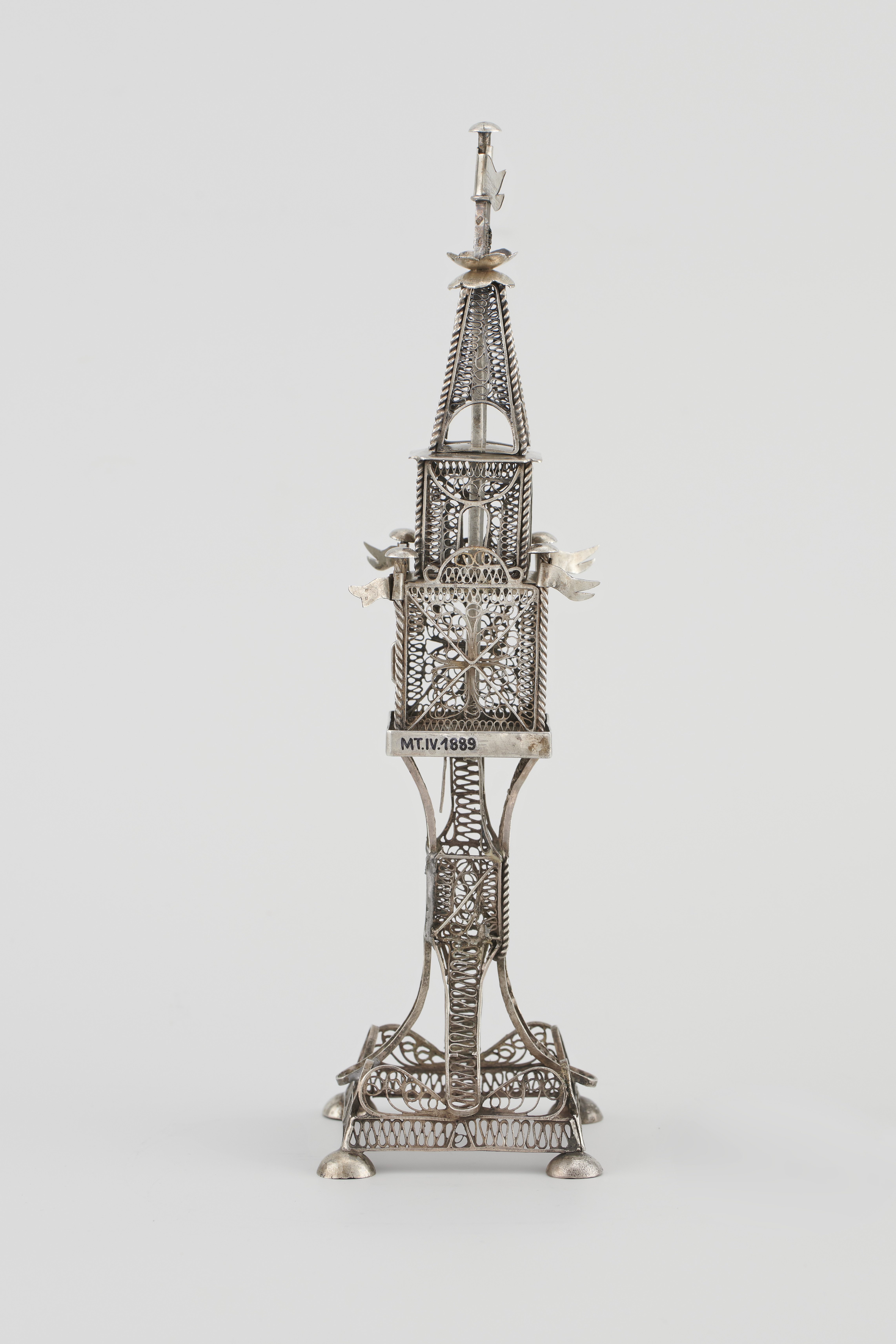
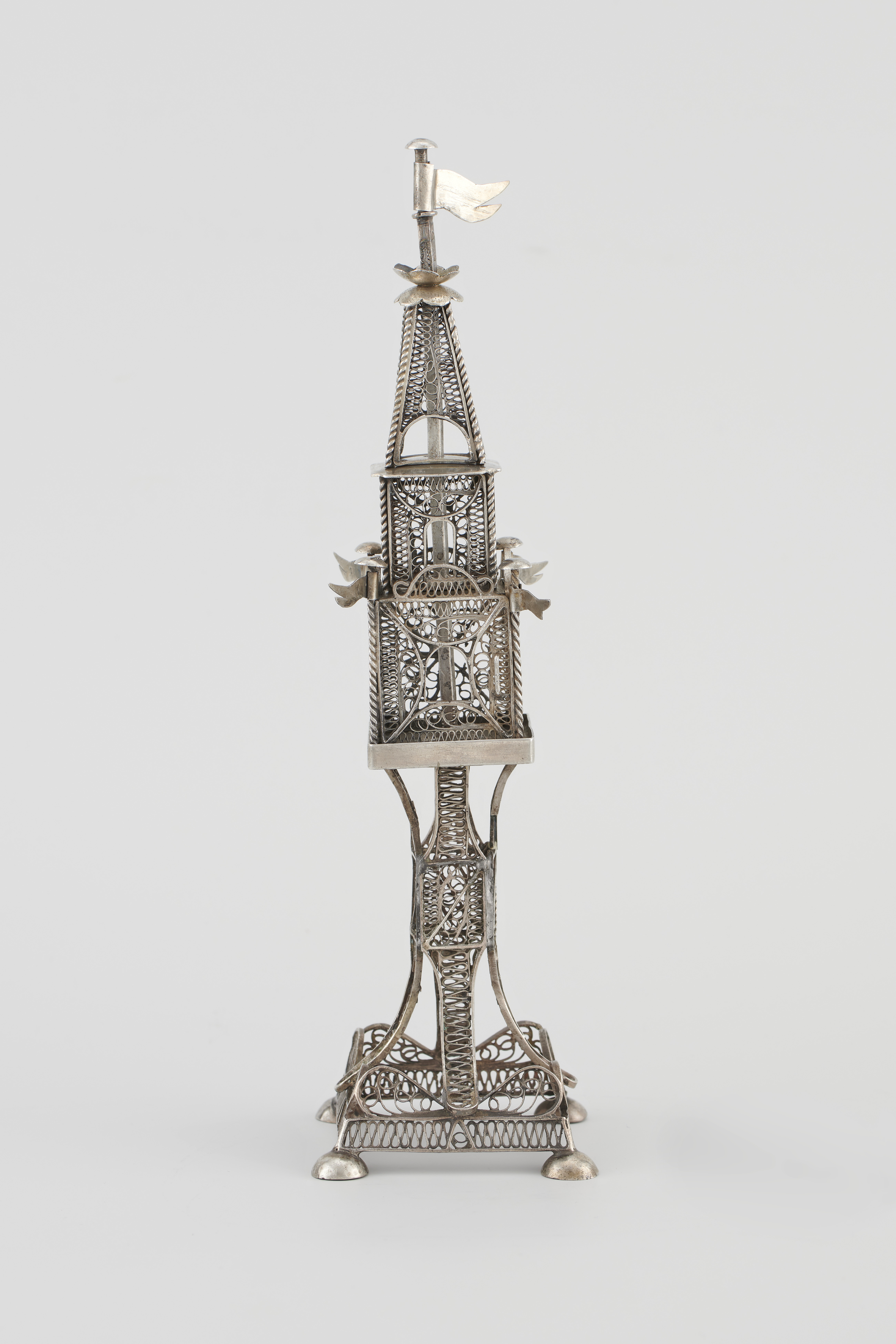
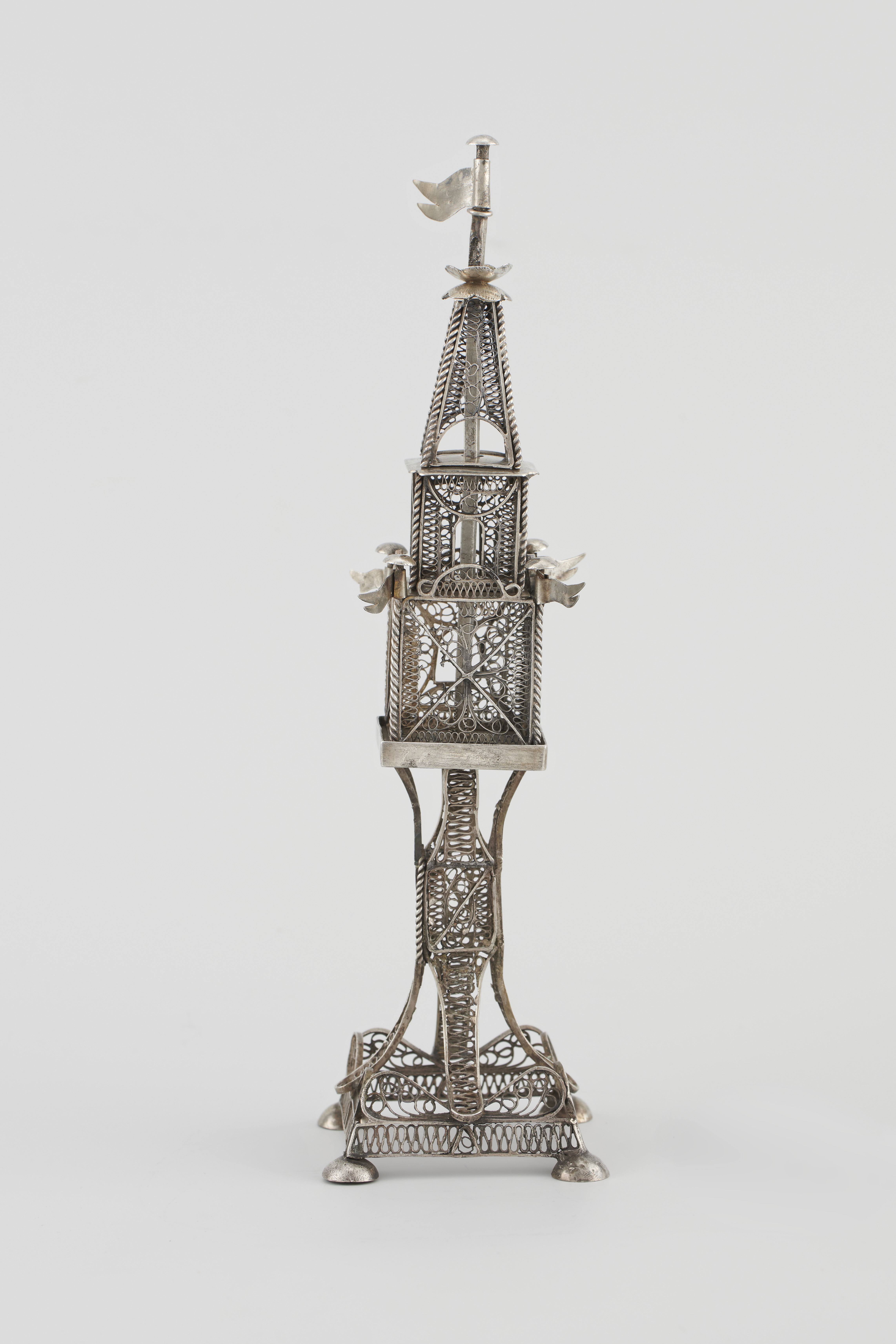
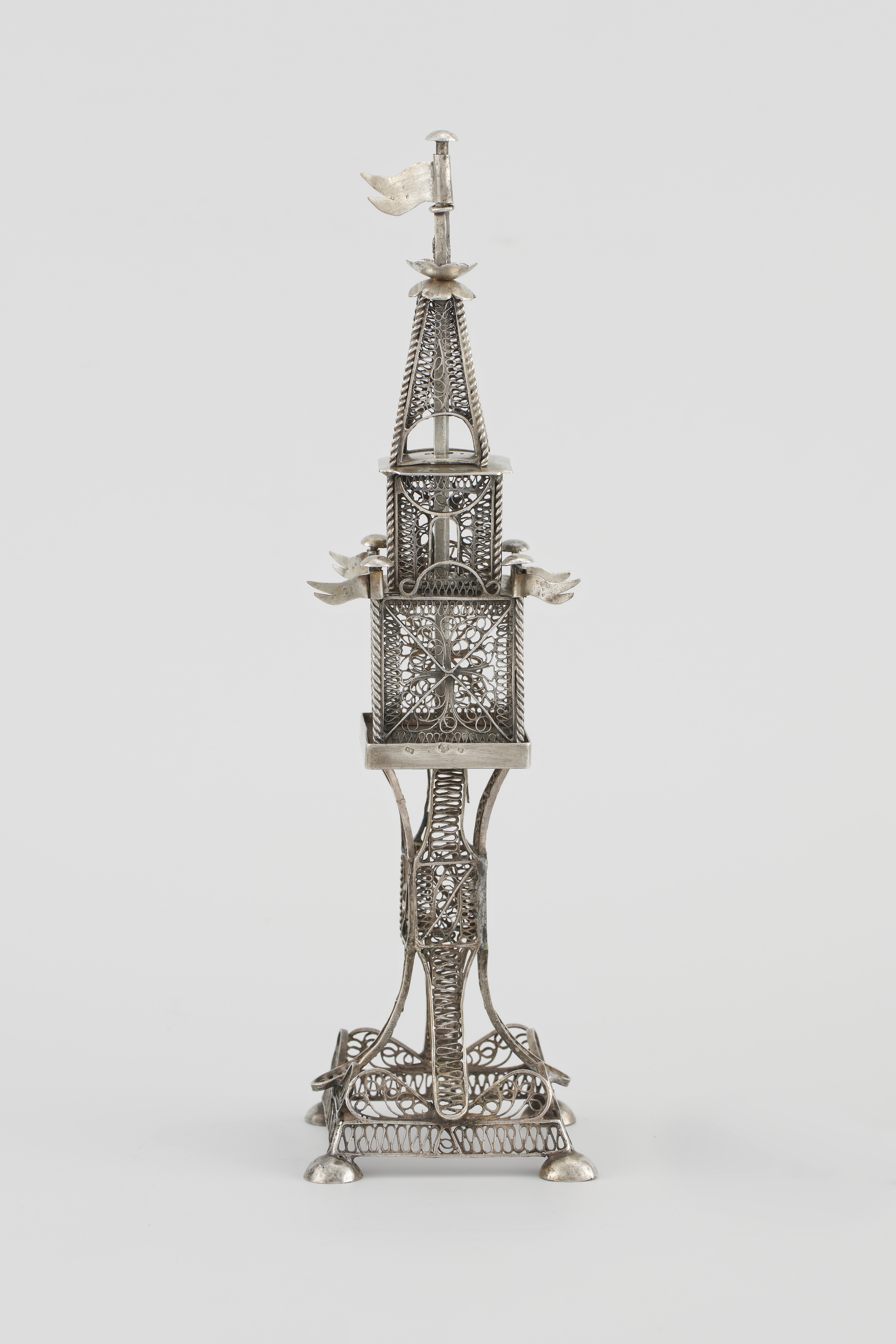
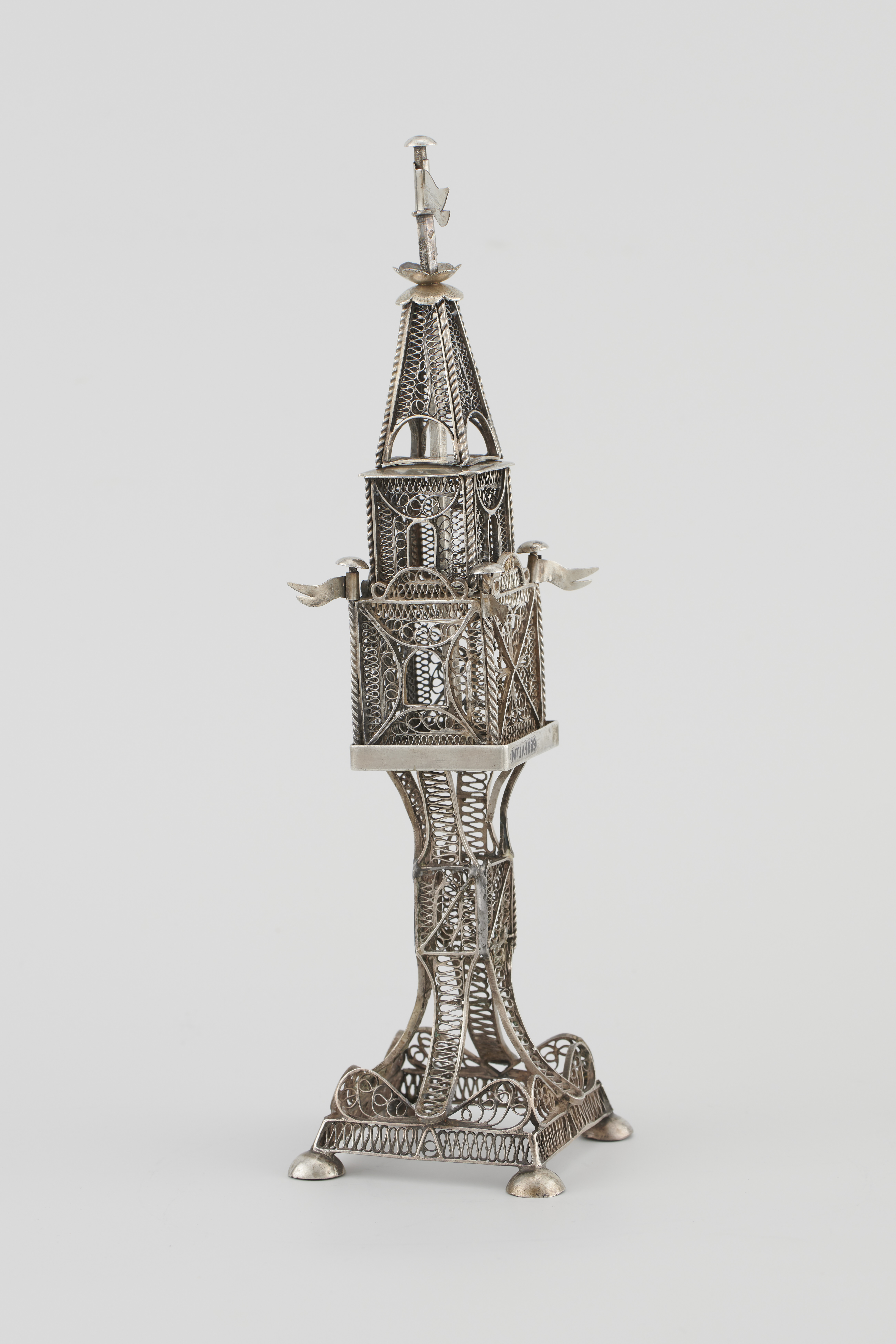
Besamim box (Hebrew: besamim – "fragrant herbs, roots, spices"), which is a decorative container for fragrant herbs or roots, is found in every home and synagogue. It is used during the Havdalah (Hebrew: "separation") ceremony performed at the end of the Sabbath. The appropriate blessing over the besamim box is recited by the head of the family, after which each member of the household approaches it one by one and smells the aromas emanating from it. The scent of the herbs is symbolically meant to invigorate the body that has been left by the additional Shabbat soul (Hebrew: neshamah yeteirah). It is also believed to help the faithful cope with the hardships of the coming week. The forms of spice towers have changed over different periods but with the preservation of traditional designs. One of the most popular shapes of besamim boxes is a castle turret or tower.
The besamim box from the collection of the District Museum in Tarnów has the form of a three-storey turret, tapering towards the top, on a slender profiled leg, standing on a base with a square outline, on four semicircular legs at the corners, with flags at the top and on the sides. It was made using the filigree technique, which involves creating individual ornaments (and surfaces) from thin silver wires twisted together, successively tapped, soldered and glued to the surface. Using this technique, an openwork (with holes and clearances) was created, determining the lightness of the construction and, in this case, the release of fragrances from the herb container, which is located on the first storey of the turret (with room for the missing hinged door). The second storey has a similar, cuboid shape, with a rectangular opening closed with an arch on each side. The finial of the top third tier is in the shape of a pyramid ending at the top with a swallowtail metal flag. Similar rotating flags were placed in the corners of the second storey. They are all separated from each other by square tiles, which form the base of the subsequent turret level.
The following punched hallmarks can be seen on the herb container: 1. goldsmith's name mark: initials "EE" in a horizontal rectangle with truncated corners; 2. Austro-Hungarian basic hallmark for silver fineness of "3" of the Brno Assay Office (A6); 3. hallmark of the Brno Assay Office: symbol "A6" in a horizontal rectangle with truncated corners. Repeated set of hallmarks punched on the tiles separating storeys: 1. goldsmith's name mark: initials "EE" in a horizontal rectangle with truncated corners; 2. Austro-Hungarian hallmark for marking small products of fineness "3" from the Brno Assay Office. An identical set of hallmarks is repeated on the bar below the crowning flag. Punched hallmarks on each flag: double-struck hallmark of the Brno Assay Office: "A6" symbol in a horizontal rectangle with truncated corners.
The besamim box, along with other silver items donated to the District Museum in Tarnów in 1973 by the Municipal and District Civic Militia Headquarters in Tarnów, was found between the ceiling and the floor during renovation works of a tenement house on at Lwowska Street. It was probably hidden there by its last owners during World War II. Lwowska Street marked the border of the ghetto, which was liquidated in September 1943.
Divided into two parts, damaged and slightly incomplete (filigree elements), it was cleaned at the Archaeological Museum in Kraków and reassembled at the Metal Conservation Workshop of the District Museum in Tarnów.
Barbara Bułdys