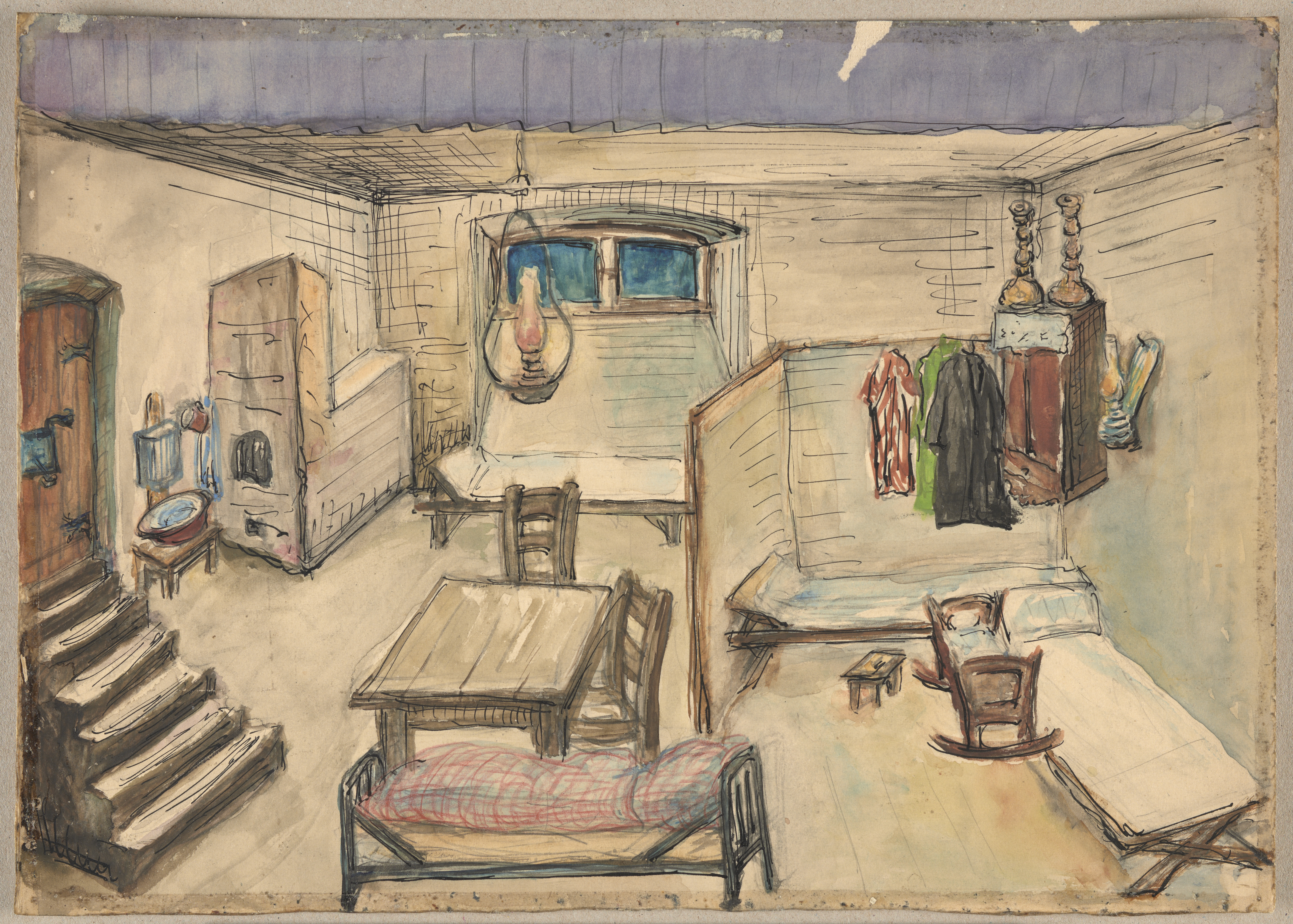
The design of theatre scenography – the interior: a basement

Pacanowski, Bolesław (1901-1977)

The basement (suterena, suteryna), which we see in several of Bolesław Pacanowski's theatre set designs, is, according to the Polish Language Dictionary: "a part of a building located under the ground floor, partly below ground level, used for example for workshops or cheap flats". To this day, we can still see basement windows in many big tenement houses in Łódź, Warsaw or Lublin. Nowadays, it is rare to see anyone living in them. In the past, living in a basement was synonymous with extreme poverty, which Icchok Leib Peretz depicted in his story "In the basement chamber" (see MPOLIN-M). Polish readers are familiar with this world and life of the metropolitan poor from a poem of the same title by Maria Konopnicka (see https://literat.ug.edu.pl/mariakon/016.htm, accessed on 8.11.2021.):

"In the cellar room early dusk falls,

Damp and gloomy;

A small window with cloudy panes

Looks at the dirty walls.

In the cellar room the voice of a child can be heard:

It sighs, it talks...

Father is forging black bread with a hammer,

By the needle the mother is pale.

[...]

In the cellar room a heavy sigh

From a dark corner is heard...

The child is silent on its bed,

The mother is in tears.

The dusk fell black in the cellar room,

As this black misery...

Who will give this child some sun,

Show him the forests, the fields?"

See also other design versions: MPOLIN-M1155, MPOLIN-M1156, MPOLIN-M1157, MPOLIN-M1162, MPOLIN-M1163, MPOLIN-M1166.

Renata Piątkowska

czytaj więcej
Information about the object
Author/creator
Pacanowski, Bolesław (1901-1977)
Object type
drawing
Time of creation/dating
1949-1951
Place of creation
unknown
Technique
painter’s
drawn
drawn
Material
paper
aquarel paint
ink
Keywords
Copyrights status
contact the Museum
Owner
POLIN Museum of the History of Polish Jews
Identification number
MPOLIN-M1157
Localization
The object is not currently on display
The purchase of the object for the POLIN Museum Collection was made possible thanks to the support of theAssociation Of The Jewish Historical Institute Of Poland.