In 1927, Zgierz industrialist, Josef Hersz Szpira (1880-1941), accompanied the tzaddik Abraham Mordechaj Alter, from Góra Kalwaria, on a journey to Eretz Israel (Palestine). In Jerusalem, he commissioned Torah scroll rollers from a Polish craftsman, Berysz Sztoker. Upon returning to the country, together with the Torah scroll, he donated them to the synagogue in Zgierz in memory of his parents - his father, Beniamin Zeew, who died in 1901, and his mother, Rywka, who died in 1922.
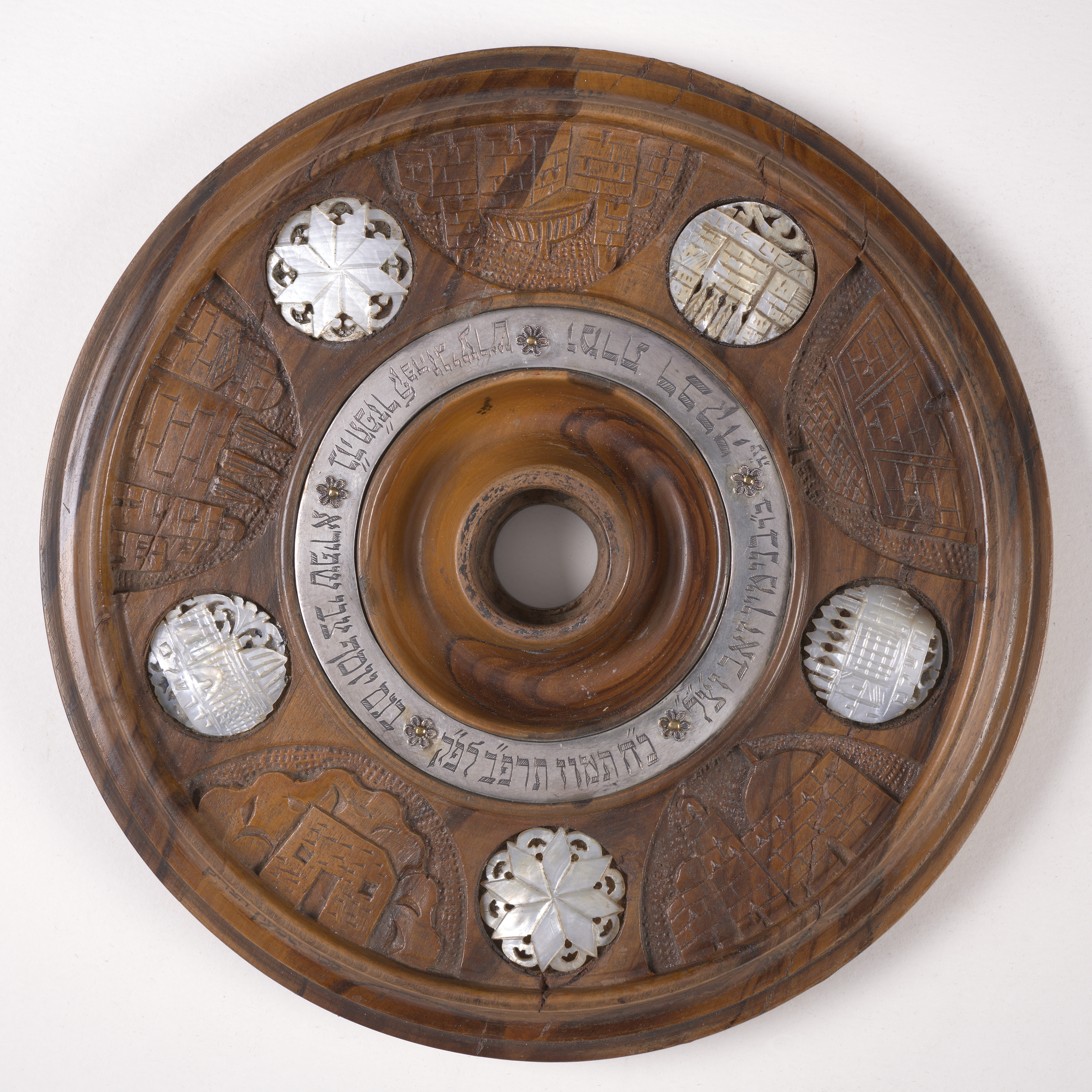
Around the inner opening of the roller’s shield is an inscription in Hebrew:
Son of Rabbi Benjamin Zeew, of blessed memory (z.b.p.)
and Mrs. Rywka, peace be upon her (living)
With the help of God (B”H), here, Zgierz
Their son Josef Cwi Szapiro | 28 Tamuz 5682 [July 24, 1922]
A preserved shield is one of the elements of the rollers around which the Torah scroll was wound. The Torah consists of the five books of the Old Testament, which are handwritten on parchment by a scribe (sofer):
1. בראשית – Bereshit (eng. In the Beginning; łac. “Genesis”; pol: “Księga Rodzaju”),
2. שמות – Shemot (eng. Names; łac. “Exodus”; pl. “Księga Wyjścia”),
3. ויקרא – Vayikra (eng. Leviticus; łac. “Leviticus”; pl. “Księga Kapłańska”),
4. במדבר – Bemidbar (eng. Numbe; łac. “Numbers”; pl. “Księga Liczb”),
5. דברים – Dvarim (eng. Deuteronomy; łac. “Deuteronomium”; pl. „Księga Powtórzonego Prawa”).
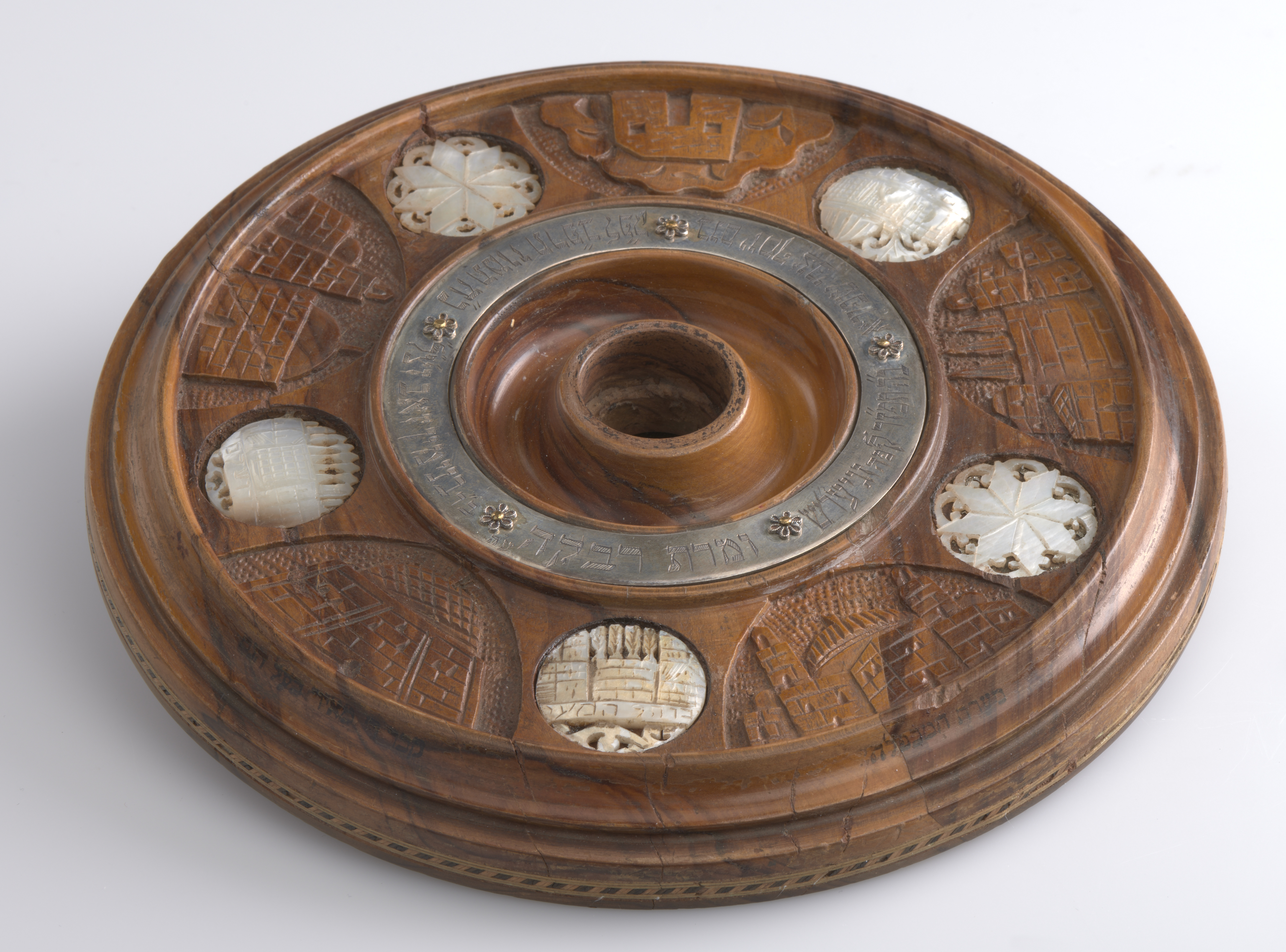
Along the outer edge of the Torah scroll roller shield from Zgierz, there are wood-carved reliefs, symbolically depicting (with Hebrew inscriptions) sacred sites in Eretz Israel (the Land of Israel), to which thousands of Jewish pilgrims have journeyed - and continue to journey - including Jerusalem and the Temple Mount, the Cave of the Patriarchs and Matriarchs in Hebron, the Tomb of Rabbi Meir Baal Hanes ("the Miracle Worker") in Tiberias, the Tomb of the Prophet Samuel in An-Nabi Samu’il, and the Tomb of the High Priest Simon the Righteous in Jerusalem.
כותל מערבי – The Western Wall
Among these depictions, the most important is the Jerusalem Temple, which, filled with Shekhinah (the Divine presence], will be rebuilt when the Messiah comes. Since the destruction of the Temple, the only remaining part is the Western Wall (a fragment of the courtyard wall of the Second Temple, built circa 20 BCE during the reign of Herod the Great), which has continuously been a place of prayer.
מערת המכפלה – The Cave of the Patriarchs and Matriarchs
According to the Zohar, Adam and Eve, Abraham and Sarah, their son Isaacc and Rivka, as well as Jacob and Leah are interred in the Cave of the Patriarchs and Matriarchs in Hebron. The cave was purchased by Abraham, to buy his wife Sarah (Genesis 23, 1-20).
“As long as our people endure, throughout the entire painful journey through history, the sacred resting places of our righteous ancestors have served as spiritual oases. From the earliest times, the burial sites of our Patriarchs and Matriarchs, the founders of our nation, have been places where Jews would go to pray” (https://chabad.org.pl/jaskinia-patriarchow/, accessed 05/09/2024).
The graves in Ma’arat Ha’Machpela, have played, and continue to play, an important role in Judaism and the history of the people of Israel, affirming the eternal presence on their own land, purchased for eternity.
קבר רבי מאיר בעל הנס – Grób Rabina Meir Baal Hanesa („Cudotwórcy”)
The grave of Rabbi Meir Baal Ha’Nes (“The Miracle Worker”) in Tiberias, one of the most important sages of the 2nd century CE and a participant in the Bar Kokhba Revolt, holds huge spiritual significance for followers of Judaism.
קבר שמואל – The Grave of the Prophet Samuel
The tomb of the prophet Samuel, a high priest, and the last judge of ancient Israel, between the death of Joshua and the establishment of the Kingdom of Israel, is today located inside a mosque in Nabi Samwil. The prophet Samuel is traditionally considered the author of several biblical books - the Book of Judges, the two Books of Samuel and the Book of Ruth.
קבר שמעון הצדיק – The Grave of the High Priest Simon the Just
High Priest Simon the Just was a Jewish judge of Judea. According to the Talmud, after his death, the pronunciation of the Name of God (the Tetragrammaton, composed of the Hebrew letters yod, he, vav, he – revealed by the Creator to Moses in the burning bush) was discontinued, including in temple worship.
Between the semicircles depicting sacred places, five round medallions filled with mother-of-pearl have been placed. Two of them feature decorative rosettes (eight-pointed stars), and three contain views of Jerusalem, the Western Wall and the Temple - each identified with Hebrew inscriptions.
These duplicated depictions of Jerusalem and the Temple emphasise how they are central in Judaism. It was God who indicated Mount Moriah to Solomon, where he built the Temple “for the Name of the Lord, my God” (1 Kings 5:5). Although it was destroyed in 70 CE by the Romans, its power and significance have endured. The only remaining part of it – the Western Wall – remains, for every Jew, the most important symbol of Judaism, identity and faith.
Other sites depicted on the disc - both real and symbolic - form a spiritual map of Eretz Israel, with Jerusalem and the Temple as the supreme points, confirming the eternal presence of the people of Israel in the Land and strengthening their faith in the one God.
Józef Hersz Szpiro (1880-1941) came from a respected Hasidic family who had lived in Zgierz since the mid-19th century. His grandfather, also named Józef, who had moved to Zgierz from Aleksandrów, was a wealthy timber merchant and forest owner. He was connected with the courts of tzaddikim in Aleksandrów, Góra Kalwaria and Kock.
During the January Uprising, he was falsely accused of aiding the Russian occupier. At the last moment, he was saved from execution by a priest from Zgierz, who testified to his innocence.
Józef Hersz's father, Rafał Jakub Szpiro (c. 1849–1901), was granted the honorary title of admor (our master, teacher). His wife, Rywka née Lezer (c. 1850–1922), was known as Rojcza Di Szpirita, or "Beautiful Rywka." They had fifteen children (“The Book of Zgierz. An Eternal Memorial for a Jewish Community of Poland”, League City 2007, pp. 368–371).
Józef Hersz Szpiro died in the Łódź Ghetto. He is buried in the Łódź Jewish cemetery. Most members of his family perished in the Holocaust. Only one of his daughters, Ada Falk, survived.
The Zgierz synagogue, along with its furnishings, was burned down by the Germans (see: https://sztetl.org.pl/pl/miejscowosci/z/323-zgierz/112-synagogi-domy-modlitwy-i-inne/90364-synagoga-w-zgierzu-ul-lodzka).
Only one item survived the destruction - the already mentioned wooden Torah scroll roller shield. It was taken by an unknown German soldier, who later gave it to his former teacher, Pastor Otto Michel. After Pastor Michel’s death, his widow donated the shield to the museum in Tübingen. In 2011, during a ceremonial event, the mayor of Tübingen returned this Torah scroll relic to the descendants of Józef, among whom was Ada Falk’s son, Dr. Avner Falk.
In 2015, Avner Falk’s grandchildren - Gili Haberberg, Dr. Ibby Mekhmandarov - as well as great-grandchildren - Dorit Itzchaki and Ofer Berger - donated it to the POLIN Museum.
Renata Piątkowska, Maciej Wzorek