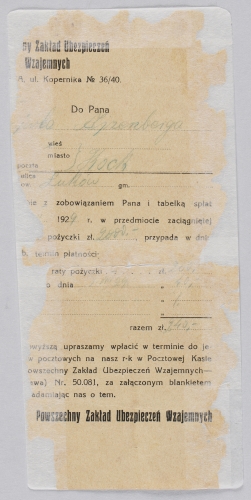
The documents were found in a door frame during the renovation of a former Jewish house at Wesoła Street (now Wojska Polskiego Street) in Kock. The owners of the house then decided to hand over the find to Maria Kowalewska, who is interested in the history of Kock's Jewish community and is trying to reconstruct the fate of individual families, thereby restoring their memory. The woman is also interviewing residents of Kock who may remember pre-war times. In 2016. Maria Kowalewska donated the memorabilia to the POLIN Museum collection.
The bulk of the documents are receipts for cyclical payments issued by the Kock Municipal Board. Among the contributions we can find, e.g., the sign tax, which entrepreneurs were obliged to pay. That Fajwel Ajzenberg ran a store in his house is confirmed by the pre-1939 Census of Kock inhabitants (Radzyń Podlaski 2017, compiled by Dariusz Magier, pp. 11-12). According to the census, the house at 15 Wesola Street in Kock was the home of: Fajwel Ajzenberg (b. 1896, trader, householder; his parents: Icek Majer and Małka née Nierenberg; his wife Chana Ajzenberg née Zakalik (b. 1893); her parents: Hersz-Lejb and Chaja-Sura, née Ciechanowska; and their sons: Azryl Ajzenberg (b. 19.02.1920) and Szyja Ajzenberg (no date of birth). This is virtually all we know about the Ajzenberg family today.
Already in 1787, Jews accounted for approx. 44 per cent of the total population of Kock (850 out of 1,904 people). A significant development of the Jewish community in Kock took place in the first half of the 19th century, when a disciple of the tzaddik of Przysucha, tzaddik Menachem Mendel Morgenstern, known as the Kocker Rebbe, settled in the town in 1829 and established a Hasidic centre in the town. He was visited by Jews from all over Poland and even from abroad. Its prominence and popularity led to a growing Jewish community in Kock, which in 1907 accounted for 62 per cent of the total population.
Despite a decline in the Jewish population in the interwar period (to 49 per cent of the total in 1921), caused by a general decline in the population as a result of warfare and war-induced economic and sanitary difficulties (epidemics), the community grew. In 1924, the Jews owned all the town's bakeries, butcheries, oil mills and dye works. The Jews also owned most of the more than 100 shops that existed in Kock, many small craftsmen's workshops and businesses dealing in grain and wood. There were Jewish cooperatives, political parties and organisations, cheders, a communal talmud-torah and yeshiva (from 1913), a Beit Yaakov religious school for girls, and numerous cultural and educational establishments. | German troops entered Kock on 9 October 1939. It was then that the Jewish population was forced to wear the Star of David on their clothing. In 1940, a group of approx. 1100 Jews from Nasielsk, Serock and Suwałki was resettled to Kock. Jews were also brought to Kock from the surrounding towns (e.g., Firlej and Lubartów). At the end of 1940, a ghetto was established in what was then Żydowska Street (near the department store and health centre). Famine, typhoid and tuberculosis prevailed in the ghetto. More Jews were brought to the ghetto from other cities (including Nowy Dwór Mazowiecki). At the beginning of 1940, the Germans set up a Judenrat. It was also during this time that the first executions of the Jewish population took place. Some Jews were forced to march towards Radzyń Podlaski. Those who could not keep up the pace of the march were killed. Those who managed to reach Radzyń were taken by rail to Biała Podlaska, and then to Terespol and Rososz, where they performed slave labour. In August 1942, the Judenrat was forced to select 100 families to be deported to Parczew and then to the Treblinka extermination camp. Another deportation of 1,700 people took place in September 1942. On 8 October, hundreds of Jews who remained in the town were transported to the Łuków ghetto. The remaining inhabitants of the vestigial ghetto (located between Warszawska Street and Wojska Polskiego Alley) were forced to clean and sort Jewish property left in town. The liquidation of the Kock ghetto began on 6 November 1942. The Jewish community was deported partly to Łuków and then probably to the extermination camp at Treblinka. The 200 people remaining in the town remained in a labour camp (a sawmill in Poizdów). Less than 30 Kock Jews survived the Holocaust. The family of Fajweł and Chana Ajzenberg were not among them. We will never know how and when exactly they died. Knowing the fate of the Jewish community in Kock, we can only guess which of the events described above they were participants in. Marta Frączkiewicz