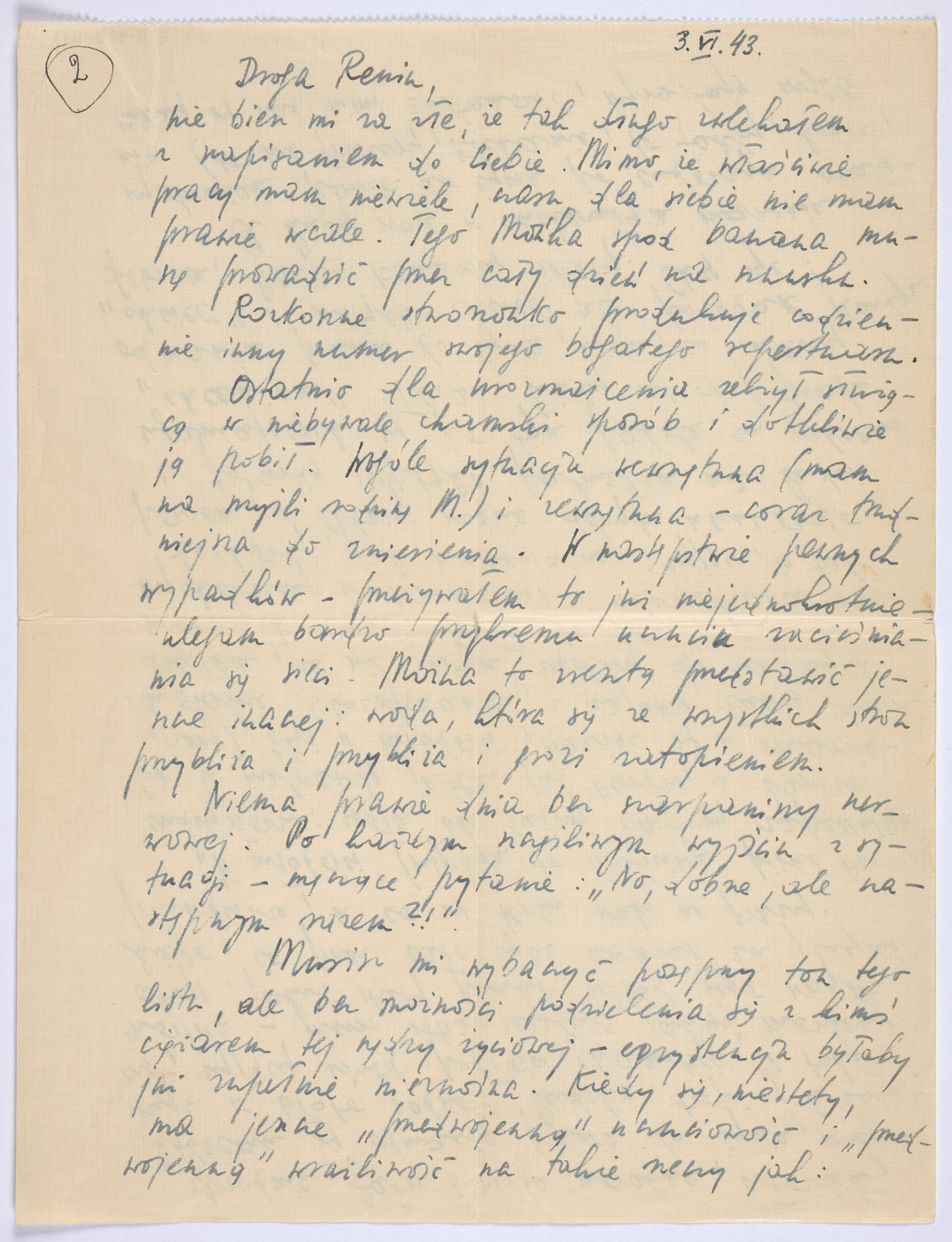
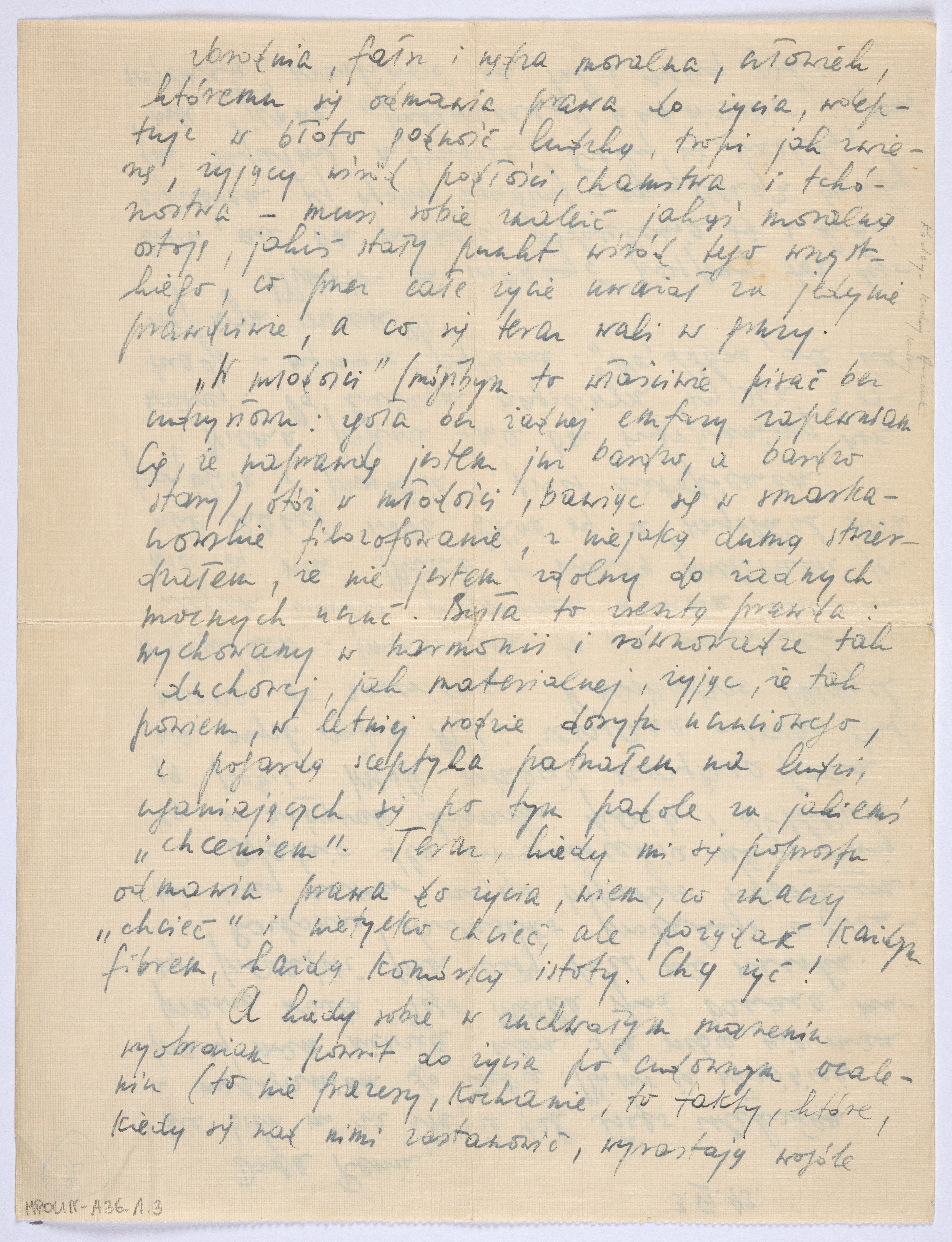
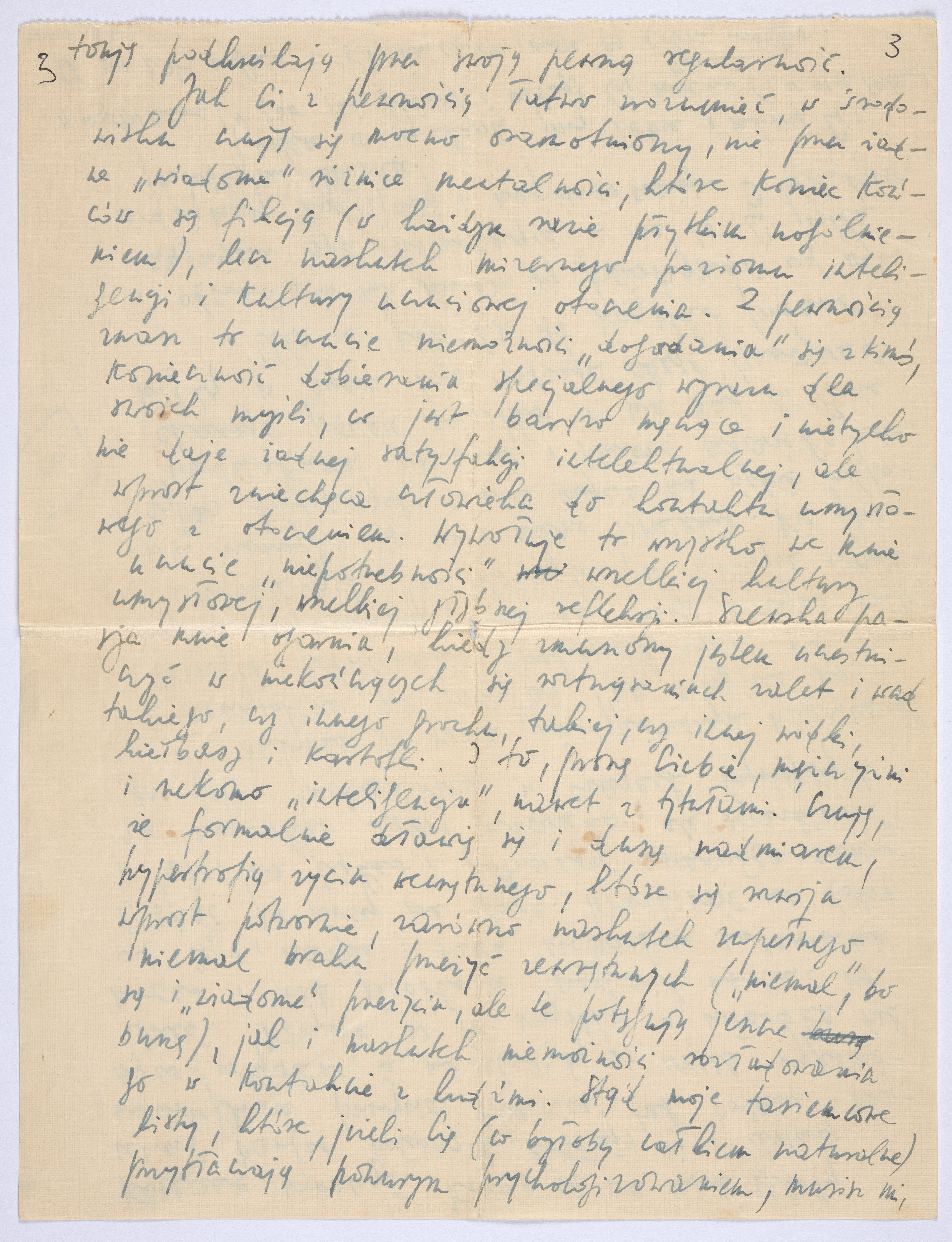
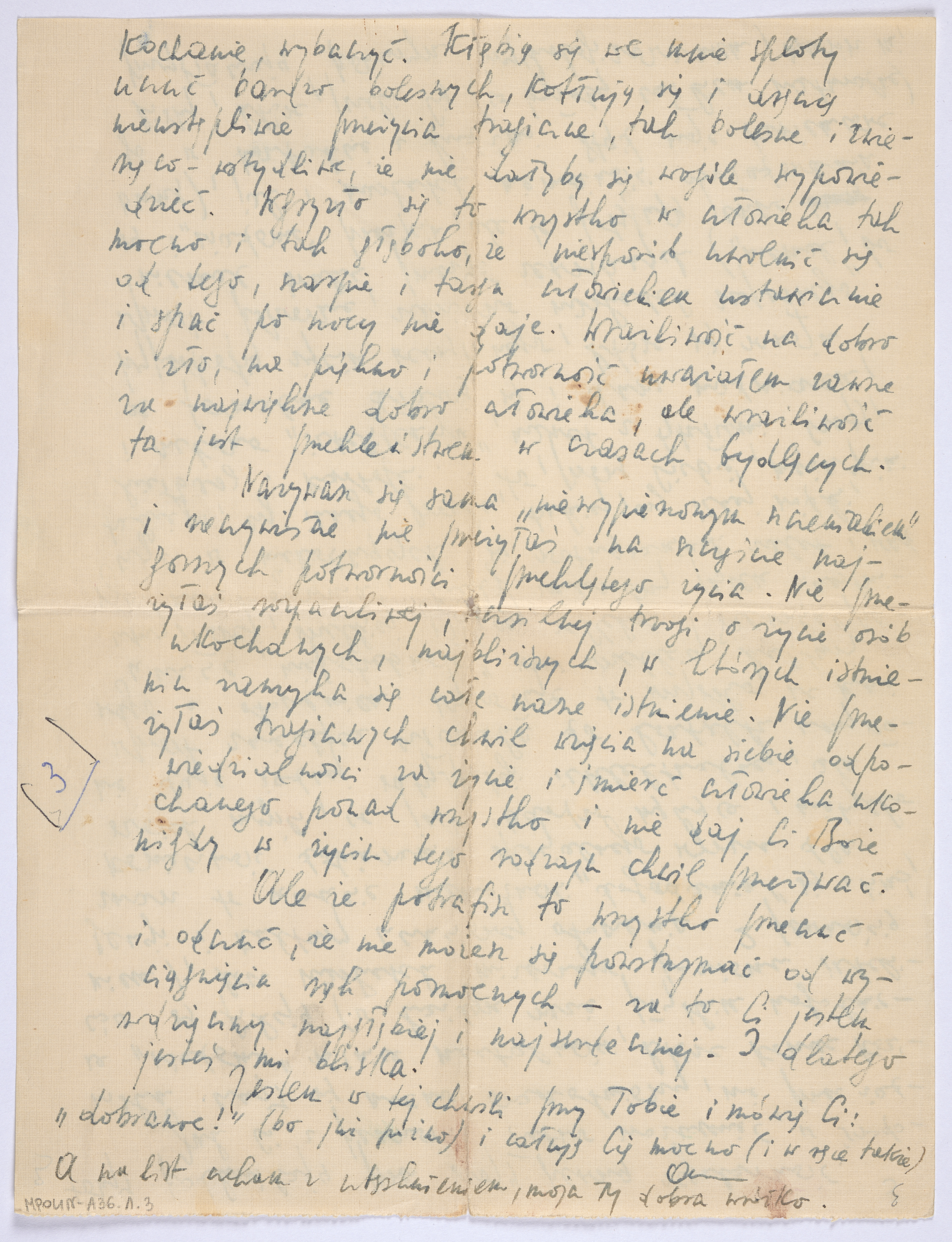
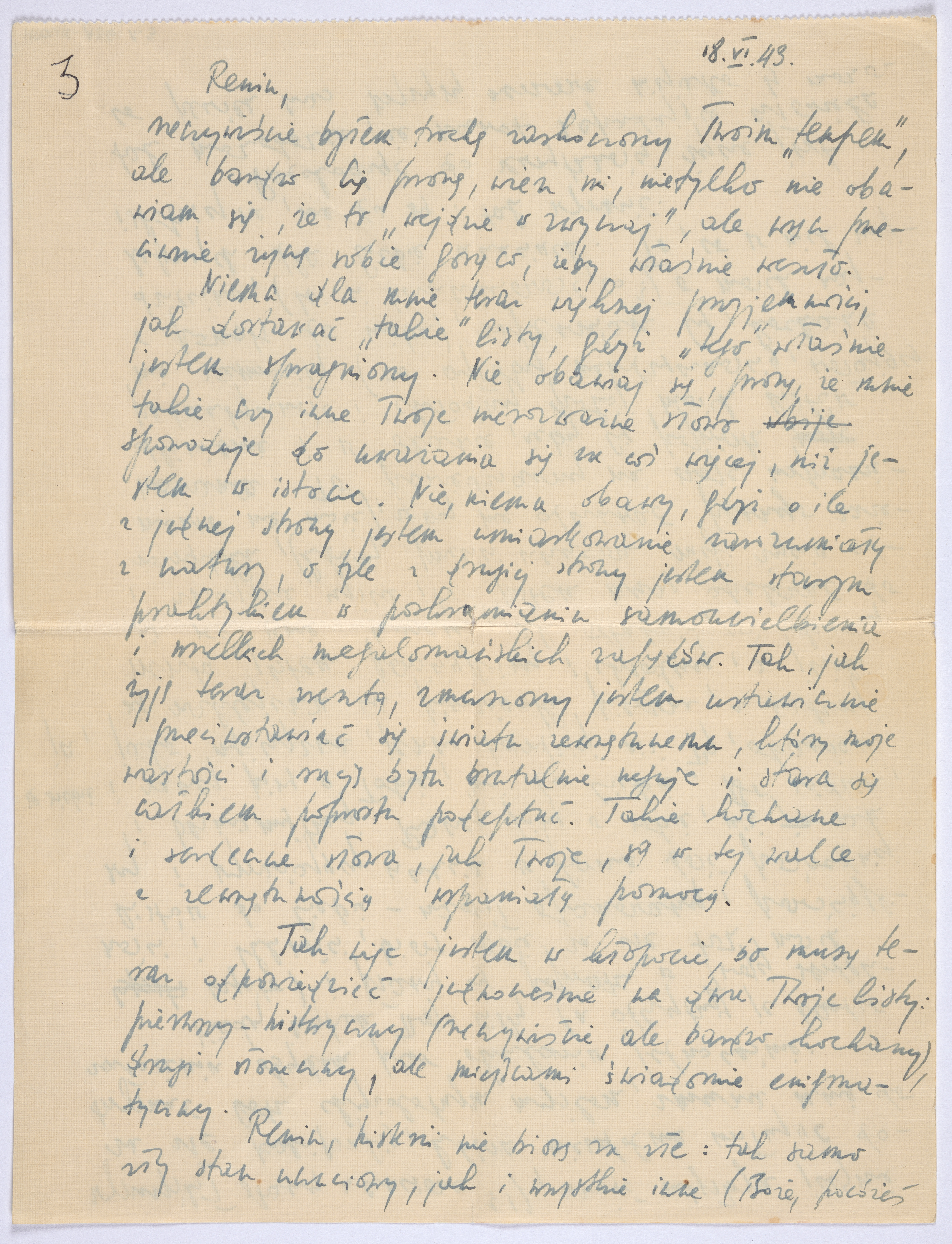
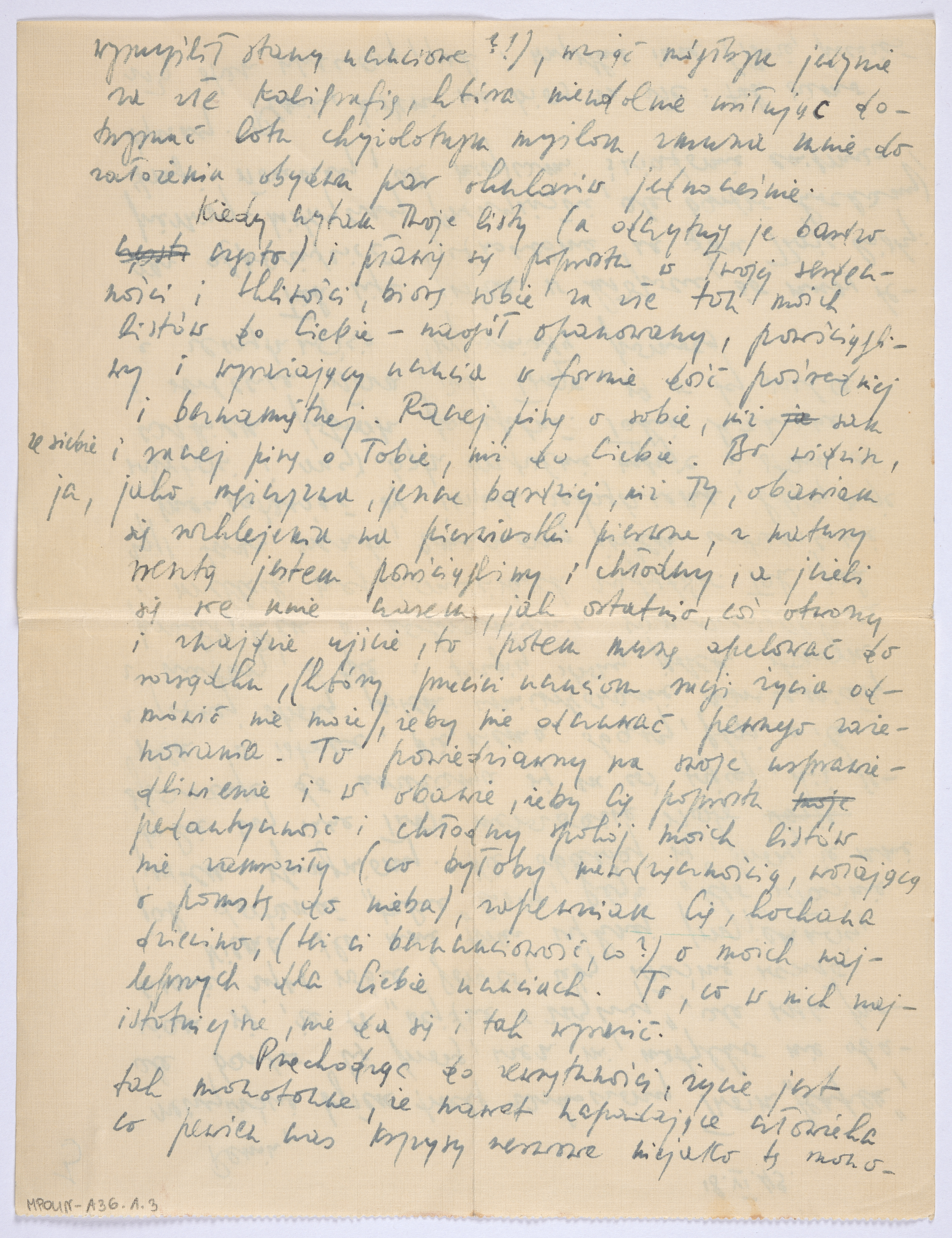
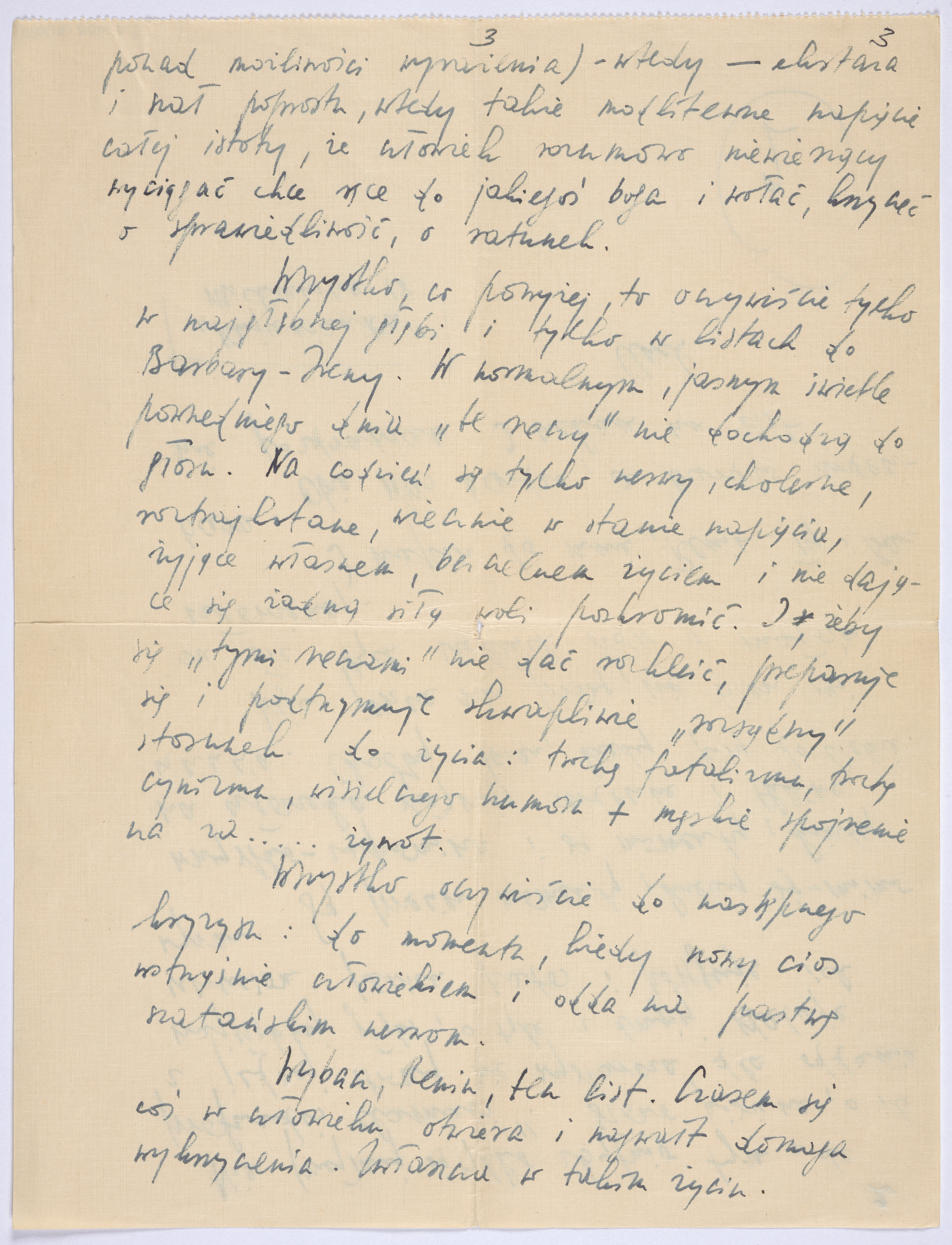
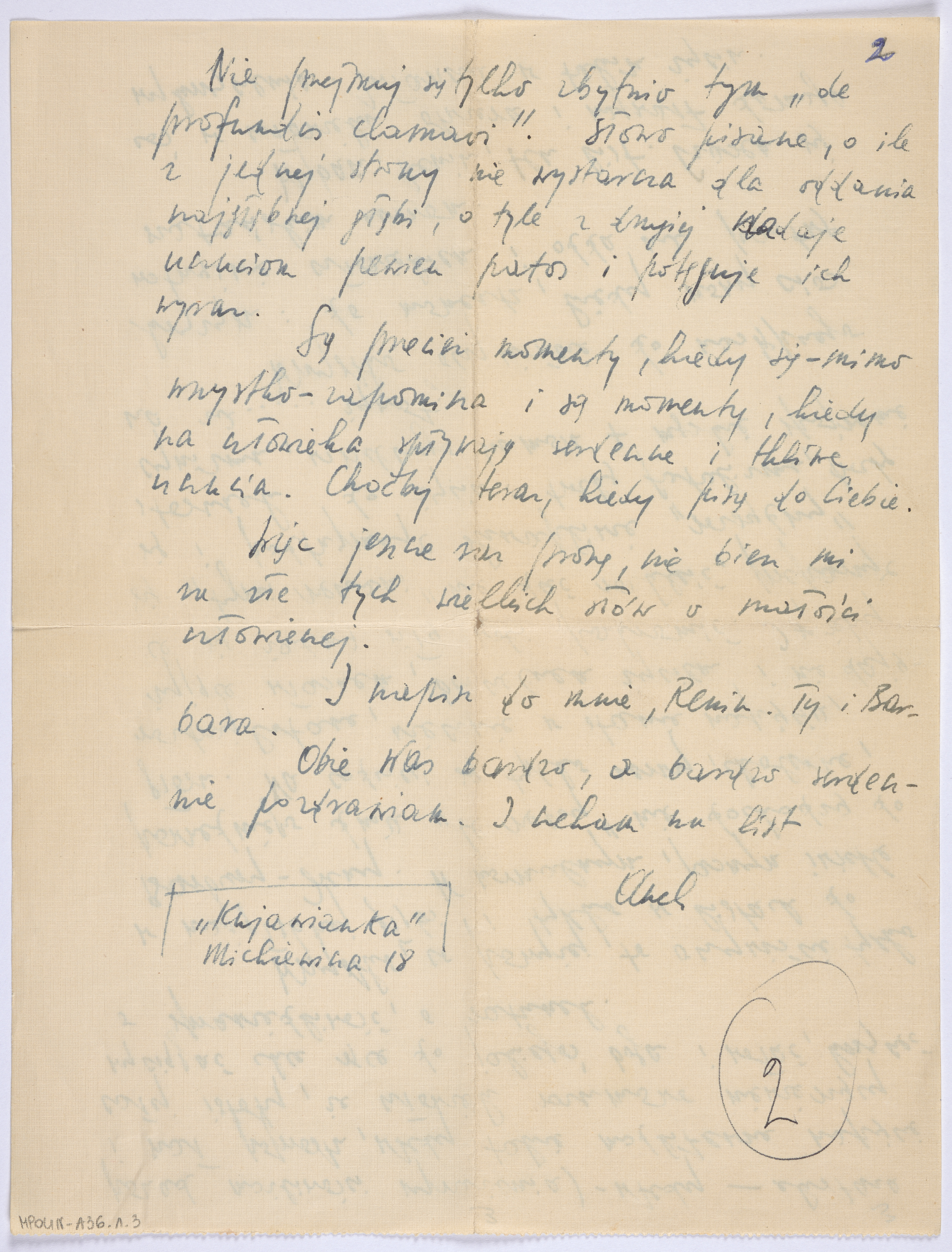
The second letter, was also written from Chylice, nearly two months after the previous one, on two separate sheets with fine perforation on the upper edge of recto pages; the verso pages have perforation along the bottom edge. Apparently, the author of the letter would turn the page over in a letter block (mentioned in the fifth letter, dated 7 August 1943), turn the whole block upside down in order to write more comfortably, and only then would he tear the page out; hence, the text on the verso pages is oriented opposite to the recto ones. All the pages are written over. Notes are handwritten by the addressee (probably many years after receiving the letters): number "2" in various places indicates the second letter.
Full text of the letter:
Dear Renia,
Do not blame me for taking so long to write to you. Even though I have little work, I have hardly any time for myself. I have to lead that Moniek from under the banana tree [talking about Waldemar (?) Miszczak, the pupil – ed.] on a string all day.
The delightful creature produces a different act from its rich repertoire every day.
Recently, for a treat, he insulted the maid in an extremely rude manner and beat her badly. In general, the internal (I mean the M. family) and external situation are growing more and more difficult to bear. As a result of certain incidents – I have experienced it more than once – I succumb to a very unpleasant sensation of being in a tightening net. It can be represented in another way: water that comes up closer and closer from all sides and threatens with overflowing.
There’s hardly a day without a nervous struggle. Every time you luckily find the way out of a situation, the tiring question comes back: "Okay, but what about the next time ?!".
You must forgive me the gloomy tone of this letter, but were it not for the possibility of sharing the burden of this life’s misery with someone – existence would be completely unbearable. When, unfortunately, one still has "pre-war" emotionality and "pre-war" sensitivity to such things as: crime, falsehood and moral meanness, a man who is denied the right to life, whose human dignity is being trodden into mud, who is being hunted like an animal, living among meanness, rudeness and cowardice – he must find some sort of moral refuge, some permanent point among everything that he has considered, throughout his life, to be the only truth, and that is now collapsing into rubble.
"In my youth" (I could actually write it without the quotation marks: I assure you with no emphasis that, in fact, I am already very, very old); in my youth then, playing kidlike philosophy, I would claim, with a hint of pride, to be unable to nurse any strong feelings. That was, in fact, true: brought up in harmony and balance, both spiritual and material, living, so to speak, in the lukewarm water of emotional well-being, I looked at people chasing after some kind of "want" with the contempt of a sceptic. Now that I am simply denied the right to life, I know what it means to "want" and not only want, but also desire with every fibre, with every cell of one’s being. I want to live!
And when I imagine, in a bold dream, my comeback to life after a miraculous salvation (these are not clichés, Darling, these are facts that, when you probe about them, grow beyond any and all possibility of expression) – then – ecstasy and simply frenzy, then such a prayerful tension of the whole essence that a rational unbeliever wants to reach out to some god and cry out, scream for justice, for help.
All of the above is, of course, only in the deepest depth and only in letters to Barbara–Irena [perhaps Majorek wrote parallel letters to Barbara Majda, a friend of Irena Rybczyńska’s – ed.]. In the normal, bright light of the previous day, "those things" do not come to the fore. Everyday life is nothing but nerves, damn, jittery, always tense, living their own, insolent life and no willpower is able to tame them. And in order not to come apart because of "those things", you prepare and eagerly maintain a "reasonable" attitude to life: a bit of fatalism, a bit of cynicism, a bit of gallows humour + a manly outlook on the …particular life.
Everything, of course, until the next crisis: until a new blow shocks you and commits you to satanic nerves.
Forgive me this letter, Renia. Sometimes, something opens up inside and demands being screamed out. Especially in a life like this.
Just don’t worry too much about this "de profundis clamavi" [Latin, ‘I cry out from the depths’; reference to Psalm 130]. The written word, while it is not sufficient to convey the deepest depth on the one hand, it does convey a certain pathos of feelings and intensifies their expression on the other hand.
After all, there are moments when one forgets, despite everything, and there are moments when one gets overflown by warm and tender feelings. Even now, when I am writing to you.
So, once again, please do not blame me for these big words in human littleness.
And write to me, Renia. You and Barbara.
I greet you both very, very warmly. And I’m waiting for a letter
Anek [Below, left, framed; in the same ink:] "Kujawianka"
Mickiewicza 18