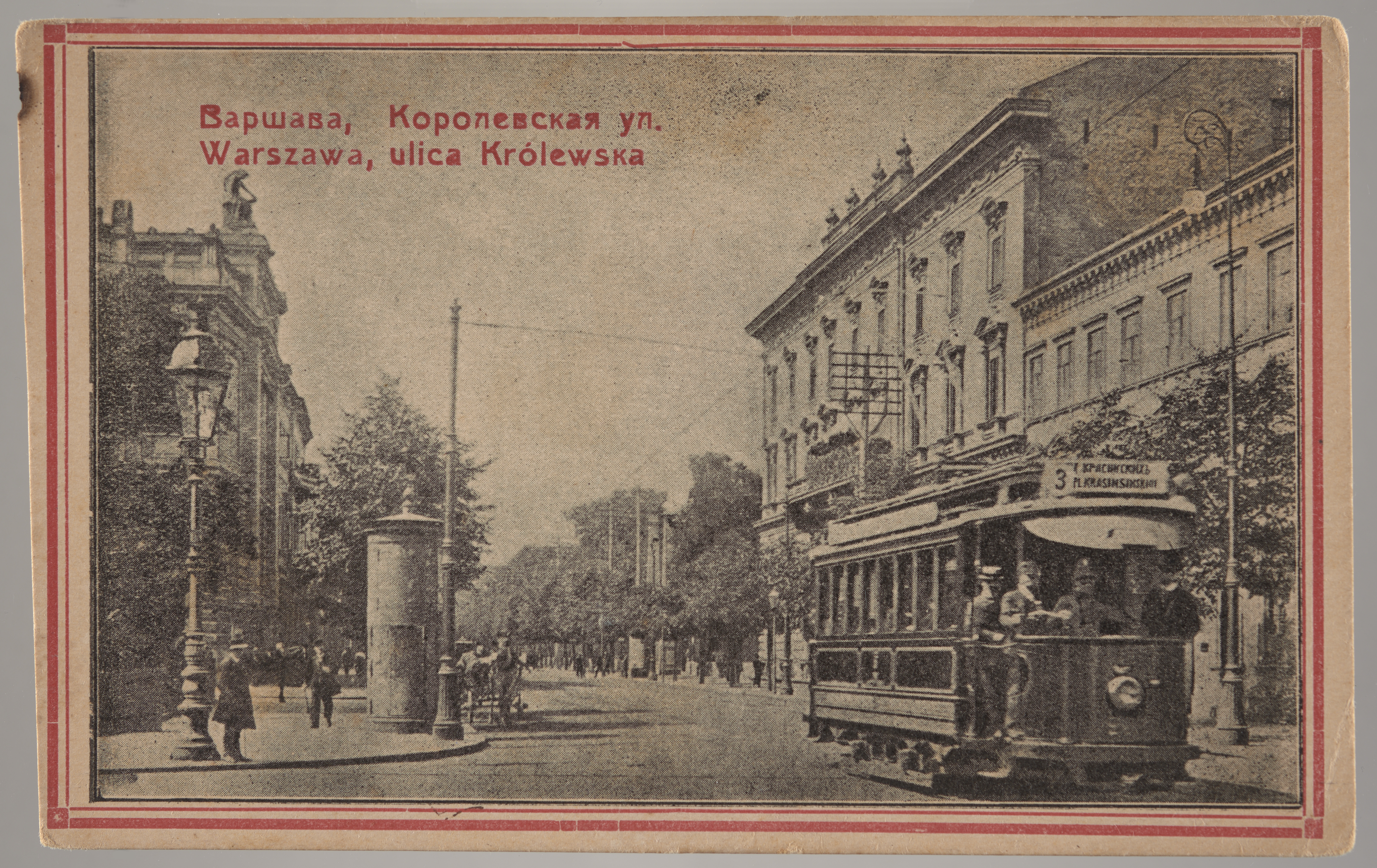
Two-colour postcard (photograph: black-and-white; inscriptions and borders: red) with a view of Królewska Street in Warsaw from the early 20th century. On the right, we can see tenement houses near the Saxon Garden (Polish: Ogród Saski), including the premises at 10/12 Królewska Street (the tallest one is the Lessels' house, for more information see http://www.warszawa1939.pl/obiekt/krolewska-10, accessed 20 May 2021) and, on the left, the building (visible partially) of the Society for the Encouragement of Fine Arts (Polish: Society for Encouragement of the Fine Arts), built in 1900; the view of its façade is interrupted by a tree and a lantern. At the bottom right, in the foreground, a tramway facing the lens can be seen, with the number 3 and the route direction written: pl. Krasińskich, in Russian and Polish. It is an electric tram; such type of transport operated in Warsaw from 1908, which is a clue for the dating of the postcard. The Russian language (also in the prints on the postcard, commented on below) suggests that the card shows the city still under the Russian rule; it was issued during the partitions, i.e. not later than 1914, date of the outbreak of World War I.
The obverse bears a bold red lettering at the top left, in Russian and below in Polish: Варшава, Королевская ул. | Warszawa, ulica Królewska
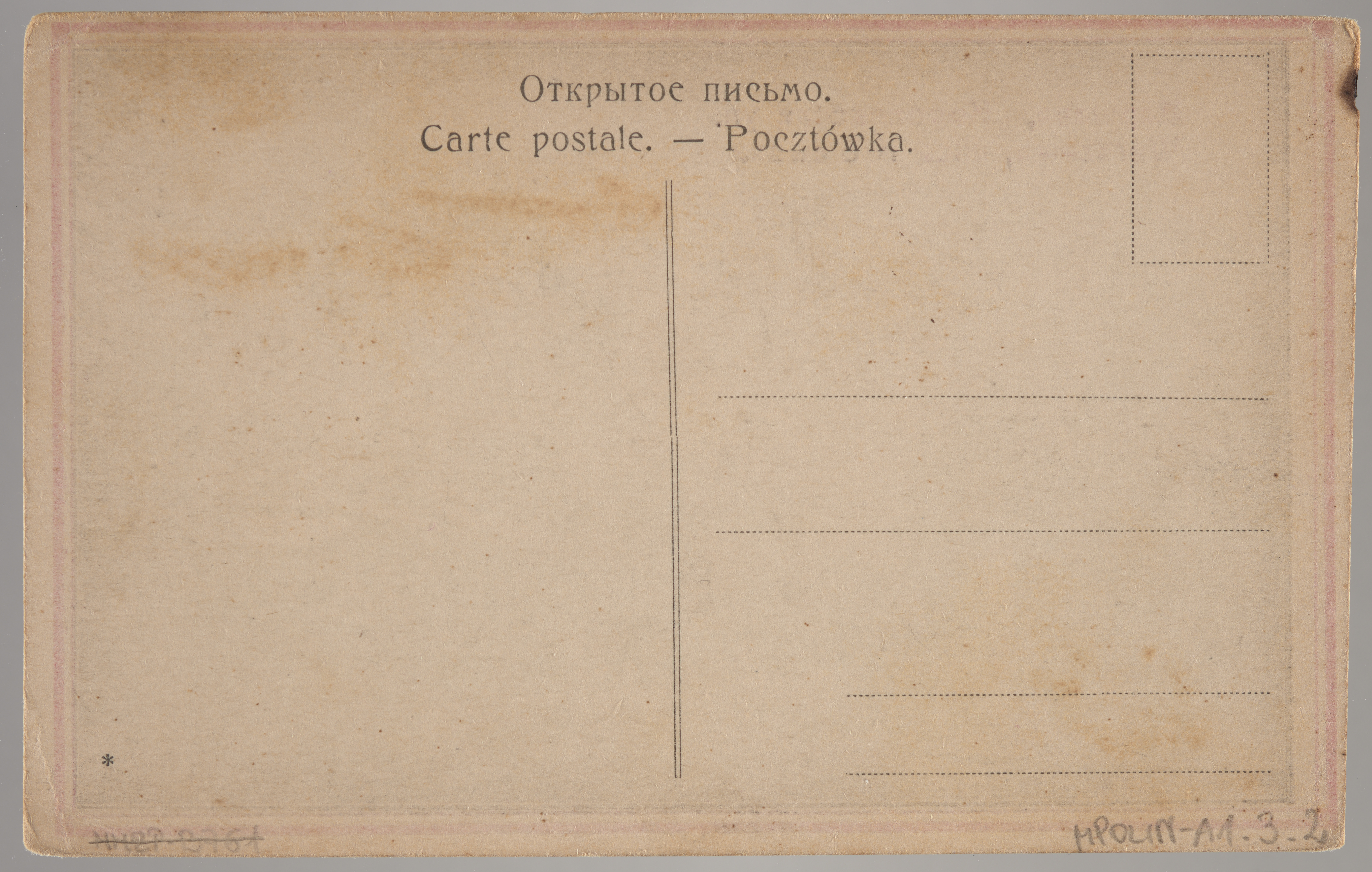
On the reverse, at the top, black print in Russian, French, and Polish, in two lines: Открытое письмо. | Carte postale. — Pocztówka.
In the upper part, near the corner, spot burns are visible. We do not know the history of the item; purchased at an online auction in the 21st century, it was donated to the collection of the Polin Museum. The place shown on the postcard is significant for the history of Warsaw Jews: Królewska, a prestigious street, was an address of numerous wealthy Jewish families. This is, for example, where Edward and Amelia Natanson lived (Królewska 10/12, i.e. in the Lessel house, on the ground floor) and held their extremely valuable collection of works of art (including paintings by Brueghel, Gainsborough, Michałowski, Chełmoński, Wyspiański, sketches by Matejko), which burned down in a fire of the building in September 1939.
PK