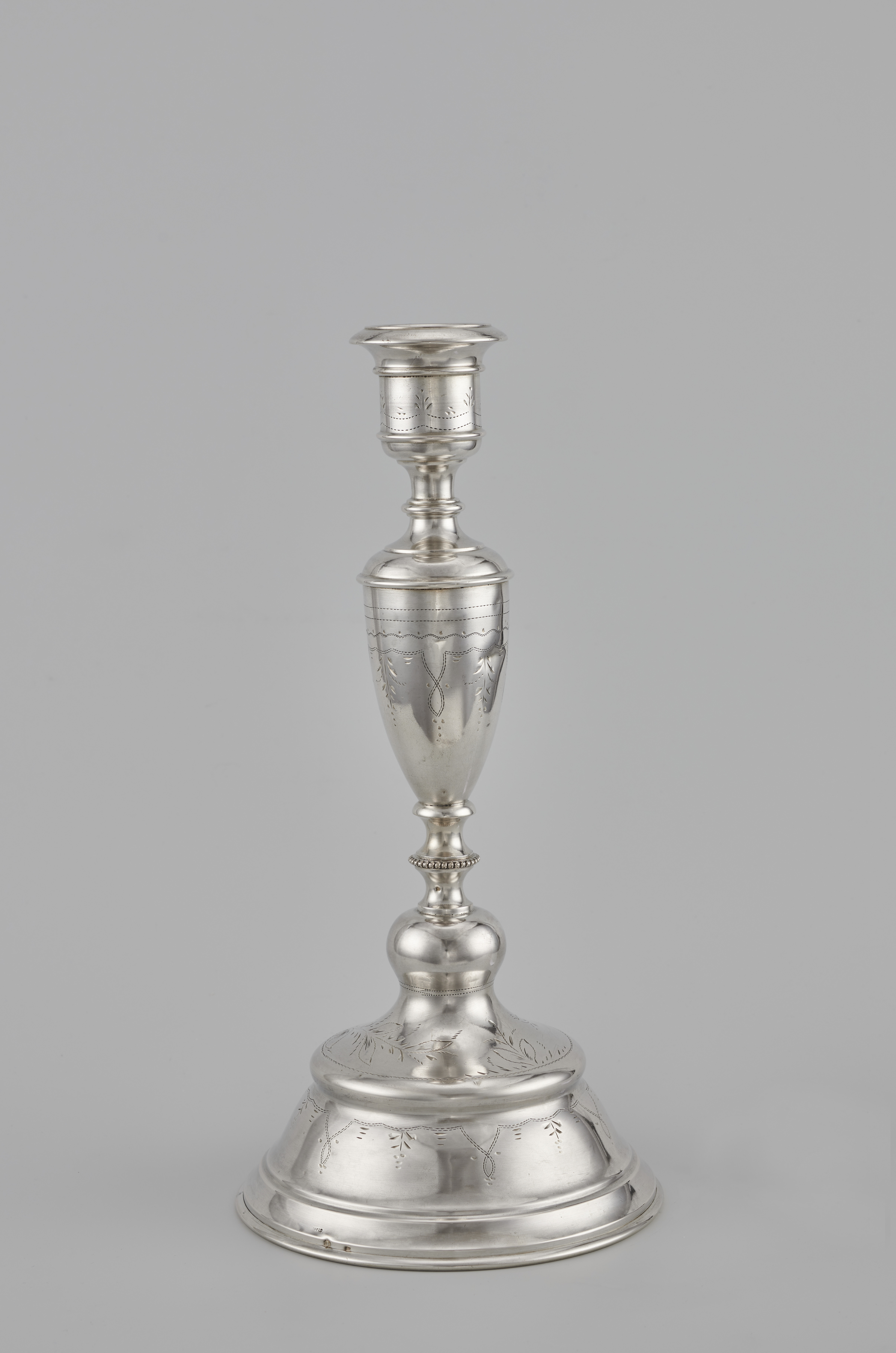
Two silver candle holders from the collection of the District Museum in Tarnów have a round, high, profiled foot, with a steep mantle and a prominent edge. Above, there is a baluster-shaped stem with a cup-shaped knop supported by two tapered rings separated by a plate with a pearl ornament. Above, the cylindrical sleeve is surrounded at the bottom and top with two smooth rings, passing into a bobeche in the form of a profiled, wide collar with a sloping edge. The foot, knop and sleeve are engraved with floral (zigzag line) and geometric motifs. On the foot, just above the edge, there are three punched goldsmith's hallmarks: 1. Austrian basic hallmark for silver fineness of "3" from the Vienna Assay Office; 2. goldsmith's name mark: "HS"; 3. inscription: "SÜDFELD". On the lowest ring of the stem, repeated: 1. the hallmark of the assay office (with traces of repeating a faintly stamped mark); 2. goldsmith's name mark. The candle holders were made of silver by the well-known Viennese company Südfeld & Co, operating since 1825, producing high-class metal utilitarian and artistic objects. The time of their creation is determined by the goldsmith's name mark: "HS", Hermann Südfeld (1835–1915), who took over the company in 1881 and ran it until 1914.
Shabbat, according to the Jewish calendar, is the seventh day of the week and is observed as a day of rest. It begins on Friday evening and, according to the teachings of the Talmud, requires a complete detachment from the concerns of everyday life. The strict rules applicable to the followers of Judaism may only be broken in a life-threatening situation or when caring for the sick. The Sabbath is considered to be a special gift of God and at the same time a sign confirming the divine origin of the universe. The successive stages of the creation of the world culminated precisely on the Sabbath day, when God rested after completing his work. For Jews, this signifies the need to follow the Creator and to abstain from all daily activities.
Shabbat in the Jewish home begins with the lighting of candles a few minutes before sunset. The candles should be tall enough to burn for the entire Shabbat evening. The person lighting the candles – usually the lady of the house – spreads her hands over the flames and, in a circular motion, draws her hands together three times, hereby embracing the sanctity of the Sabbath. She then covers her eyes and pronounces a blessing over the candles (see more at: https://www.chabadkrakow.org/templates/articlecco_cdo/aid/1016318/jewish/wiece-szabatowe.htm, accessed on 1 September 2023).
The candle holders, along with other silver items, were transferred to the District Museum in Tarnów in 1973 by the Municipal and District Civic Militia Headquarters in Tarnów. They were found between the ceiling and the floor during renovation works of a tenement house at Lwowska Street. They were probably hidden there by their last owners during World War II. Lwowska Street marked the border of the ghetto, which was liquidated in September 1943.
Barbara Bułdys