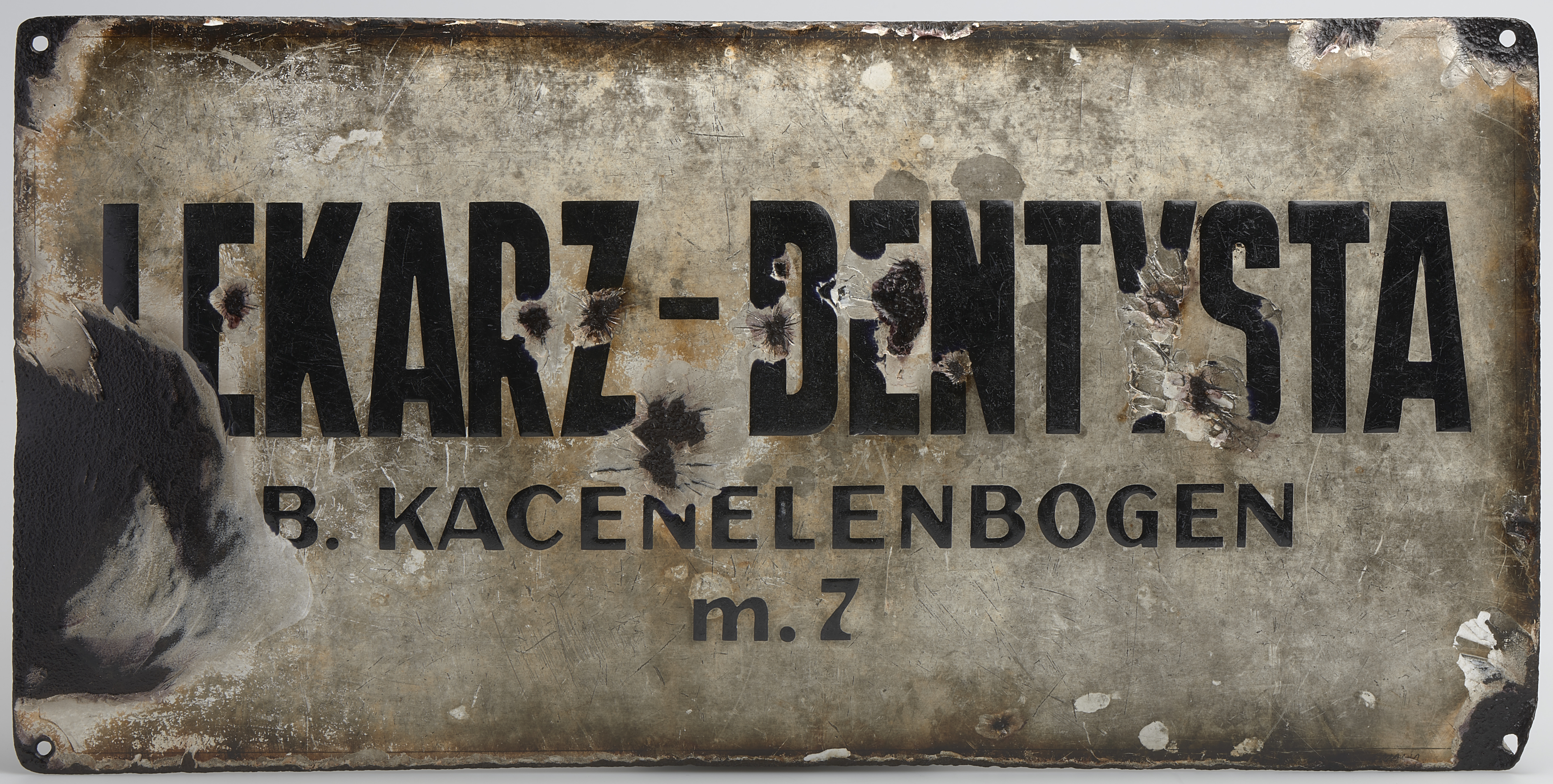
This sign was found in the ruins of the Warsaw Ghetto, near the site where the POLIN Museum of the History of Polish Jews now stands.
It was discovered by Ryszard Cywiński and his colleague Lucyna, both then students at the University of Warsaw, during communal work in the Muranów district. Years later, he even pointed out the exact date and location of the discovery - near the current intersection of ul. Karmelicka and ul. Pawia, around the turn of April/May 1953.
(It is significant that this work was not organised in connection with the 10th anniversary of the Warsaw Ghetto Uprising, which fell on 19th April, but rather for the 1st May celebration - International Workers' Day. In the People's Republic of Poland, the memory of the Warsaw Ghetto Uprising was not officially commemorated.)
The finder took the still-uncleaned tin sheet - a valuable, hard-to-find and useful material - to his aunt’s house in Legionowo. At the time, the family was expanding their house. When his aunt washed the sheet and discovered the inscription, she felt that it was inappropriate to repurpose such an object, a witness to the Holocaust. It remained in the house. In 2006, after reading an article in the newspaper about the newly established museum, Ryszard Cywiński decided to donate the object to the Museum’s collection. It was one of the first gifts, immediately included in the group of exhibits for the POLIN permanent exhibition.
The location of the find, clearly indicated by the donor (in fact, the area was only cleared in the early 1950s), suggests that the sign was moved into the ghetto. It is difficult to imagine any other purpose for which it was being used other than as an advertisement for a dentist's office.
(It should be noted that, when the Warsaw Ghetto was established in the autumn of 1940 and the Jewish population was forced to live within its boundaries, there were nearly a thousand doctors in the ghetto, from circa 400,000 people. Most of them ran private practices. When the Germans began their liquidation action in July 1942, the number of doctors had increased to about 4,000, mostly dentists, surgeons, and gynaecologists, due to the transfer of Jews from the suburban ghettos to Warsaw.)
However, this was definitely not the sign of the office run by this specific dentist, whose name appears on the plaque. We know her story (at least to a certain point.
Research utilising bibliographic material indicates that this was the sign of Berta Pik-Kacenelenbogen, born in 1885, who obtained her medical diploma in 1905. In 1938, she lived and practiced in Warsaw at ul. Polna 72, apartment 7 (according to "Monitor Polski", dated 2nd July 1938, No. 148, see "List of members of the electoral committees for the regional medical-dental chambers").
The apartment number (No.7) matches the number on the sign, so it was the sign which she used during her time working on ul. Polna. She had been seeing patients there from, at least,1930 (according to information in "Cała Warszawa" address book from 1930, page 415, i.e., page 30 in section IX). In 1939, it appears that she moved her practice to ul. Emilii Plater 4, apartment 16. http://genealogyindexer.org/frame/d1182/11
Her husband was Samuel Kacenelenbogen, who was also born in the 1880s. He passed away in 1927. His gravestone has been preserved, and obituaries in the press indicate his address, which is known from address books, ul. Polna. Condolences were also expressed in the press, to the deceased Samuel's daughter and widow Berta – Lidia (spelled as "Lidja Kacenelebogenówna" in the original 1927 documents). Condolences were sent by her classmates from the French Lyceum (see "Nasz Przegląd" newspaper, dated 22nd June).
Information about Berta Kacenelenbogen's pre-war history is further added to by other contextual archival material. She is most likely the same Berta Kacenelenbogen mentioned in a 1926 archival document, as one of the heirs of Mowszy Pika (properties in Grodno, located at ul. Dominikańska 17 and ul. Kołożańska 13 - see "Public Notices. Supplement to the Official Journal of the Ministry of Justice", dated 2nd June 1926, No. 44). Her name also appears on a list of vacation guests, in the summer of 1938, at a sanatorium in Truskavets, a resort town near Lwów.
However, the most crucial details, to reconstruct the history of the sign, involve other pieces of information. Berta Kacenelenbogen did not end up in the Warsaw Ghetto, as she and her daughter managed to escape Warsaw at the beginning of the war. By mid-1940, they were in Algeria, but were soon captured and sent to the Le Vernet camp. Ultimately, both survived the war and the Holocaust (see her daughter's biography in: "1919-2019. Centenaire du Lycée Français de Varsovie. Stulecie Liceum Francuskiego w Warszawie", p. 124).
Just how the sign ended up in the Warsaw Ghetto remains a matter for speculation. The most plausible hypothesis, although based only on deduction and difficult to prove, is that someone - possibly a doctor or dentist, who was well-known to Berta Kacenelenbogen and, perhaps, worked closely with her before the war - used this sign, in 1940 and, with it, move into the ghetto. They might have taken it as part of their practice’s equipment (possibly bought at the beginning of the occupation) and continued their dental practice inside the ghetto. It is also possible that new markings (e.g., covering up the name and number) were added to the sign during this time, especially if Berta Pik-Kacenelenbogen had to change the location from No.7 to No.16 in 1939, when she moved her practice).
If such alterations existed on the sign, over time, they would have likely been damaged or erased, unlike the original pre-war inscriptions, which, although damaged, are still legible.
Unfortunately, we will probably never know the answer to the question of whether that assumption is correct and, if it is, the answer as to who used this sign until the destruction of the Warsaw Ghetto.
Przemysław Kaniecki, Maciej Wzorek