Part of the Marciniak family, which took over the care of the cutlery in the 1990s, also took in Jewish summer visitors from Lodz for the summer. In this case, it was a family of small fabric and haberdashery traders. The summer visitors rented a room, which could be entered directly from the road, where they conducted their seasonal trade. This family also spent their last summer vacation in Orchów in 1939. The fact that two families related to each other maintained the seasonal lease over the years testifies to good relations between Polish landlords and Jewish summer visitors. However, the donor's account shows that (just like the Jewish cutlery) the room, where the tenants conducted their seasonal trade, was not used by the family until the 1990s when the granddaughter of the landlords (the donor's aunt) decided to renovate it and make the space available for the family's daily use.
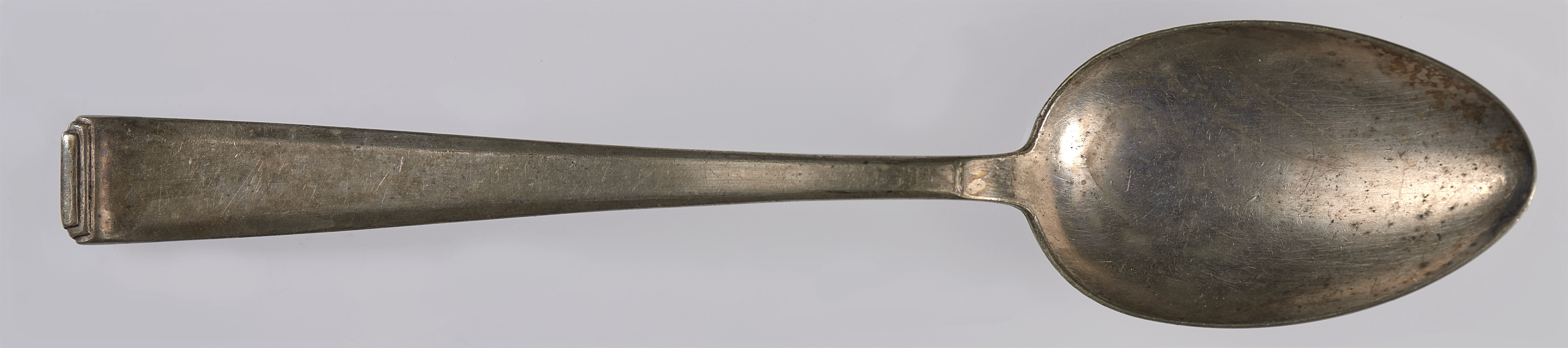
A silver-coloured tablespoon has been decorated with a geometric motif and plated. Plating is the coating of metal objects with a thin layer of another metal, making them more resistant to external influences (corrosion, abrasion). In the case of household items, such as tableware, plating also has a decorative function. Items of this type are usually covered with a thin layer of silver or gold, and alloys (usually aluminium or copper). Plated products are called platters.
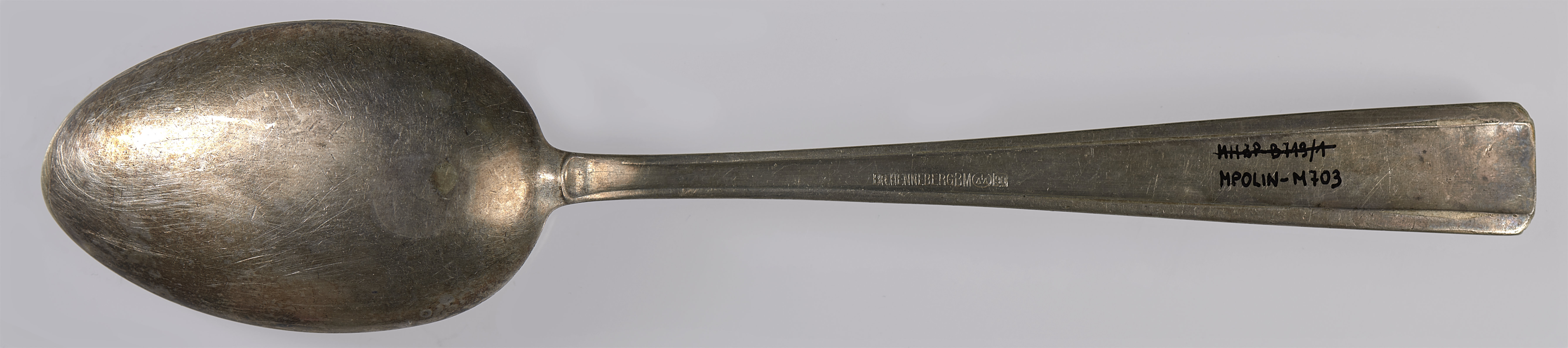
On the handle of the spoon (on the back), there is a producer's signature (punch) "BR. HENNEBERG" - Henneberg Brothers Plated and Bronze Products Factory (founded 1857). Then there are the markings "BM" and "90". The first abbreviation means that the object was made of the so-called white metal (Britannia metal alloy, with about 92% tin). The number "90" suggests the thickness of the silver coating that the metal was covered with (90 grams of silver on 24 square decimeters of the product's surface).
The handle was decorated with a sparse geometric pattern in the art déco style. The decoration consists of three straight transverse grooves placed at its end. After each successive groove, the handle narrows to form three steps, the narrowest of which is at the edge.
Marta Frączkiewicz