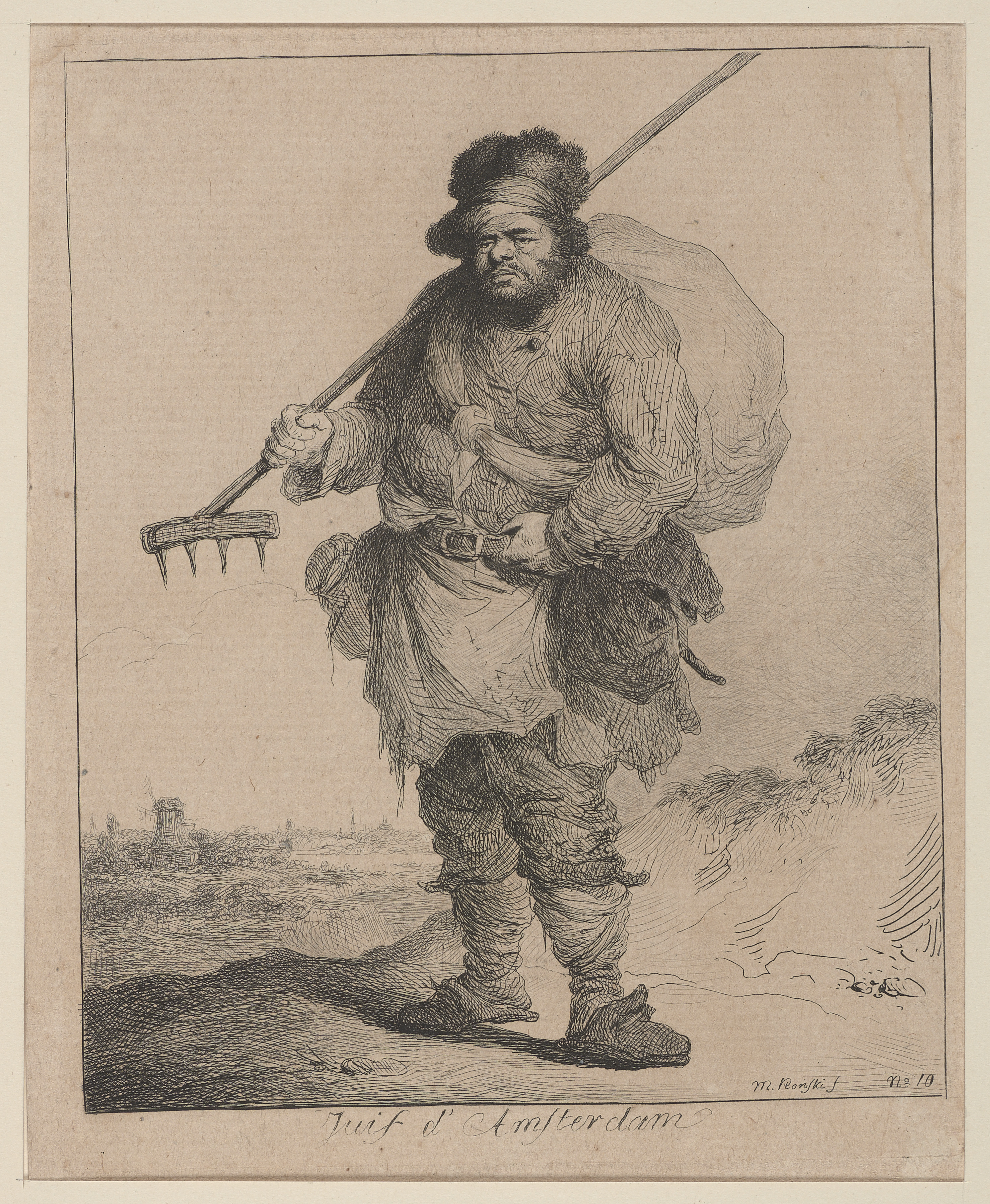
Michał Płoński was a Polish draftsman, miniature painter, and graphic artist. He learnt drawing in the workshop of Jan Piotr Norblin in Warsaw. He was considered the most outstanding student of the French painter, alongside Aleksander Orłowski. He studied engraving in Copenhagen, Paris, and Amsterdam, where he focused on the graphic works of Rembrandt. In the capital of France, he worked in the Imperial Cabinet of Engravings. He created numerous etchings that were copies of paintings by Rembrandt and other masters of classical painting. His main graphic work is considered to be a portfolio published in 1802, containing 19 plates with study portraits (https://sztuka.agraart.pl/autor/licytacje/2440/michal-plonski, accessed on 25 February 2021).
Płoński's graphic depiction of a male figure is printed on ribbed paper in the shape of a standing rectangle. The work stylistically resembles Rembrandt's etchings. In the foreground, there is a large male figure, with a massive body, slightly shown in profile. The man has disheveled, curly hair, tied with a scarf over his forehead. He carries a bundle tied with a cloth on his back. In his right hand, he holds a rake resting on his shoulder, while his left hand is tucked behind his belt. He is dressed in rags, short pantaloons, and footwraps. He wears wooden clogs on his feet. Travel bags (saki) are attached to his belt. In the distance, on the left side, there is a small silhouette of a windmill. The image is presented within a simple frame. In the lower right corner of the graphic, there is the artist's mark: "M. Płoński f" and the print number "No 10". Below the frame, there is the title in French: "Amsterdam Jew".
The print was donated to the District Museum in Leszno in 2005 by Janina Skoracka from Poznań. The artwork came from the collection of her deceased husband, the artist Józef Skoracki. The widow of the painter did not provide any information about the circumstances of acquiring the graphic.
Dariusz Czwojdrak