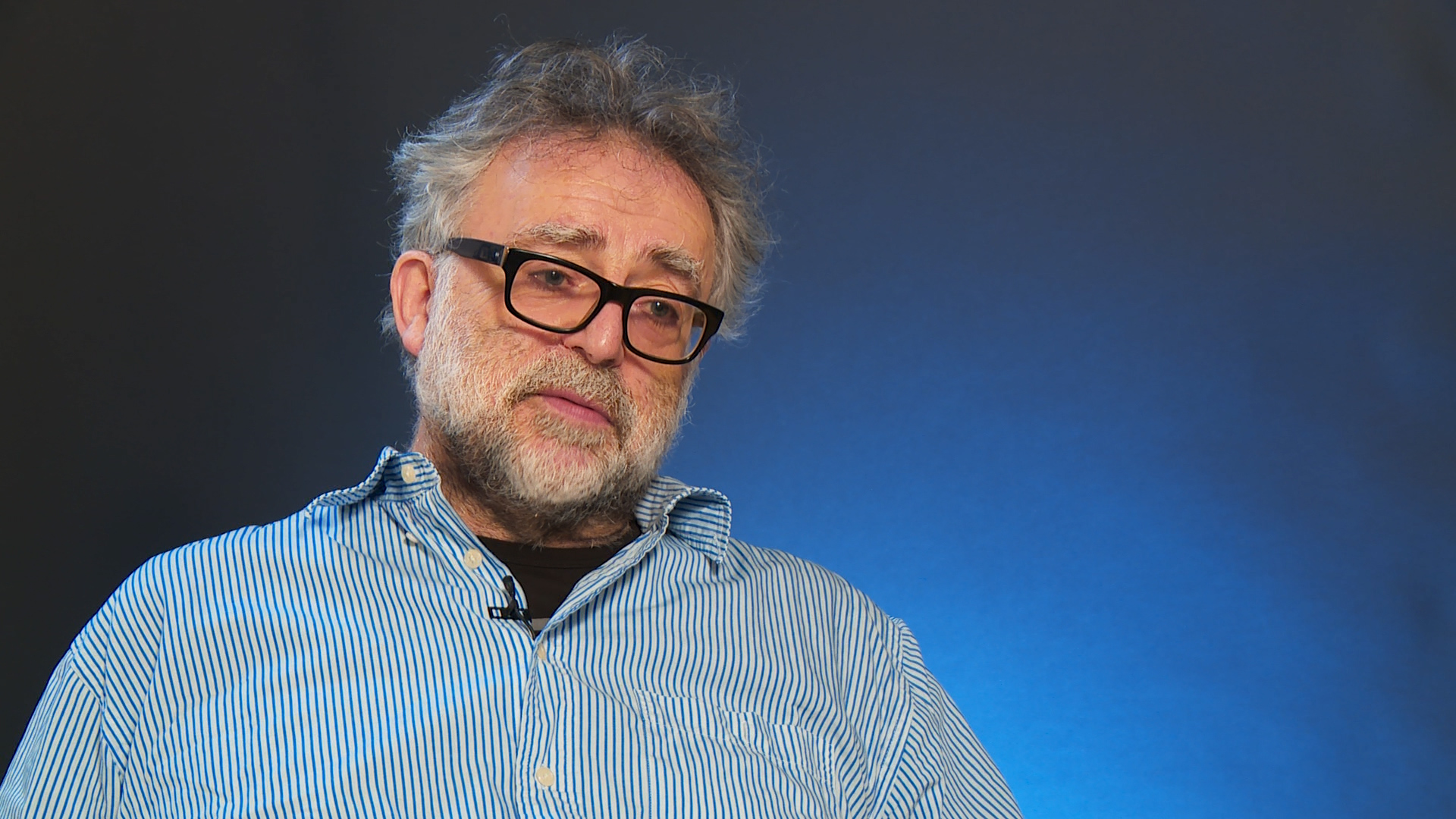
Jerry Bergman was born in Tarnów in 1948, in the third largest city in the Galicia region and important in the consciousness of the Jewish community. His parents emigrated to the east at the beginning of the War, when they as yet did not know each other. When they settled in Tarnów and started a family, they ran a religious, kosher, Jewish home, in which both Polish and Yiddish were spoken. After the War, his father worked in the postal service and his mother looked after the home. When he was living in the city, there was already no synagogue, but was replaced with a prayer-house, which was actually a separate room. In 1967, he graduated from technical school and became interested in photography and film. He then wanted to study in a film school, but he doubted that he could due to his origin.
Due to the growing societal tensions, he felt that there would be a need to Leave Poland. In the interview, he recalls that, when he was a young boy, he wanted to wear a beard, something about which his mother was not happy. One day, on the bus, he overheard, “And I thought that all the Jews had been gassed”. He understood then why his mother was not happy with her son’s beard. In 1965, he wanted to leave for Israel, but his parents would not consent. Eventually, on 24th October 1969, he left the country. He assumed that he would go to Israel. However, he stopped in Vienna in order to wait for his parents, who he then wanted to relocate in Europe. He remained there for a few days and then went to Denmark. His parents, however, never left Poland. His father died in 1980 and was buried in Tarnów. His mother passed away a few years later and was buried in Kraków.
He did not plan to stay longer in Denmark. As he says, he was there “in suspense”. At that time, the emigre community had differing views, the result of which was that confusion reigned. He began studying something in which he had an interest, namely film. He also began work as a photographer through establishing contacts with the local press. In time, he worked with the large agencies and became a Denmark correspondent. He became Deputy Chairman of the Foreign Correspondents and had accreditation to the Royal Palace and to Parliament. He photographed the waves of refugees and illustrated the covers of books on that subject. He then established a committee which dealt organising Polish-Jewish seminars, namely meetings of emigrant young people. After a long stay in Denmark, his first return to Poland for the funeral of his father.
As Deputy-Chairman of the Committee for the Preservation of Jewish Cultural Monuments in Tarnów, he is actively involved in the protection of his heritage. About his emigration experience, he says, “Without doubt, if your mind works well, it is a chance to enrich your knowledge and gain a mass of experience. It is an education. It is a chance to start life anew in a new place. To do that without any help is an excellent experience which can either benefit or harm (…) people have committed suicide because they simply could not find a place for themselves in the new reality. But, if someone has some energy, you can become enormously enriched in both common sense and experience. (…) But it is expensive. There is a price to pay and some may certainly be put off by that (…) I remember people, from our period of emigration, who walked along the street, talking loudly to themselves. For sure, there were some who paid a terrible price. There is no doubt. For some, it must have been a terrible tragedy (…) I emerged from these crises – some did not, because the crisis can be terrible.” For the temporary exhibition “Estranged. March '68 and Its Aftermath”, Jerry Bergman gave a hanukkiah which he had found as a child playing games in attics in Tarnów.