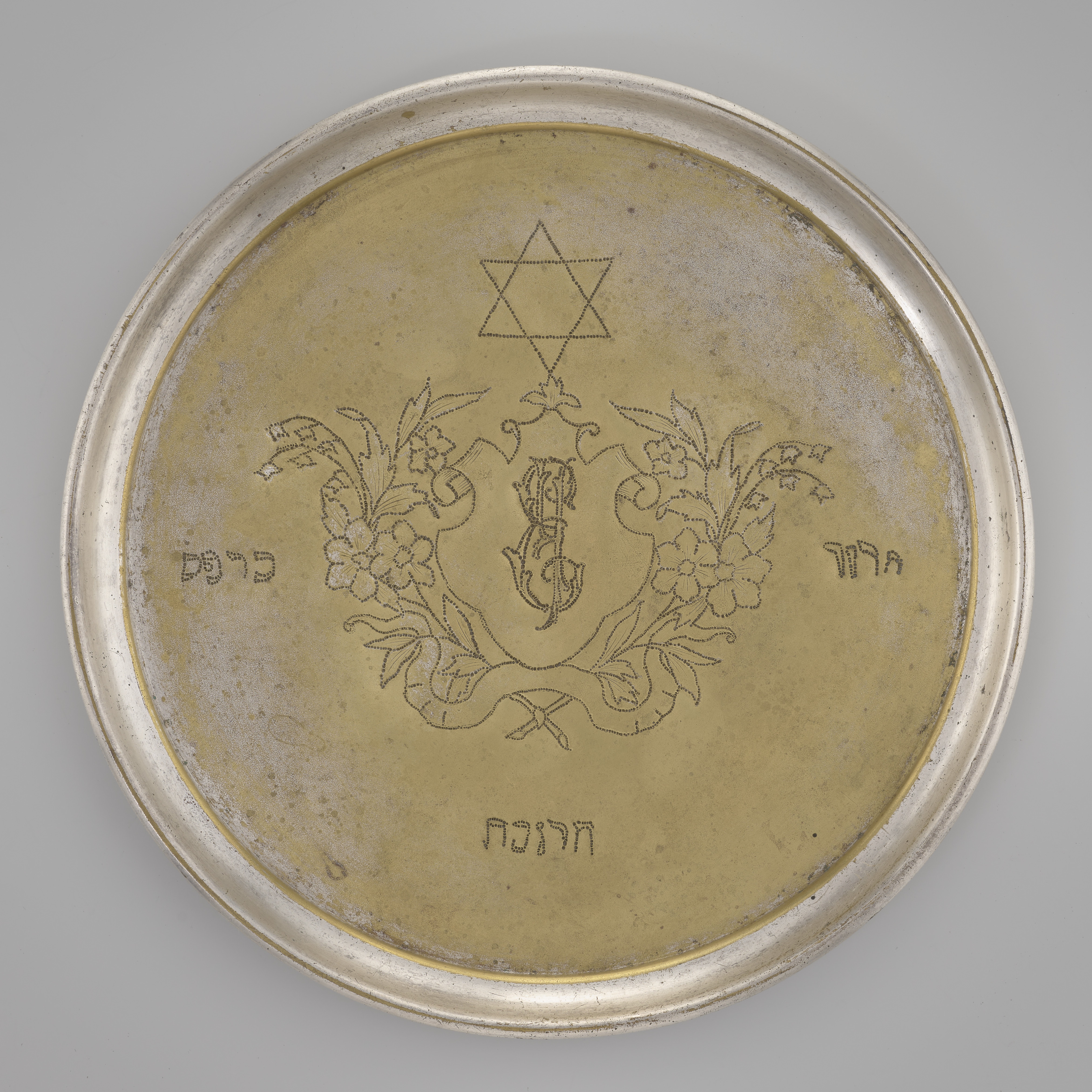
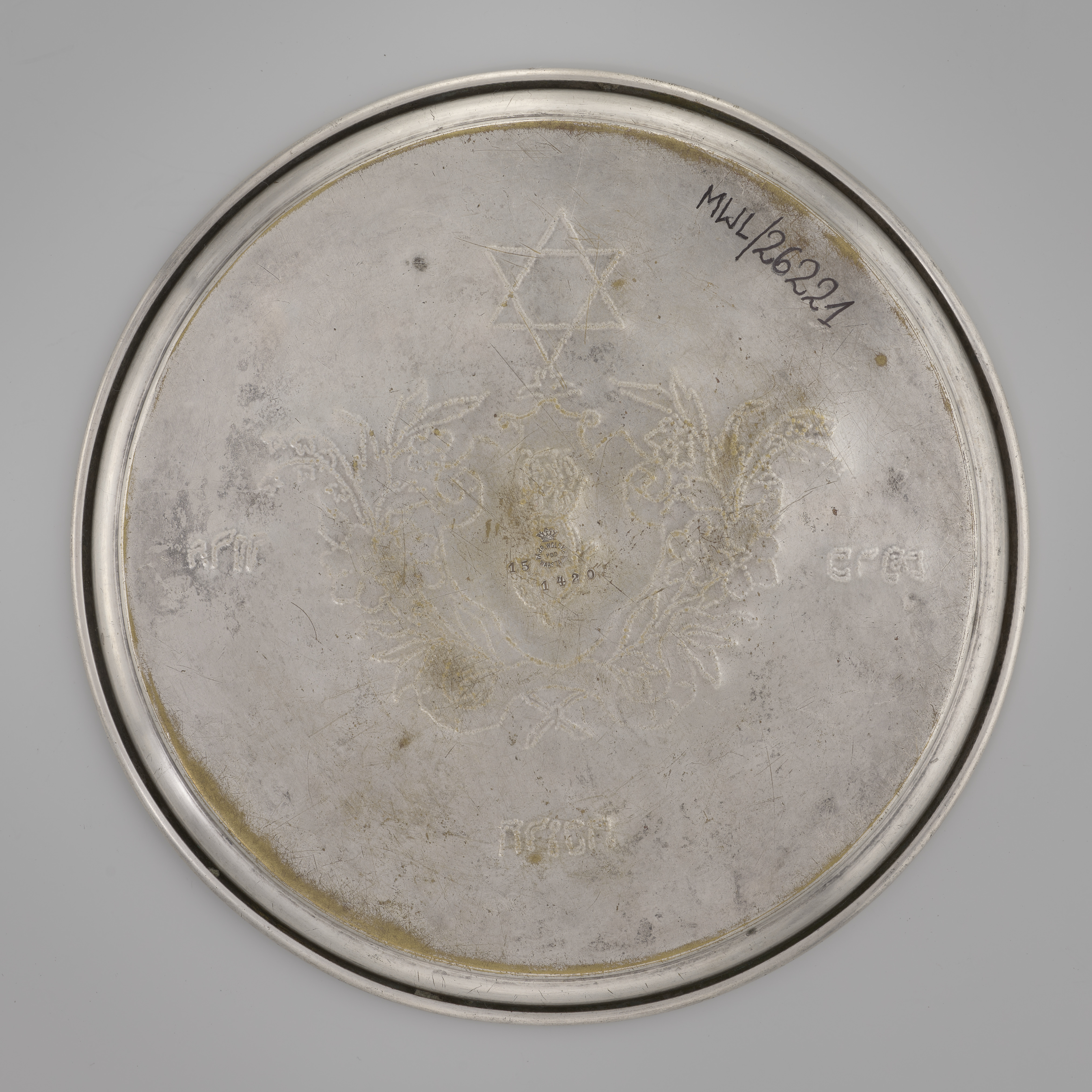
A brass circular tray with a cartouche, monogram, the Star of David and inscriptions in Hebrew, with a profiled strip around it. It was originally silver plated. On the tray, there is a cartouche with a monogram of two decorative letters, with a flower bouquet on its sides and a ribbon beneath it. The cartouche is topped with a Star of David. On the right and left sides of the tray and the bottom section, there are three words in Hebrew: "karpas" (celery or parsley), "charoset" (dessert of apples and nuts) and "maror" or "chazeret" (?) (bitter herb, misspelt). Hallmarks are placed on the bottom of the item: the inscription "FABR. WOLSKA/ POD/ WARSZAWĄ" (Wolska factory near Warsaw) with a five-bar open crown above it, as well as the model number "1420" and the number "15".
The tray was manufactured at the Wolska factory established by Abraham Luria and S. Krongold in the Wola district of Warsaw in 1885. The item was originally decorated only with engraved elements: a cartouche with a monogram and a floral decoration with a ribbon. The Star of David and the Hebrew inscriptions were added later using the point-engraving technique; at the same time, the delicately engraved lines were also corrected using the same technique. The added elements give the impression of an attempt to turn the tray into a Seder plate (the Hebrew inscriptions indicate the names of dishes eaten during the Seder supper on the occasion of Passover), although its original purpose was most likely not such. The remains of the original engraved decoration can be seen on the leaves, flower petals and in the shading of the cartouche.
The item was purchased for the collection of the Lublin Open Air Village Museum in 2007 from a collector from Warsaw who bought it in an antique shop in Warsaw.