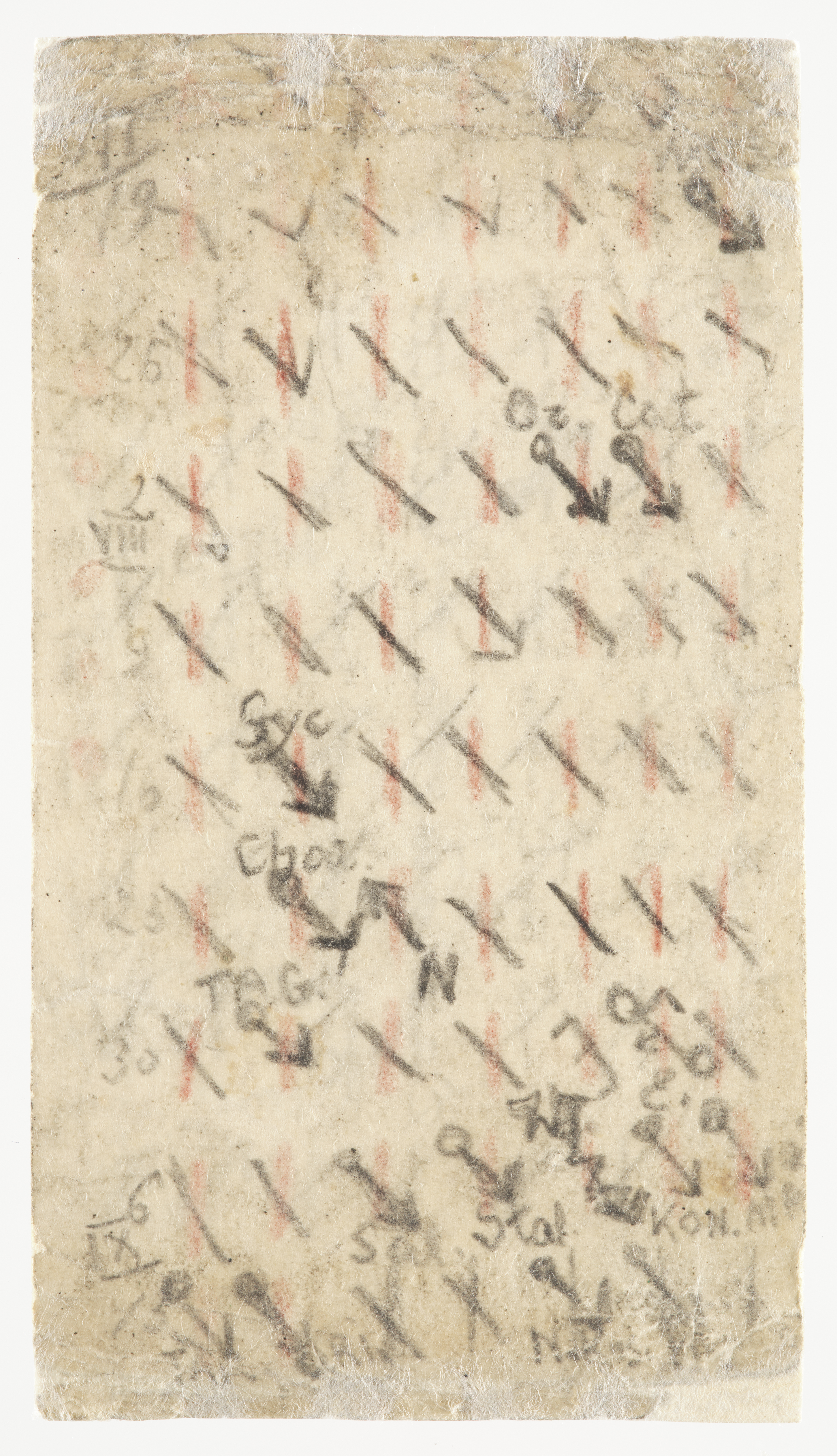
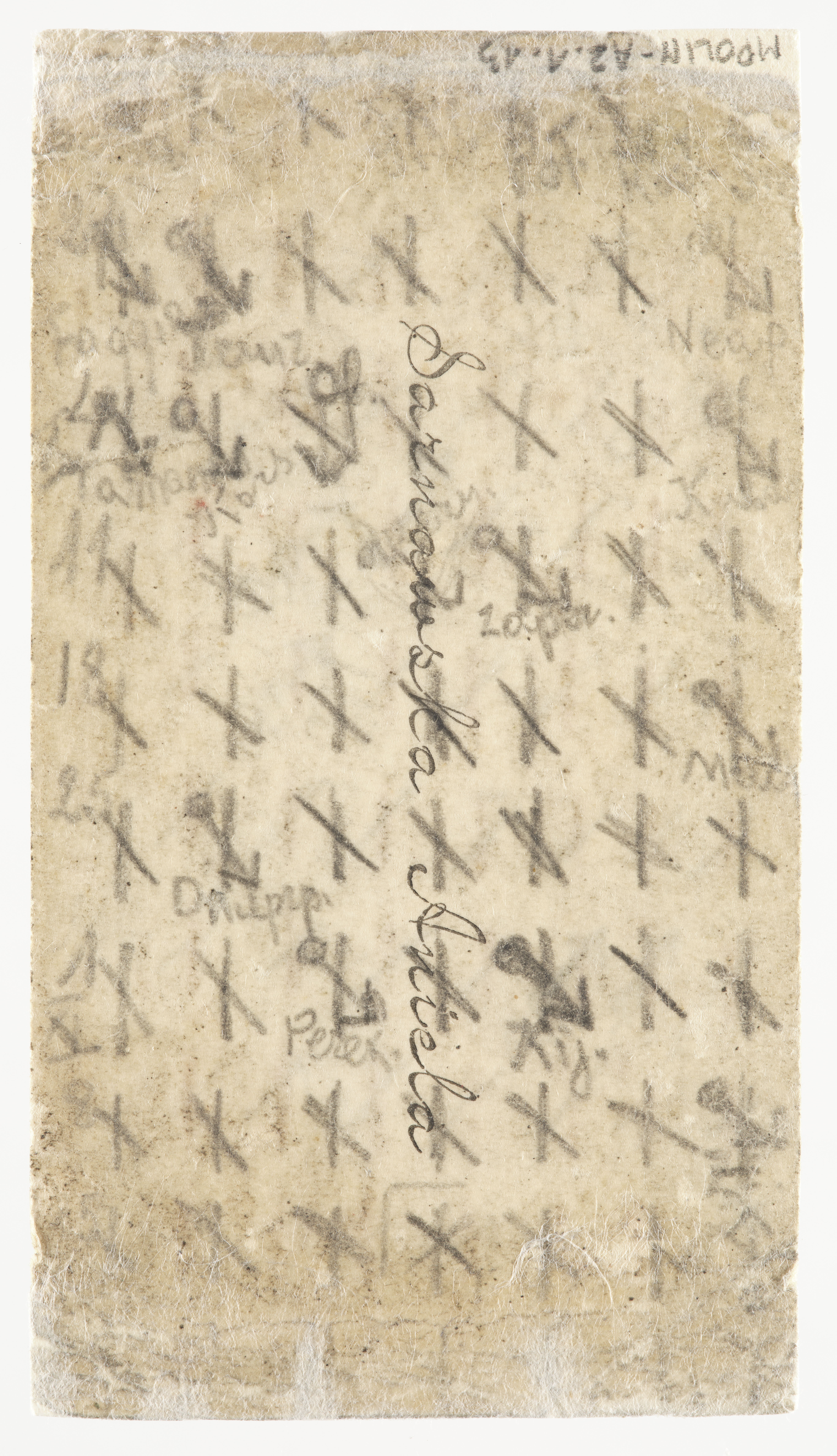
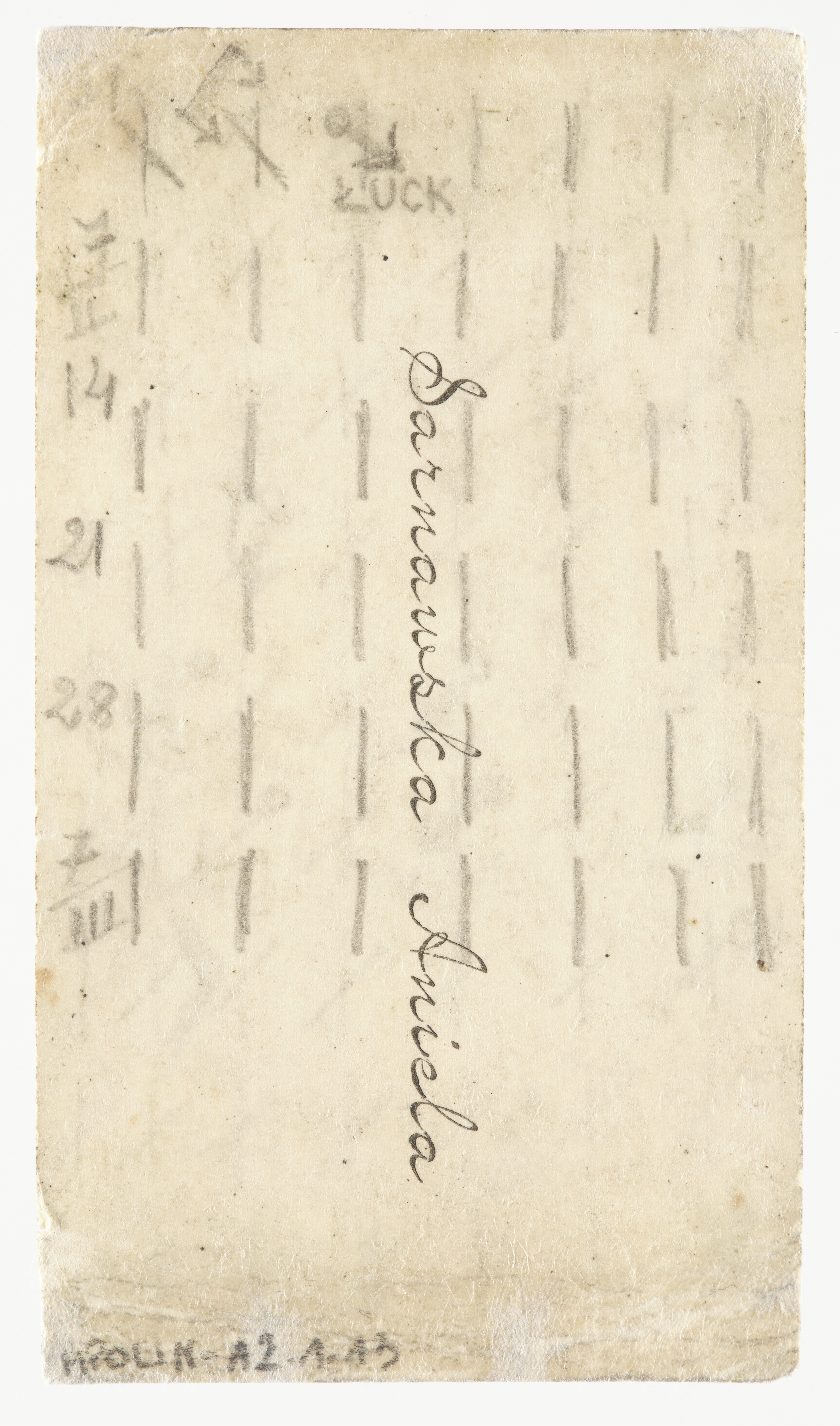
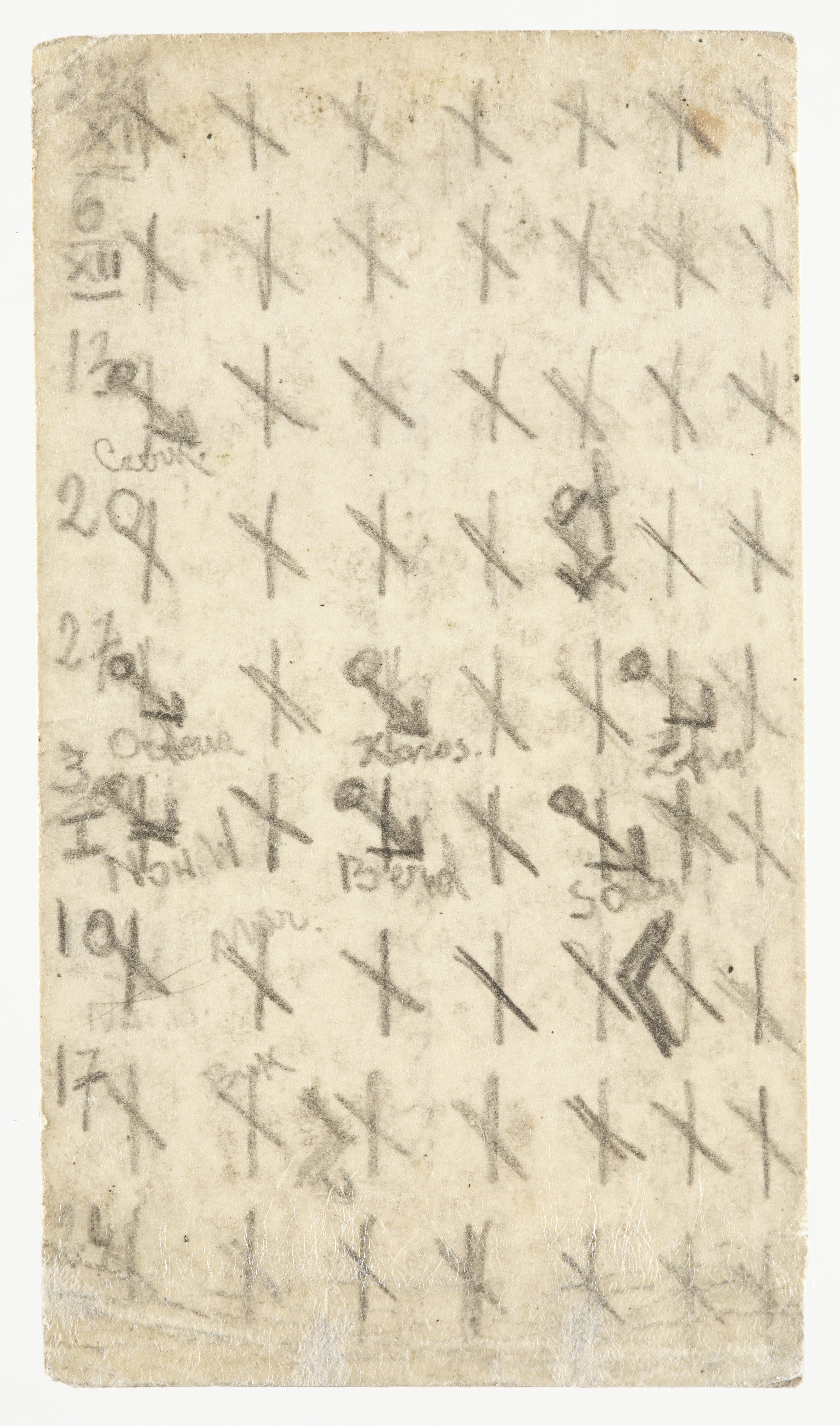
A hand-drawn calendar in which successive weeks are marked by seven vertical lines arranged in a single row (initially drawn in red pencil, later in black pencil). Each row begins with the Arabic numeral for the first day of the week, while the first Mondays of each month also labelled with the month’s name in Latin script. To keep track of the passing days, the author of the calendar, Cywia (Celina) Gliksberg (Glücksberg), crossed through each day with a horizontal line.
Cywia Gliksberg was born in Warsaw in 1914, the only daughter of Anna (Chana) née Kulik and Michał Gliksberg. Her ancestors were booksellers and publishers. Her father owned a stationery shop at ul. Marszałkowska 130 (see address directory entry) which, in the mid-1920s, was converted into a department store, of which he was a co-owner.
Before the war, Cywia studied in the Humanities Faculty of the University of Warsaw, beginning in 1932.
From the fragmentary information that Cywia Gliksberg shared with her family, long after the war (passed on to the POLIN Museum together with the donated item), it seems that she left Warsaw at the beginning of the Second World War and went to Równe, located in the territory occupied by the Soviet Union. Her parents, who remained in Warsaw, perished in the Holocaust.
From around mid-1942, she hid in Łuck, in the attic of a house belonging to an unidentified Ukrainian woman. During this period, or at least for much of it, it is assumed that she kept her calendar on two business cards (bearing the name Aniela Sarnawska). It is not known how Gliksberg came into possession of these cards, whether it was by chance or through some connection, perhaps related to food trading. A miller, named “Sarnawska A.”, appears in prewar address directories of the Stanisławów Province, in Bursztyn, a town more than 200 km from Łuck.
She reused the paper, erasing previous weekly marks, to make room for new ones.
In the first months, following the entry of the Red Army into Łuck, she worked as a teacher. However, in 1945, she returned to Warsaw. In 1947, she returned to study at the University of Warsaw.
His grandmother’s memento was donated to the POLIN Museum of the History of Polish Jews in the early 21st century by Jan Grądzki.
To create the calendar, Cywia Gliksberg, who was in hiding, reused two business cards printed with “Sarnawska Aniela”, writing on both sides of them, with a vertical orientation.
In its completed form, the calendar begins on 12th July 1943 and ends in mid-March 1944 (specifically on 14th March). However, the last crossed-off and counted day in the calendar - the one indicating the final stage of its actually being used - is 2nd February 1944, next to which the calendar’s keeper wrote:
“ŁUCK” (Lutsk).
Similarly, she had earlier added the names of various front-line locations next to certain days - though not always precisely, sometimes with a delay of about a day (we do not know her source of information, likely her landlady).
Among others, these included cities captured by the Red Army: Zaporizhzhia (noted under the line for 15th October 1943, though the city was actually taken on 4th October); the Dnieper, then Dnipropetrovsk (line for 26th October 1943, actually captured on 25th October); Kyiv (5th November 1943); Cherkasy (13th December 1943). There were also references to locations on the Western Front (for instance, mid-August: Sicily; 1st October 1943: Naples). We do not know why she marked the days 15th-18th January 1944, in an unusual way, with quotation marks “” and a “>” symbol.
Arrangement of dates:
• on page 1 recto, in the first row, a handwritten date appears at the very top - partly illegible, with only the month visible: “VII”; then: “19 | 26 | 2 | VIII | 9 | 16 | 23 | 30 | 6 | IX | 13”;
• on page 1 verso, which bears the business card print, the first line is almost illegible; the following lines begin with the numbers: “27 | 2 | 11 | 18 | 25 | 1 | XI | 8 | [illegible]”;
• on page 2 recto: “29 | XI | 6 | XII | 13 | 20 | 27 | 3 | I | 10 | 17 | 24”;
• on page 2 verso, also with a printed business card: “1 | 7 | II | 14 | 21 | 28 | 7 | III” (the last page is not filled across its entire height, with an empty space at the bottom).
Compiled by Przemysław Kaniecki