The establishment and subsequent closure of the Łódź Ghetto in 1940 allowed the Germans to introduce an internal currency within its borders. Their main goal was the looting of Jewish property and the isolation of the ghetto – outside of it, the new currency had no value. The Łódź Ghetto was the only ghetto in occupied Poland where its own means of payment were issued. The residents colloquially referred to them as "rumkes" or "chaimkes", named after the head of the Jewish administration, Chaim Rumkowski. The coin designs were created by the artist painter Pinkus Szwarc (1923-1996), and coining punches were engraved by the Łódź engraver Morduch Glazer (1890-1950). The coins were minted in an improvised mint located in the former municipal slaughterhouse building at 63 Łagiewnicka Street (ul. Łagiewnicka 63). They were issued by the Jewish Community Council in the Łódź Ghetto (https://mnki.pl/pl/obiekt_tygodnia/2014/pokaz/72,pieniadz_getta_w_lodzi,1, accessed on 7 April 2021).
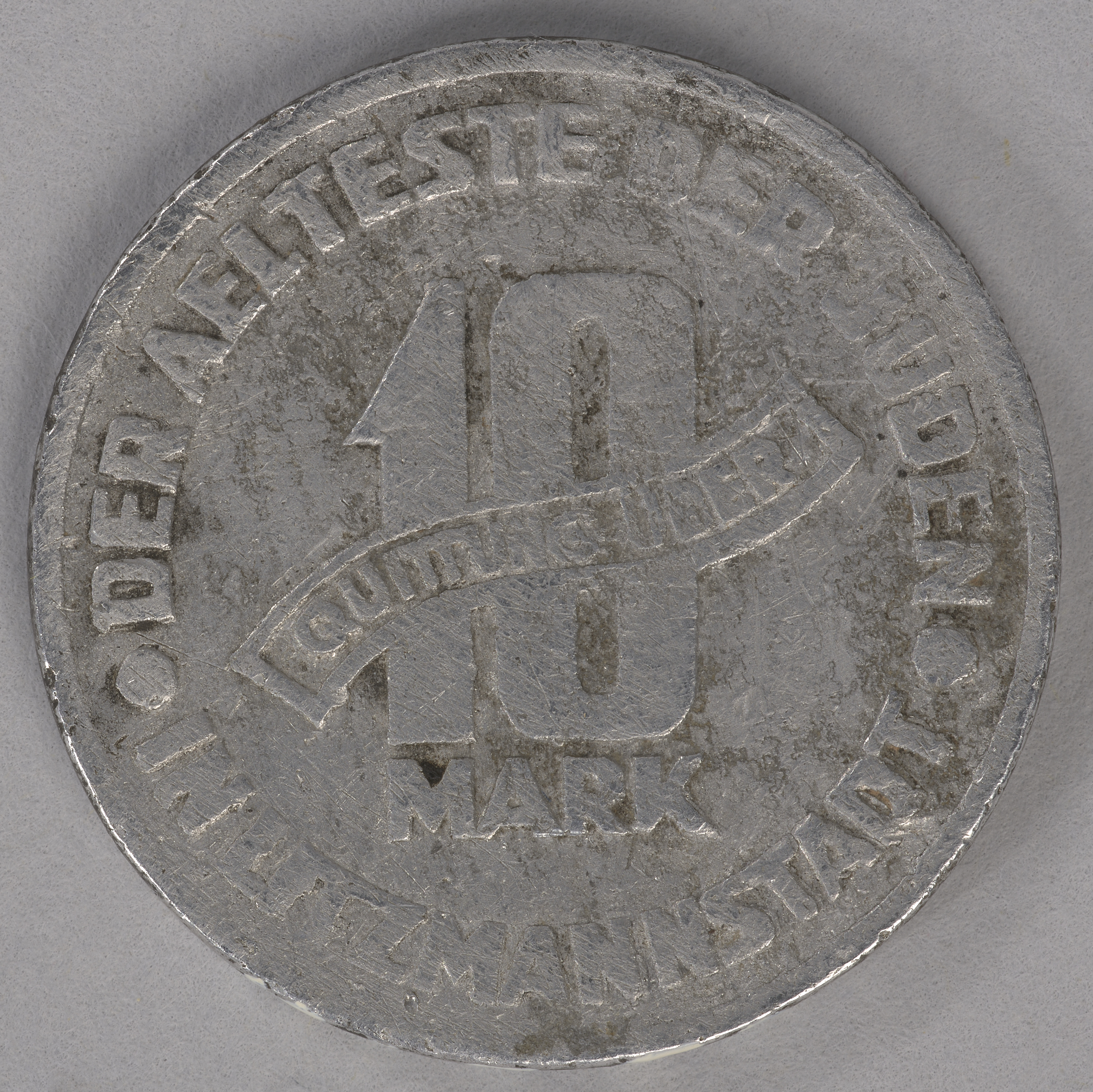
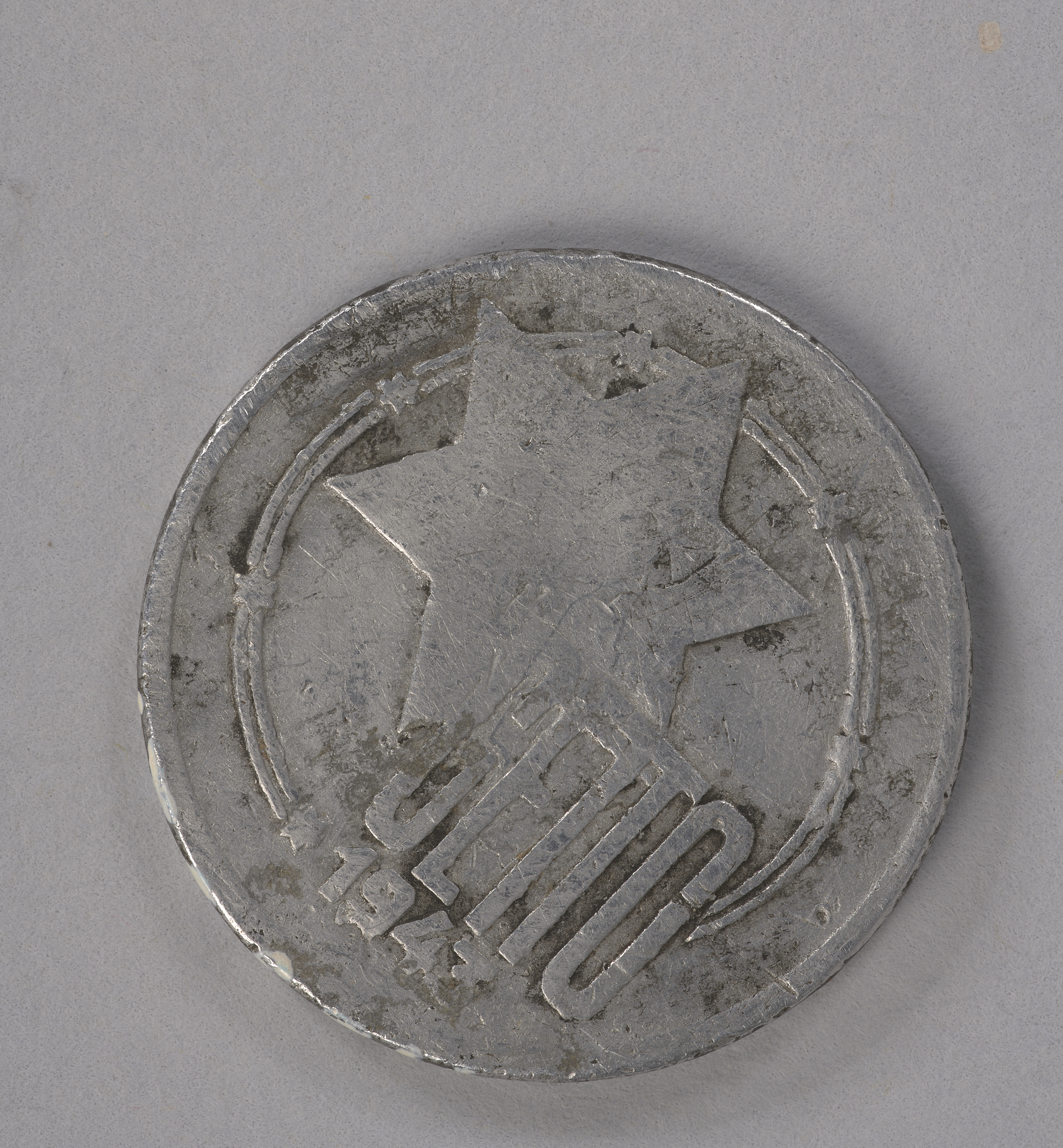
In the ghetto, banknotes were printed and coins of various denominations were minted. In the collection of the District Museum in Leszno, a divisional currency with a denomination of 10 marks is preserved. On the obverse – in a double surround punctuated by six six-pointed stars – there is a drawing of a Shield of David with an inscription partly overlapping it: "GHETTO". Below the inscription is the date of issuance: "1943". On the reverse, the central part indicates the denomination: "10/ MARKS". The number 10 is accompanied by a wavy ribbon with the inscription in German: "RECEIPT OF ACCEPTANCE". The issuer of the currency produced in the ghetto is indicated within the surround: "HEAD OF THE JEWISH COUNCIL OF ELDERS IN ŁÓDŹ". The coin has a flat die and a smooth edge. It remained in circulation until the final liquidation of the Łódź Ghetto in August 1944.
The coin was acquired for the collection in 1997 from a private collector in Leszno, Włodzimierz Janicki.
Dariusz Czwojdrak