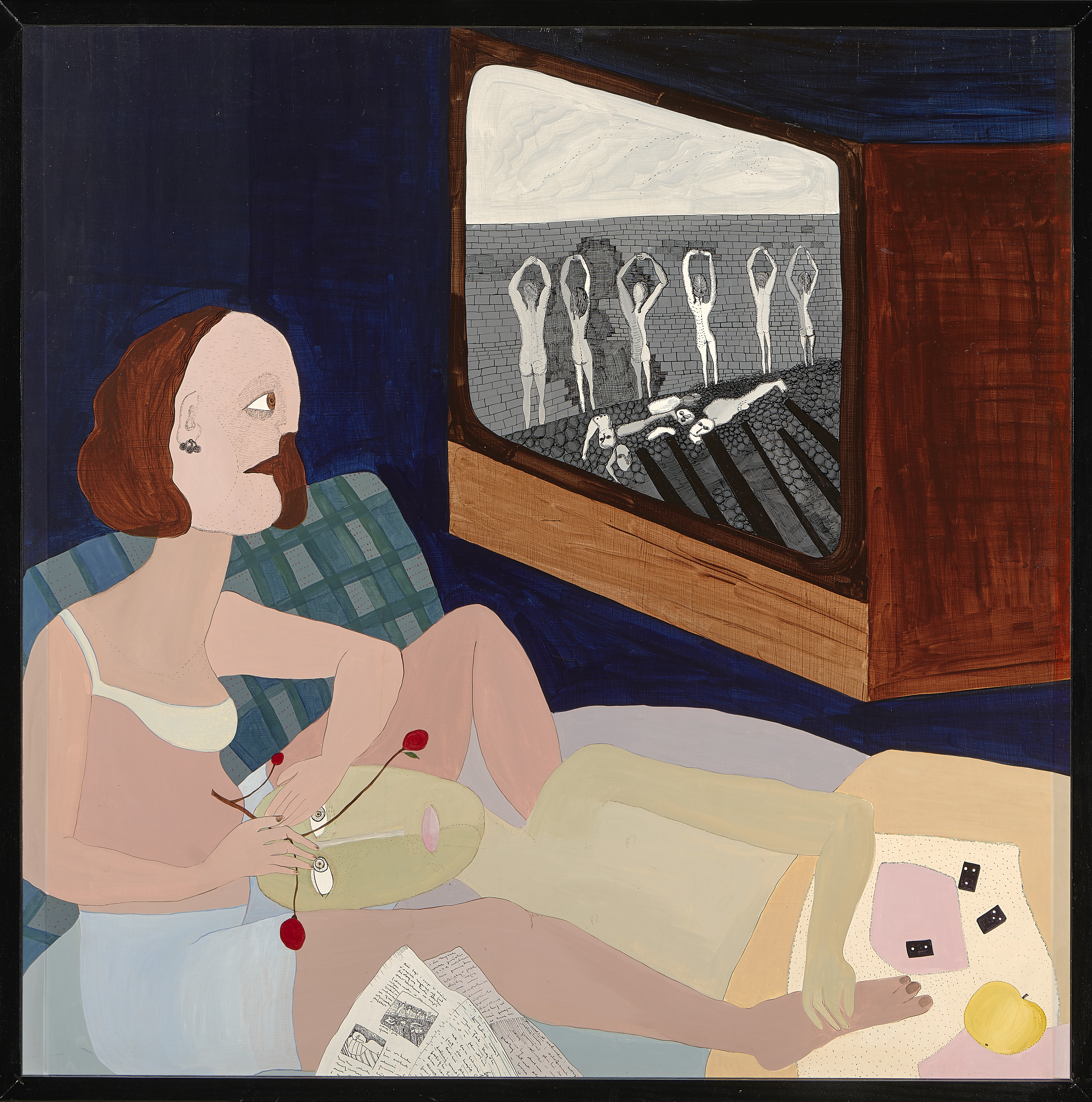
In 1970 I painted Execution, the work that initiated my series of compositions featuring the television screen,” wrote Ewa Kuryluk. “Through these paintings I wanted to express the transformation taking place in the way we perceive and experience the world today — a world that, at the push of a button, intrudes into the four walls of our intimate everyday life. Execution visually coexists with a couple lying in bed; it becomes the backdrop to their private life, contrasts with it, and determines its emotional tone. Two spatially and temporally distant aspects of reality are brought within arm’s reach of one another. Implicitly, the scene may also be reversed — to the dying there appears an act of love” (E. Kuryluk, Hyperrealism – New Realism, Warsaw 1979, p. 189).
The “Screens” series marked a new stage in Ewa Kuryluk’s artistic practice. Painted in acrylic — a medium the artist discovered during her second year at the Academy of Fine Arts in Warsaw — on fibreboard panels and enclosed behind glass, these reflective images present figures and objects subjected to cool observation. Photographs and the television screen, despite the appearance of separation, intertwine with them: side by side, close together, inseparable.
Years later, she added: “Grotesque and macabre imagery reflected the years following my father’s death in 1967, when my brother Piotruś fell ill, the events of March 1968 unfolded, and I myself was struggling with asthma. At that time I painted hospitals, extermination camps, torture cells, executions, scenes from the ghetto; loneliness, fear, apocalypse. Yet I approached these subjects unconventionally — in the sharp colours of a flower-filled meadow, or by using the motif of the screen and the aggressive colours of television” (“‘Since childhood I have longed to trace a shadow.’ Ewa Kuryluk in conversation with Ola Wojtkiewicz”, Opcje, 2011, no. 1/2).
Gift of Ewa Kuryluk.
Renata Piątkowska