Hanukkah is the eight-day Festival of Lights, commemorating the victory of Judah Maccabee's insurgents over the Syrian army in 165 BCE. After the Jerusalem Temple had been cleansed of pagan worship and the altar had been rededicated, only one vessel containing the ritual oil used to light the tabernacle was found. Thanks to the miracle of the cruse of oil, as tradition tells, the oil lasted for eight days, until a new batch could be produced. During Hanukkah, one more candle is lit each day in an eight-branched candelabrum called a hanukkiah, which is placed in the windows or in front of the doors of Jewish homes. The candles are lit by the eldest male in the family. During the holiday, one should not work or even study Torah. Fasting is also forbidden (A. Unterman, Żydzi. Wiara i życie, Lodz 1989, pp. 223-225).
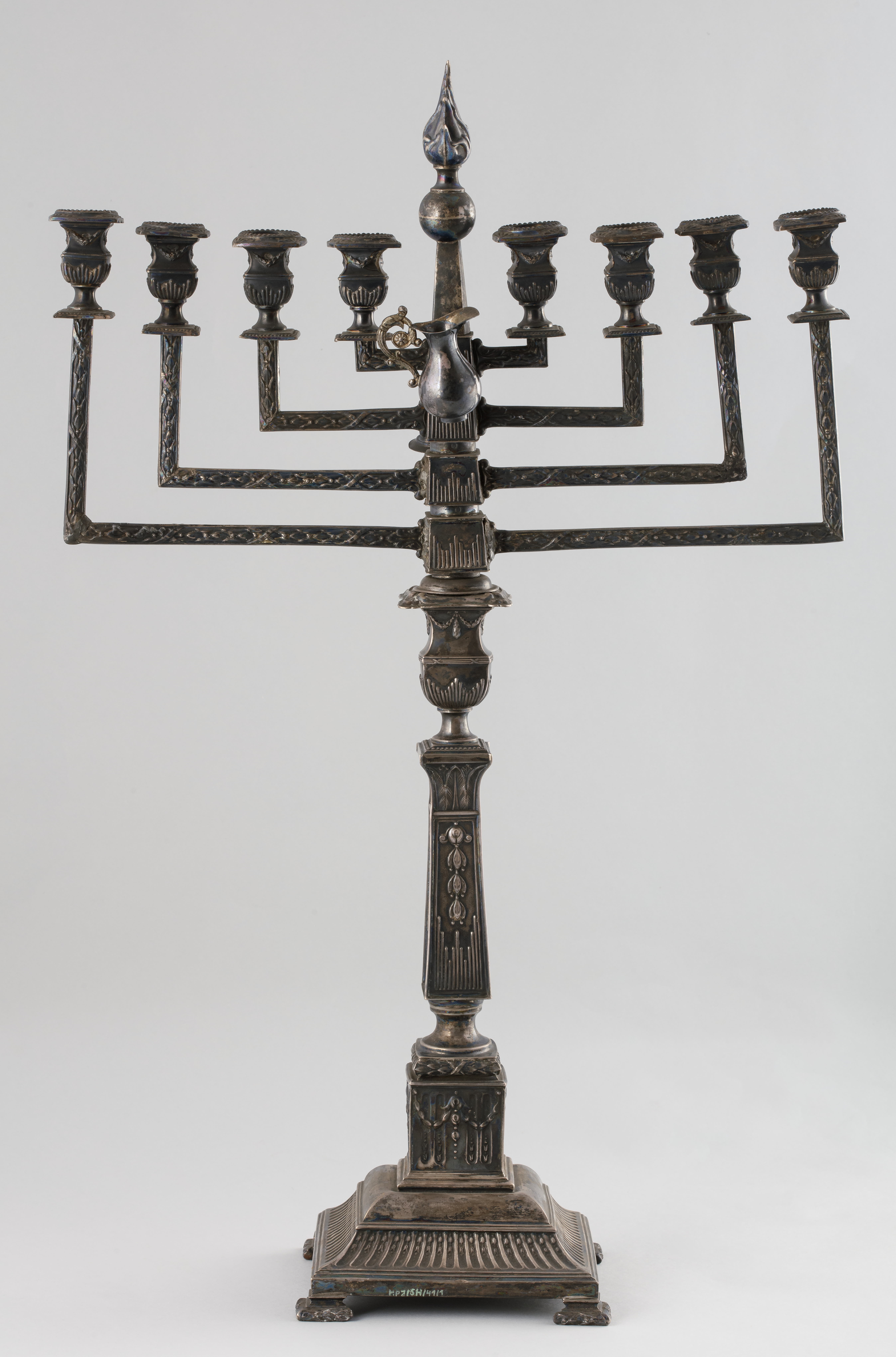
The Hanukkah lamp from the collection of the Przypkowski Museum in Jędrzejów is
supported by four cube-shaped legs. It has a square, contoured and embossed base. On the base there is a tall pedestal adorned with festoons. The shaft is in the form of a column with decorations featuring a floral motif, on which there is a cup decorated with festoons. The conical top of the lamp has four movable segments, each of which is attached to two branches bent at right angles. The branches are adorned with vase-shaped sleeves decorated with festoons. The whole lamp is topped with a sphere with a flame. An additional oil burner (shamash) is suspended from the front, and on the other side there is a small jug for pouring oil.
The item is marked with round signature marks "PŁ", head in a kokoshnik, and oval head in a kokoshnik, purity mark of "84".
These types of Hanukkah candlesticks with a columnar shaft and with classical motifs were quite popular among Warsaw goldsmiths of the interwar period.
The candlestick was purchased for the collection of the Jędrzejów Museum from Zofia Makomaska of Warsaw.