Before 1939, there were thousands of synagogues and Jewish houses of prayer in Poland. Each of these sites held at least one scroll of the Torah – the most important book of Judaism.
Each copy of the Torah is transcribed by a highly skilled scribe (Hebrew: sofer) on scrolls of parchment that are fixed on wooden rollers. (Read an article about the Torah: https://sztetl.org.pl/pl/slownik/tora; see objects from the POLIN Museum collection under the category , "Torah Scrolls in the POLIN Museum Collection").
During the Second World War, many synagogues were demolished, vandalised and desecrated. The Germans often burned their equipment, including Torah scrolls and other books. They also handed some of them to the Institute for German Work in the East, which carried out pseudo-scientific anthropological-ethnographic research.
The property of the murdered Jews that was not destroyed in the fire, ended up in various hands, including those of the Polish inhabitants. There were also cases of graves being dug up in cemeteries where, according to Jewish tradition, damaged Torah scrolls had previously been buried.
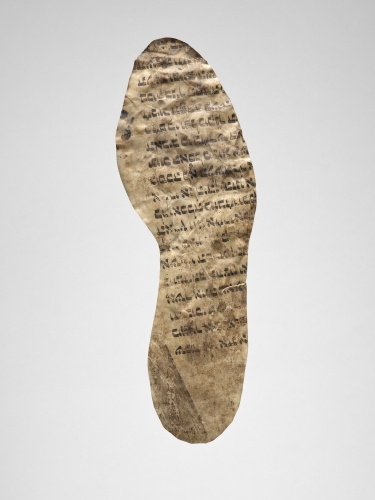
Such practice is evidenced by the objects made from Torah fragments. The album "Męczeństwo, walka, zagłada Żydów w Polsce 1939–1945" features photographs of the Torah used to line the shoes of a German soldier. In 2011, portraits of a Wehrmacht officer and his wife were found in Tübingen, Germany. It turned out that they have been painted on fragments of a Torah scroll.
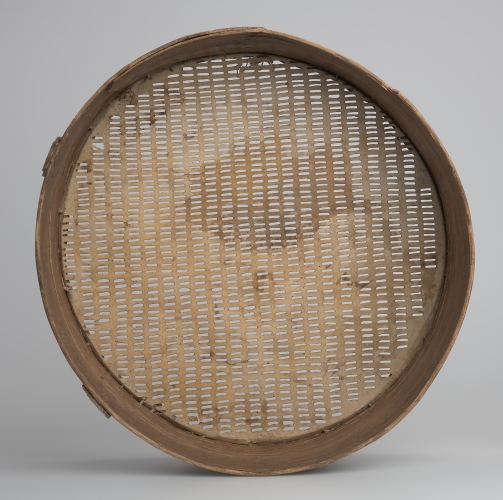
At the end of the Second World War or in the first years afterwards, the Torah was used in Brzeziny to make clogs. The well-tanned leather was also used to line shoes in Tykocin and as a shoemaker's pattern in Bialystok. It was sometimes used to bind the spines of books and to make playing cards.
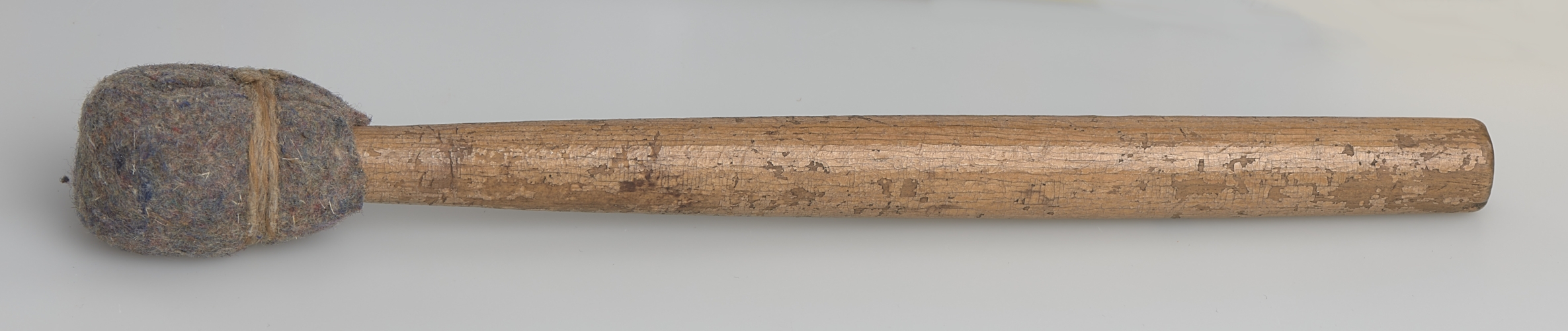
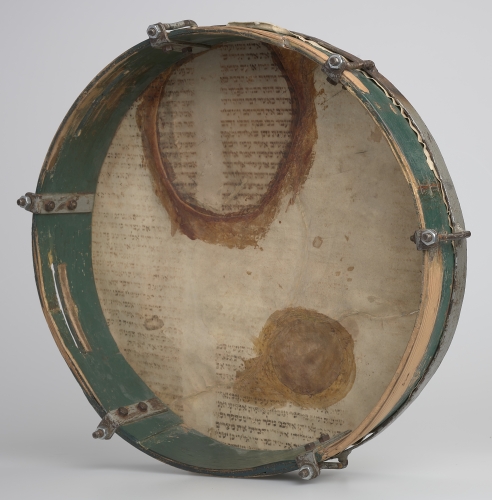
Some folk music bands used drums membranes of which were made of parchment Torah scrolls. In Skarszewy, Torah was used as a layer between the mattress and the bed springs. In 1945, a Maleniec resident lined a found helmet with a Torah fragment. The Pyzdry Land Museum in Pyzdry has in its collection artefacts made of Torah: seals from a car workshop and a fence for a hen's nest.
According to Jewish tradition, a damaged Torah scroll should be buried in a cemetery with proper funeral ceremonies. The POLIN Museum of the History of Polish Jews, in agreement with the Chief Rabbi of Poland Michael Schudrich has included several artefacts made from the Torah scrolls in its collections, treating them as artefacts bearing witness to the Holocaust and its aftermath.
Krzysztof Bielawski
Literature:
A. Bieberstein, Zagłada Żydów w Krakowie, Kraków-Wrocław 1986.
K. Bielawski, 'Tora na metry', Miasteczko Poznań 2018, no. 1.
A. Bieńkowski, Sprzedana muzyka, Wołowiec 2007.
A. Rutkowski, Męczeństwo, walka, zagłada Żydów w Polsce 1939–1945, Warszawa 1960.
J. Tokarska-Bakir, Okrzyki pogromowe. Szkice z antropologii historycznej Polski lat 1939–1946, Wołowiec 2012.