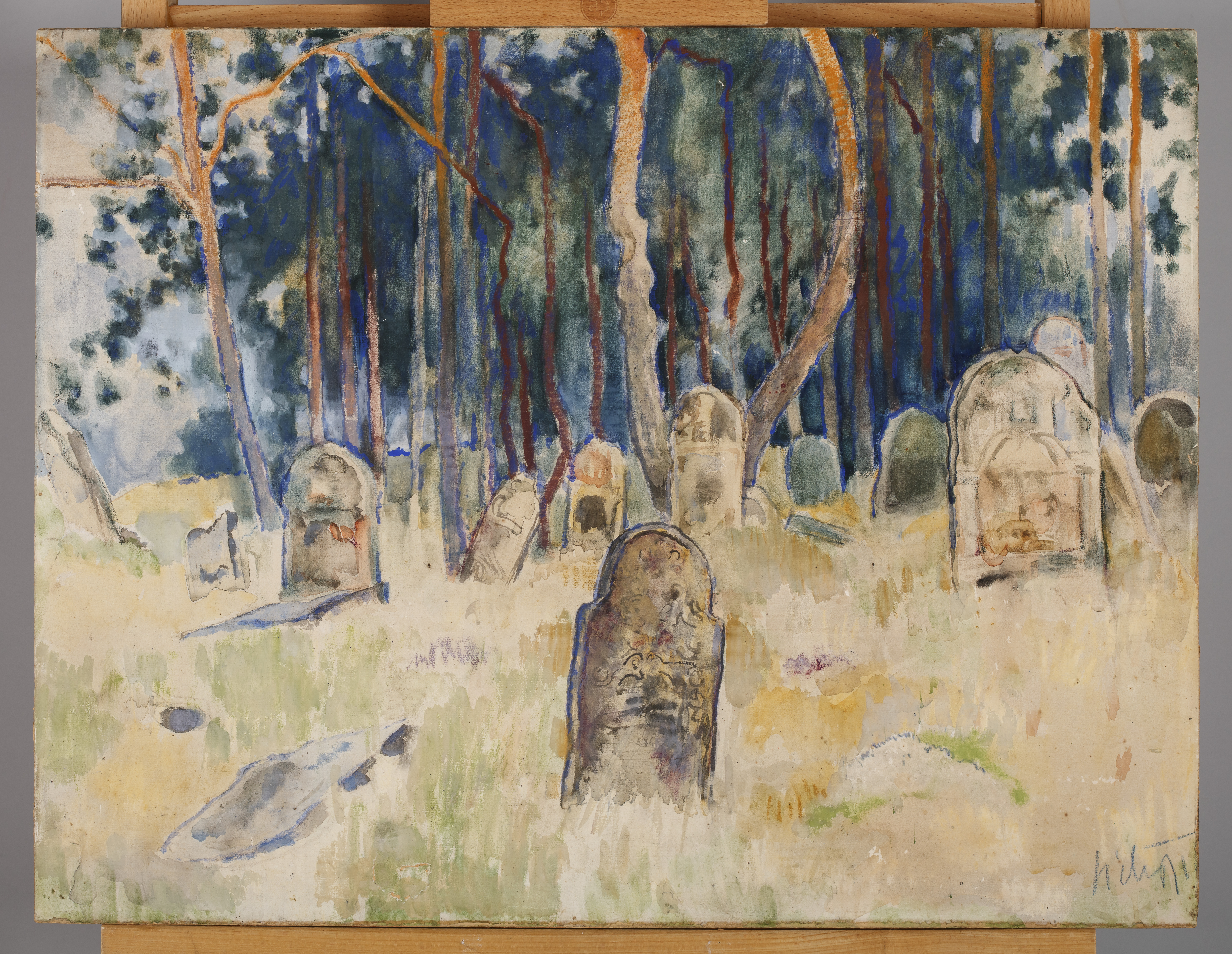
This work from 1933 (gouache, cardboard, 47 x 61 cm) was made using the gouache technique. Gouache is a water-based paint which, thanks to the addition of chalk or zinc or lead white, has covering properties. Due to this technique, the artist achieved a more intense colour.
Sichulski presented a fragment of the Jewish cemetery in Czerniawy (near Kazimierz Dolny). In the foreground, there is a centrally placed matzeva, i.e. a tombstone stele. The remaining matzevot are placed in the background against the background of the forest and are partially immersed in the grass, which has turned yellow and green. The tombstones are topped with a semicircle, each covered in bas-relief. Although they are not legible, they are known to have symbolic content. The matzeva on the right has an architectural form with clearly marked columns. Some tombstones are placed vertically in the ground, others are tilted or overturned, which would indicate that the site is semi-abandoned. Additionally, the character of the cemetery is emphasised by tall grass around the matzevot. The background is a forest. Thin tree trunks set the rhythm, only two centrally placed trees have thicker trunks, and one of them is arched. They stand out clearly from the fairly uniform forest in the background. The whole picture is kept in yellow-green-blue tones, but the work is divided horizontally into two parts and the lower one is much lighter than the upper one. Signature at the bottom right: "Sichulski".
Kazimierz Sichulski (1879–1942) – painter, caricaturist, illustrator and graphic artist, professor at the Academy of Fine Arts in Kraków. A representative of the folkloric art trend of Young Poland and co-founder of the cabaret Zielony Balonik from Kraków. The work Jewish cemetery in Czerniawy is associated with the artist's stay in Kazimierz Dolny in the 1930s.
The Jewish cemetery in Czerniawy was established in 1851 and was completely devastated at the beginning of World War II. The Jews from Kazimierz were forced by the occupiers to take historic matzevot out and pave the area around the Reformed Fathers' monastery with them, which, during the war, housed a prison and Gestapo headquarters. In the 1930s, excavation of tombstones started, some of which have survived in good condition. A monument resembling the Jerusalem Wailing Wall was built from the recovered matzevot at the cemetery in Czerniawy.