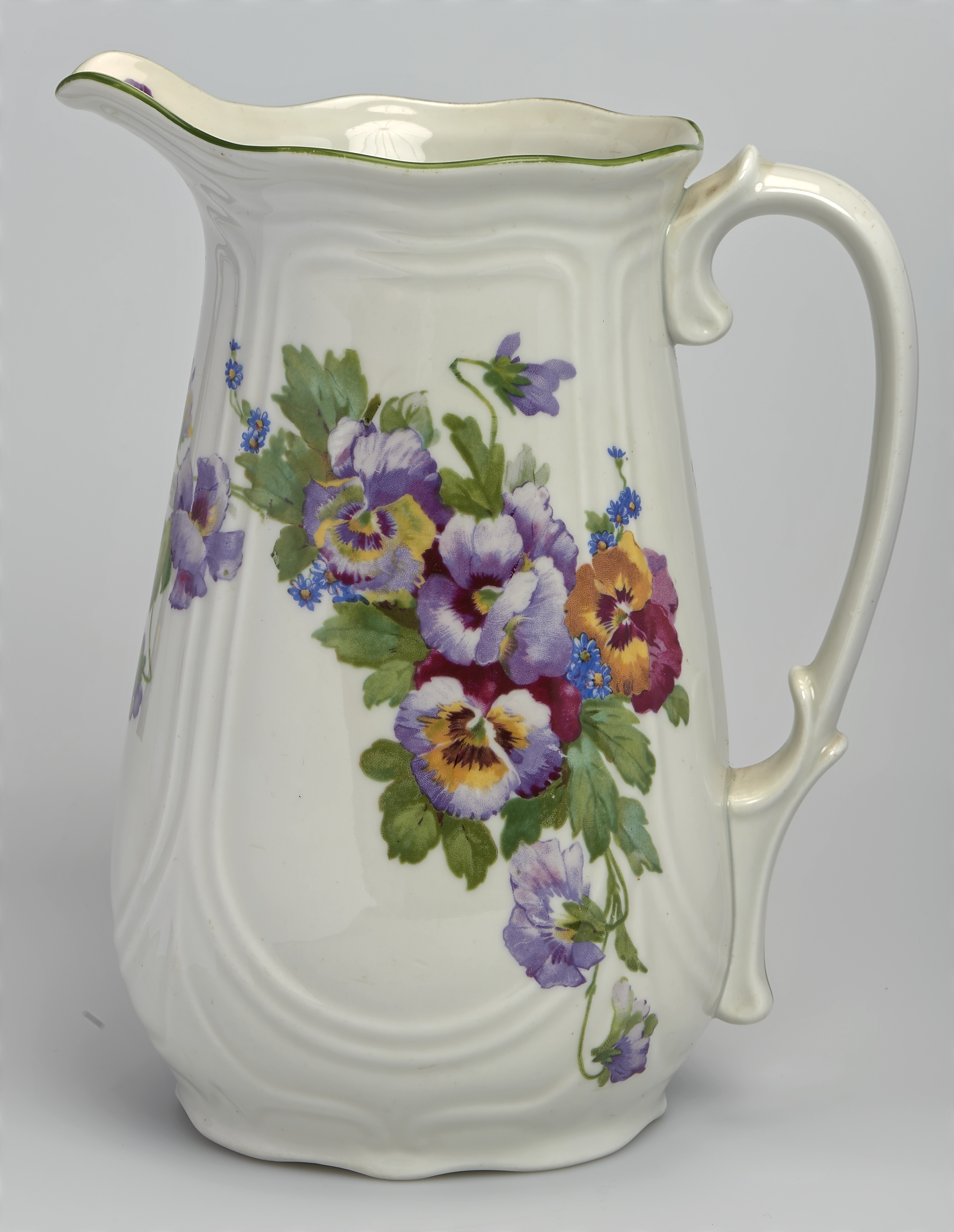
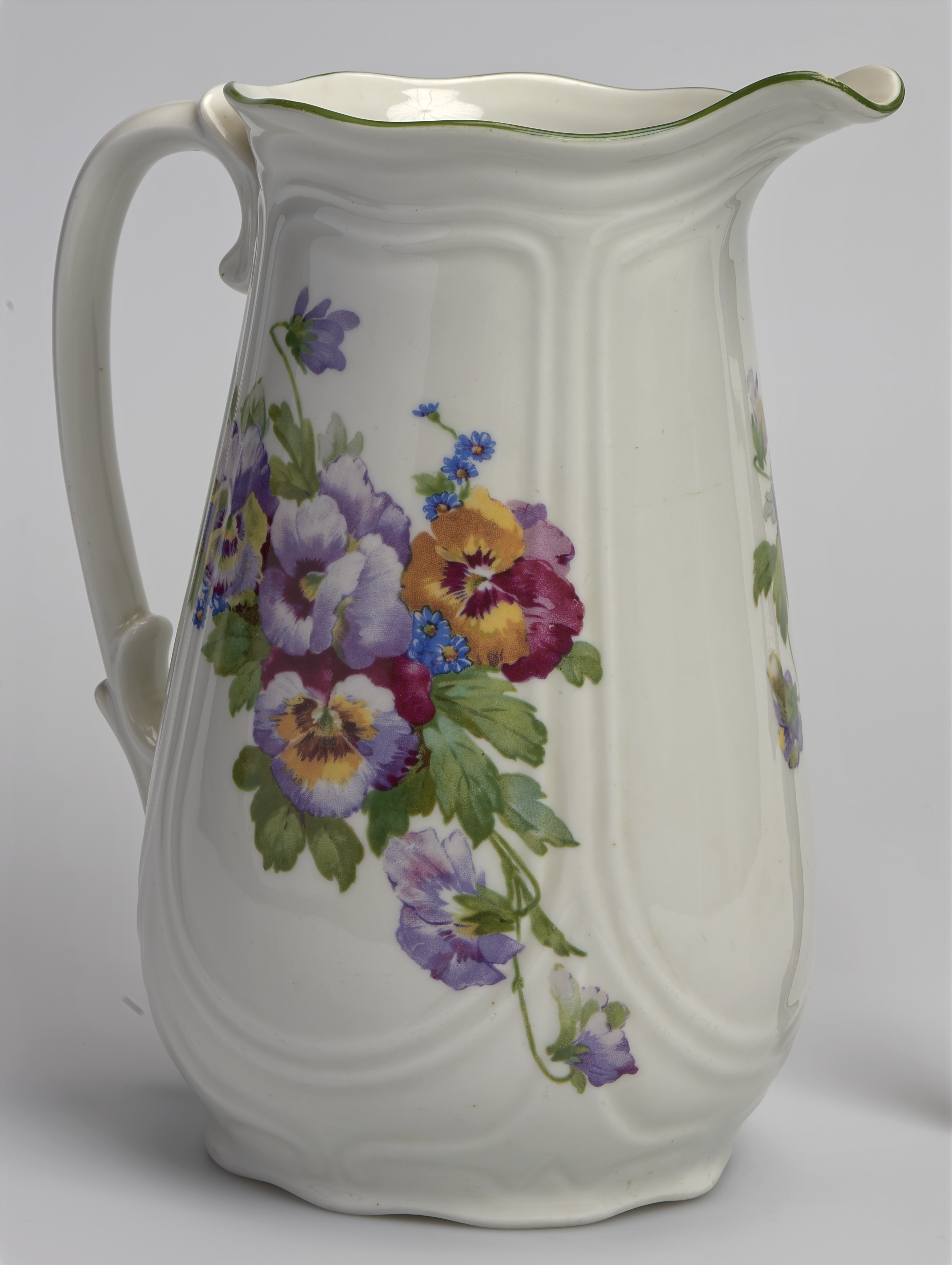
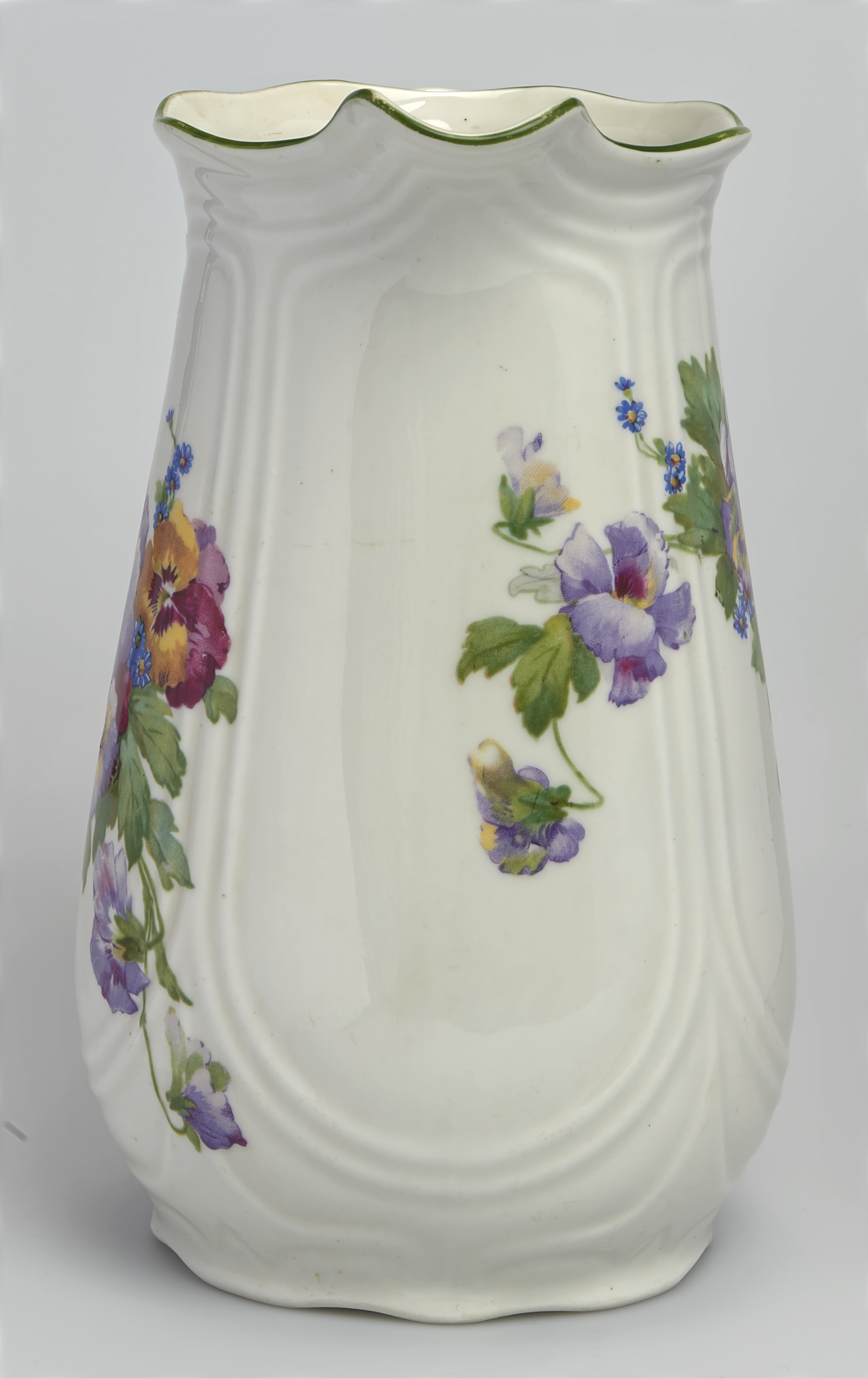
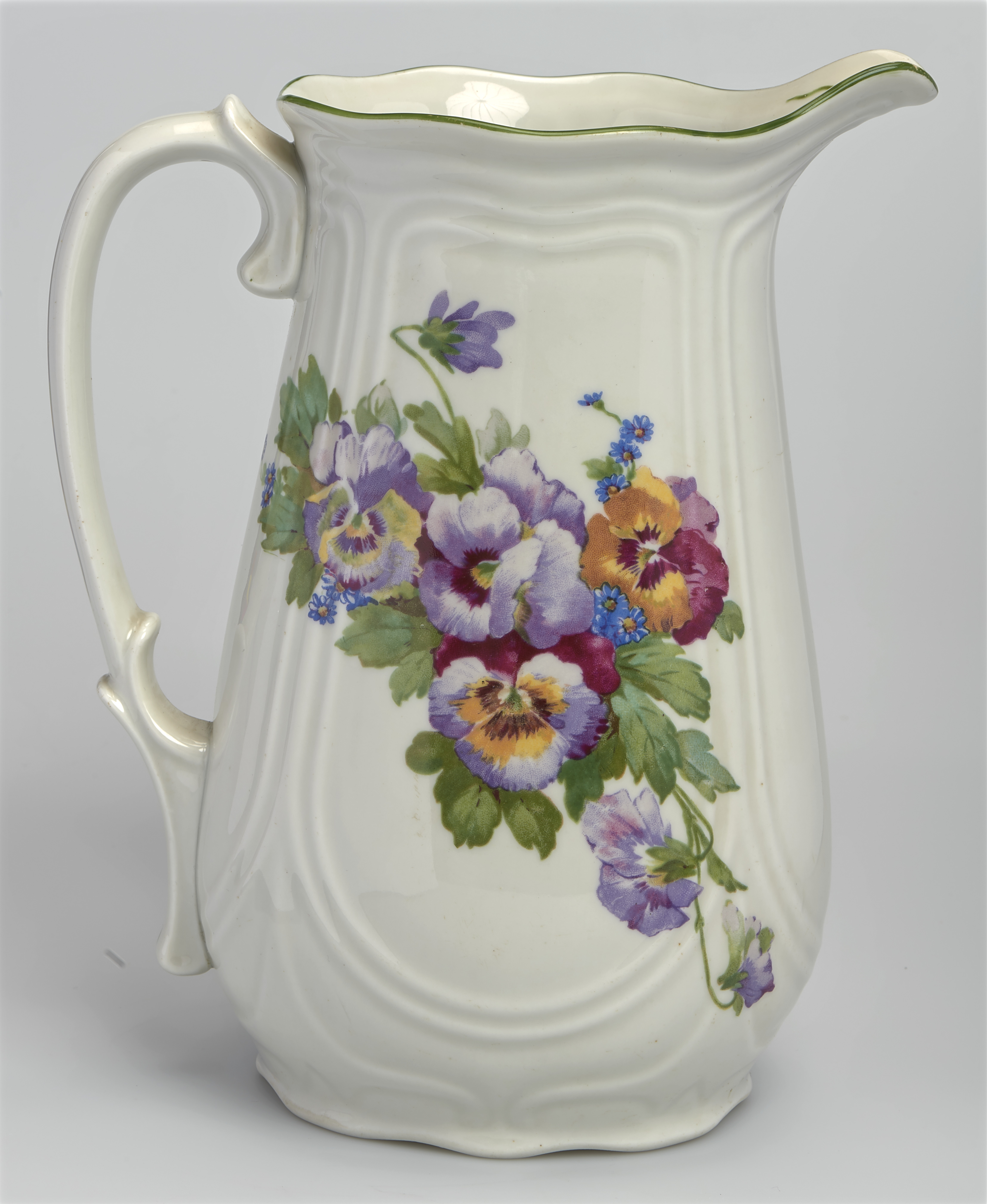
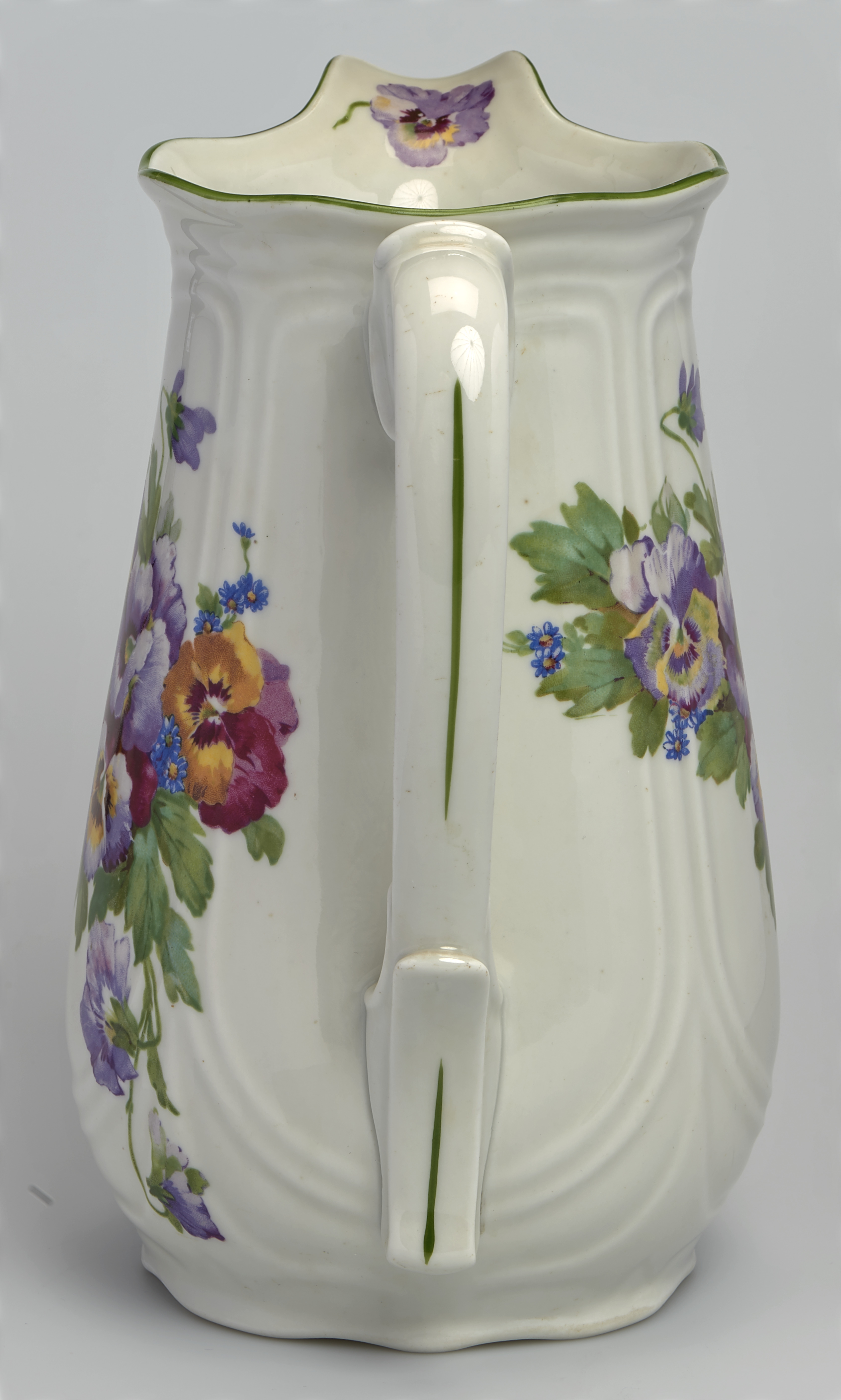
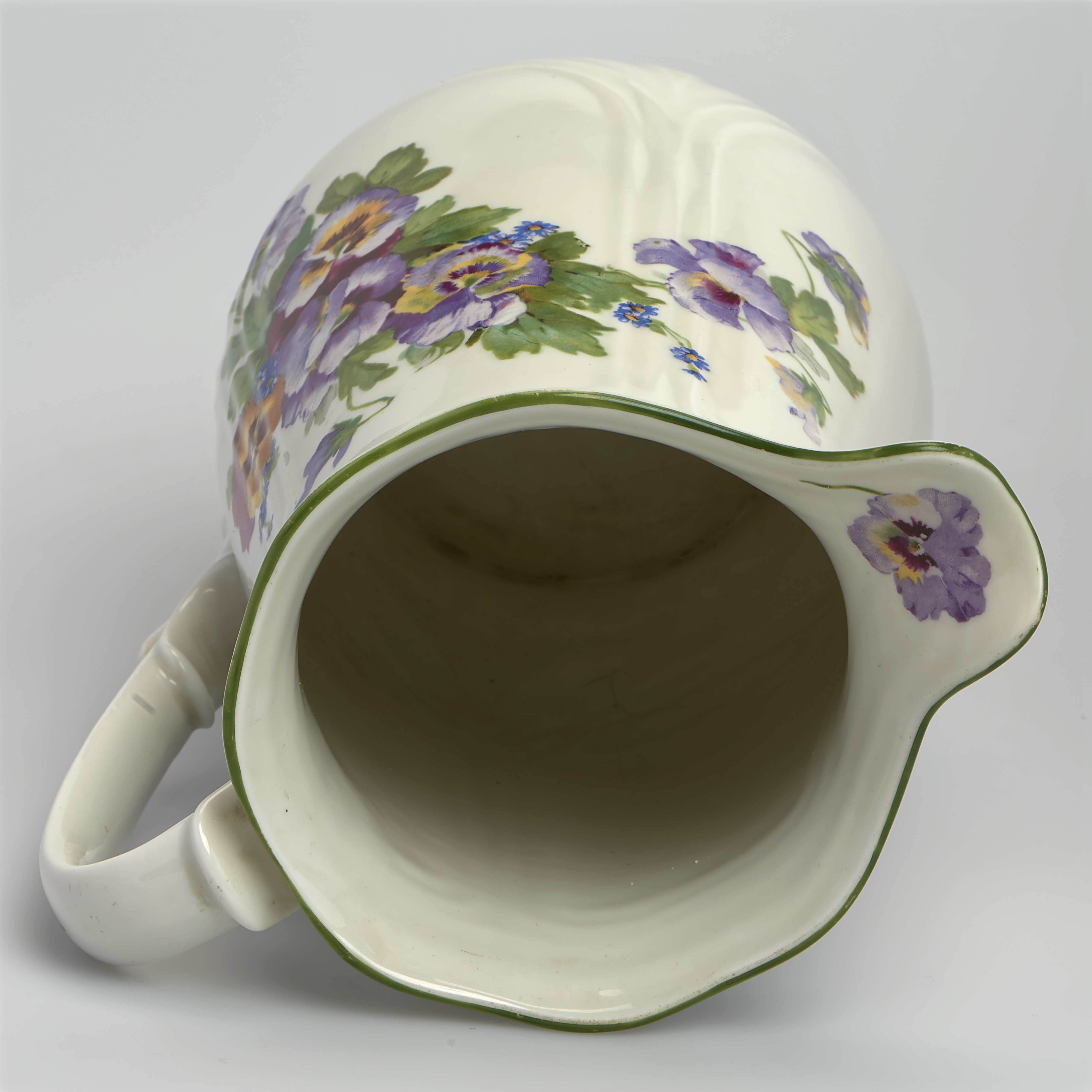
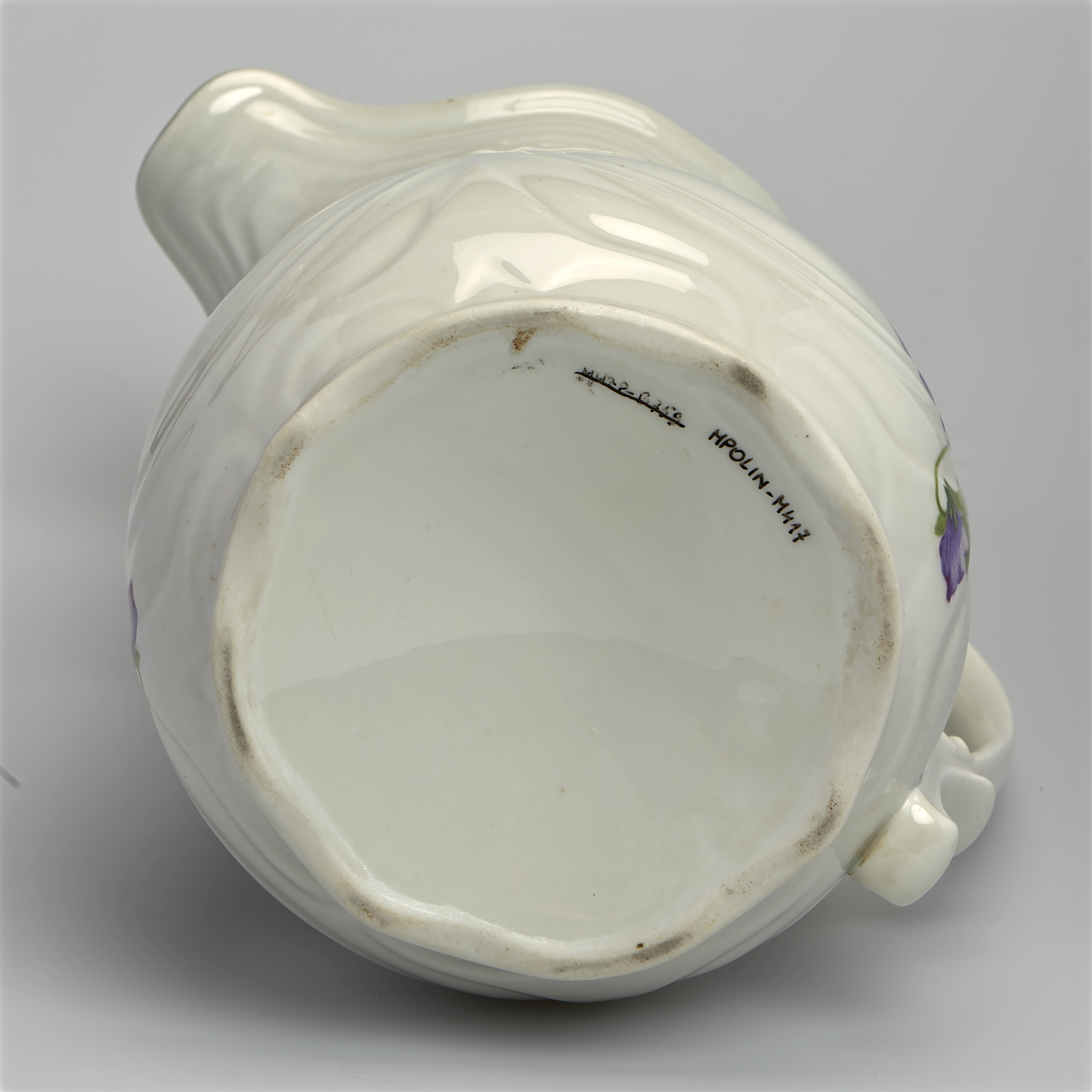
A faience water jug, decorated with a floral motif. Vessel with a cylindrical and slightly tapering belly, a separate foot and a regular spout edge. The handle, narrower at the bottom and widening towards the spout edge, is parallel to the belly and taped. The jug is decorated with an application – violet and yellow flowers, leaves that make up their background – on both sides of the belly, halfway up. A single flower can also be seen in the centre of the jug spout. The entire spout edge is decorated with a green line. An additional decoration of the jug is the belly grooving which, running from the bottom to the spout, divides the belly into four fields; the fields separated by the grooving are not consistent with the flower application.
The jar was found by Kazimierz Sopała’s father; the former donated it to the Museum’s collection. According to the donor’s testimony, after the Jews were displaced from the city, his father brought home a chest with tableware he had found in one of the abandoned houses in the former Jewish ghetto. The jug functioned in the Sopałas’ home as a memento (a kind of “relic”) of the Jewish community, which had been “erased” from the local landscape. it was not allowed to use the vessel.
The history of the jug is one of many similar testimonies of the Poles’ peculiar attitude towards the former Jewish items: their tabooisation. That attitude combined the need to preserve the memory of the former owners of the objects with the fear of a different culture and awareness of dealing with someone else’s property: thus, they constituted a sort of “taboo”.
In the interwar period, Jews accounted for approx. 25% of the population of Jasło. In 1938, it was a total of 2,639 people who lived in 290 houses. Most of the local Jewish population was engaged in trade. Out of 197 shops operating in Jasło, 148 were run by Jews. In addition to trade, the inhabitants of the Mosaic faith also dealt with gastronomy (19 restaurants and taverns), ran enterprises of various sizes (brickyards, sawmills, transport companies, shoemaking and tailor workshops). Most of Jasło’s Jewish intelligentsia were lawyers. During the Second Polish Republic, Jasło had the Great Synagogue, the old synagogue (a “bożnica/bóżnica”; the so-called “old house of prayer”), four houses of prayer, two cheders and two mikvaot. Several associations and fraternities operated in the area. There was also a communal Talmud-Torah religious school attended by the poorest children. In 1924, the Makabi Jasło sports club was established.
The decline of the Jewish community of Jasło began as early as the first weeks of World War II, when German troops entered the city. At the end of September 1939, on the Yom Kippur holiday, German soldiers blew up the Great Synagogue. The Jewish ghetto was established in the town in the spring of 1942 and liquidated in December of that same year. Jews who were still alive were sent to the ghetto in Rzeszów.
Jasło was destroyed to an extent of approx. 90% during World War II. Of all the buildings once belonging to the Jewish community, only the cemetery and the former mikveh (https://sztetl.org.pl/en/tradycja-i-kultura-zydowska/tradycja-i-kuchnia/kilka-slow-o-mykwie) have survived.
MF