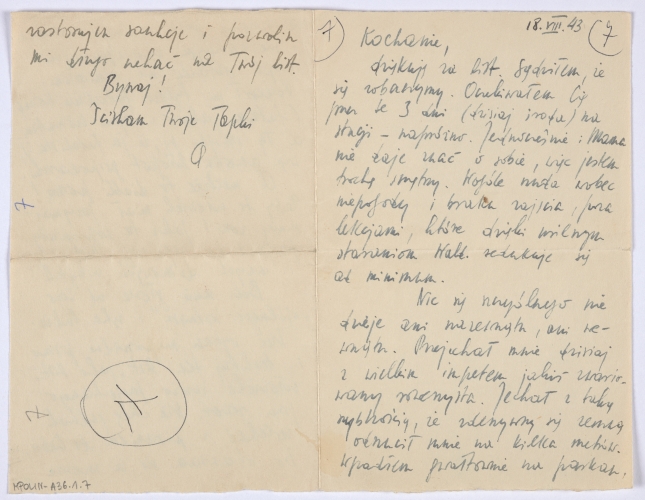
The POLIN Museum's collection contains 8 letters from mid-1943, written by Arnold Majorek (1919-1960), a Jew hiding under the name Jan Andrzej Masłowski at the time (for more on the author of the letters and his family, see the note to his obituary). The letters were addressed to a friend, Irena Rybczyńska (after the war Rybczyńska-Holland), who donated them to the POLIN Museum collection in 2014 (along with them, she donated the labels made by Majorek for Western brands of perfumes apparently forged by his wartime employer).
The letters, with the exception of the last one, were written by Arnold Majorek from Chylice, near Warsaw, where he worked for Mr Miszczak (we do not know his first name) as his son's guardian. He got the job thanks to another friend, Krystyna Ostrowska (see https://sprawiedliwi.org.pl/pl/historie-pomocy/historia-pomocy-rodzina-ostrowskich-0, accessed 8.11.2021). Miszczak, as Irena Rybczyńska-Holland emphasised during the handing over of the archives, most likely knew or guessed that Majorek had Jewish roots, so the letters are a contribution to the history of helping Jews during the Holocaust. As befits a contribution, they nuance the knowledge of how Jews function 'on the surface' and the circumstances in which aid was rendered. The letters portray Majorek's situation in a wide array of psychological complications. His surroundings irk him, he feels simply wrong in Chylice, being drawn in the troubles of the family for whom he works as a guardian. At the same time, it does not seem (the author does not go into detail in his accounts) that the problems experienced during his stay in Chylice could have resulted in his deconspiration, and thus they weren't actually dangerous for Majorek. They were distressing as, in his words, 'the misery of life', compounded by the wellbeing issues resulting from the condition of being a Jew in hiding. It should be emphasised that although Majorek is sarcastic, he by no means formulates any accusations against the parents of his protégé (apart from the last letter; however, we know that the situation described in this last letter, that of waiting for commissioned wor, also had a good ending, i.e., actual employment, as evidenced by the labels in the collections).
In two letters, the author clearly vents his experiences of his origins and having to live in hiding. In the second letter, he poignantly sketches a picture of "a man who is denied the right to life." At the end of the third letter, however, he mentions of, among other things, "a desperate, helpless fear for the lives of loved ones, closest ones" what means, as we can guess, fear for his mother, Paulina née Gutman.
It seems, however, that above all these are letters showing, sometimes almost intimately, simply a young man living in those times. In their author, we can see 'simply' a twenty-odd man who already finished his education and has his personality developed (and higly intelligent, brilliant even), who was caught on the threshold of adulthood by the war. They provide an outline of a (self-)portrait of a certain part of Polish society. The reflection layer of the letters shines with social observations.
At the same time, the linguistic aspect is also strongly present in this document – we learn about the specific style of writing letters in these times. And not only writing, since, as people of the Enlightenment era already stated: "One does not have to write as one speaks, except in letters, which are the speech of those separated by a long distance" (recommendation and motto by Franciszek Bieńkowski, quoted after "Ludzie oświecenia o języku i stylu", edited by Z. Florczak, M.R. Mayenowa, vol. 1, Warsaw 1958, p. 45). Thus, Anek Majorek's letters to Irena Rybczyńska show what the "speech of those separated by a long distance" looked like in case of young people of the second quarter of the 20th century.
Przemysław Kaniecki