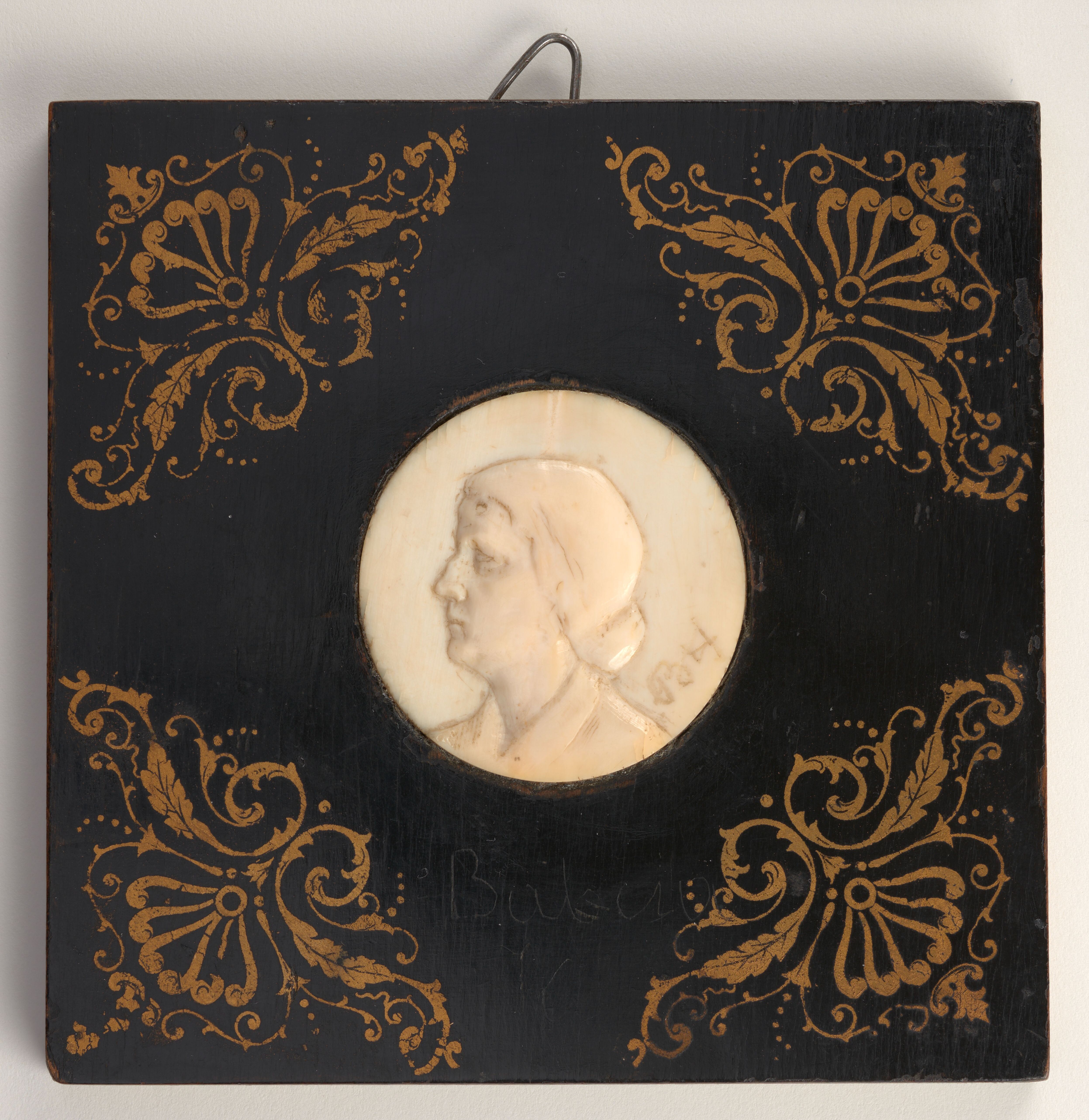
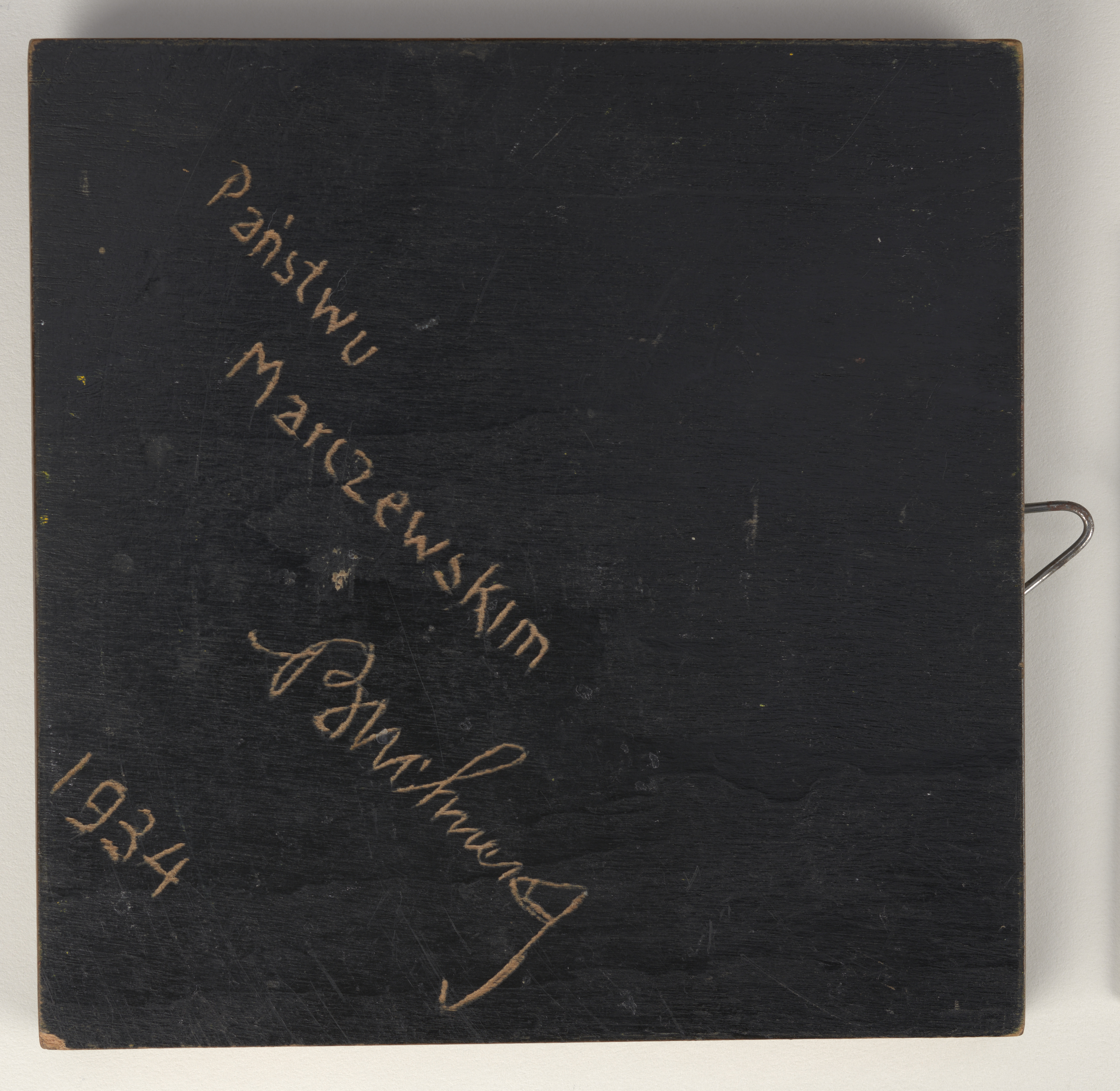
Ivory medallion in beige depicting a female bust. Below the bust is an engraved inscription in Polish: "Grandmother's". The inscription on the back says: "To Mr and Mrs Marczewski. Buchner. 1934".
A gift from Zygmunt Marczewski.
The donor, Zygmunt Marczewski, was born in the 1920s In Zawiercie. The medallion is a gift to Marczewski's mother from family friend Ignacy Icchak Buchner - a clerk, sculptor, designer of textile patterns for one of the factories in Zawiercie and an activist in the Zionist organisation. "He was a quiet and polite Jew. People respected and valued him. They admired his design." Marczewski's father, a director of one of the metal plant industry in Zawiercie, was friends with Buchner. "There was not a family celebration that we did not celebrate together. The Buchners were with us throughout my childhood. I always called him uncle, and years later I'm not even sure if his name was Maks." Marczewski does not remember on what occasion Buchner gave his mother a medallion in 1934. When the war broke out, the two families agreed that Mr and Mrs Buchner's only daughter would go to the Marczewskis' grandparents that lived outside the city. "Terrible news was reaching us... That is why we were stunned when the other day Buchner came to the village and took nine-year-old Dzidzia to the city. My father strongly urged him not to give up hiding his daughter, but he persisted. He claimed that he had spoken to the Germans and they had assured him that they were in no danger." Later, the Marczewski family learned that all the Buchners had been murdered. "We felt as if someone from our family had died. My parents were crying, and I was devastated... When I heard that the museum was looking for Jewish memorabilia, I didn't think twice. I immediately decided to show this medallion to others. Buchner deserved recognition and respect. Perhaps I could at least provide it for him in this way."
In 1940, Ignacy Icchak Buchner was appointed chairman of the Judenrat in Zawiercie. At the beginning of 1942, the Germans, through Moshe Merin, the chairman of the Judenrats in the Zagłębie, gave Buchner an order to draw up a list of sick Jews. Buchner refused. Merin was to pass this information on to the Germans, who arrested Buchner. He and his family were sent to Auschwitz-Birkenau, where they all were killed. Merin also did not survive the war, he was murdered during the Holocaust, in Zawiercie.
Natalia Różańska