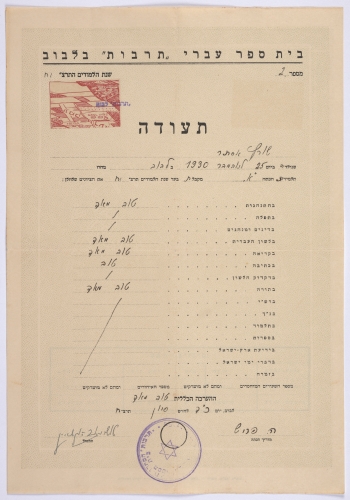
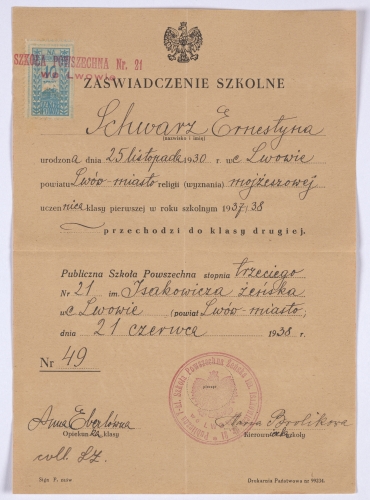
The collection of pre-war documents, memorabilia of the Schwarz family from Lviv, was preserved by Holocaust survivor Joachim Schwarz. His wife, Karolina née Samet, and their two children, Edgar (David) and Ernestyna (Ester), according to testimonies submitted to the Yad Vashem Institute, died in the Janowska camp in Lviv.
Joachim Schwarz fought in the ranks of the Home Army, being part of the 1st Company of the 40th IR. (J. Wegerski, W lwowskiej Armii Krajowej (In the Lviv Home Army), Warsaw 1989, pp. 147-148). During this time he met his future second wife. They married in September 1944. After the war they moved from Lwów, which was already within the USSR's borders, to Poland. While still in Poland, they had two children, Batia Schwarz and her brother. Eventually, the family emigrated to Israel.
Years later, Batia Schwarz Gilad recalled that her parents never told their children about their past. It was only during her first visit to Poland after emigrating that she managed to get more information about her family's pre-war fate. "In Warsaw I met someone like our "grandmother". I didn't know exactly what we had in common. During my meeting with her I heard the story for the first time, everything that was successfully tried to be hidden from us children" (B. Gilad, Dokumenty i pamięć drugiego pokolenia (Documents and Memory of the Second Generation), in: Pamięć i miejsce. Perspektywa społeczno-edukacyjna (The Memory and Place. The Socio-Educational Perspective), edited by M. Mendel and W. Theiss, Gdańsk 2019, p. 8).
After her mother's death in 2014, Batia Gilad found in her belongings a folder with pre-war documents of the Schwarz family. She and her brother donated them to the POLIN Museum.
The documents she found and the fragments of family history she heard inspired Batya Gilad to think about Jewish identity, memory and the obligation to preserve and tell history. "I took on this imperative. To research, find, know and tell. To immortalise not only by donating documents to the archives, but to bring to life the characters of the children, to leave them in the family so that they are not forgotten, so that they tell us what they went through as part of the fate of the Jewish people" (ibid., p. 9).
Maciej Wzorek