
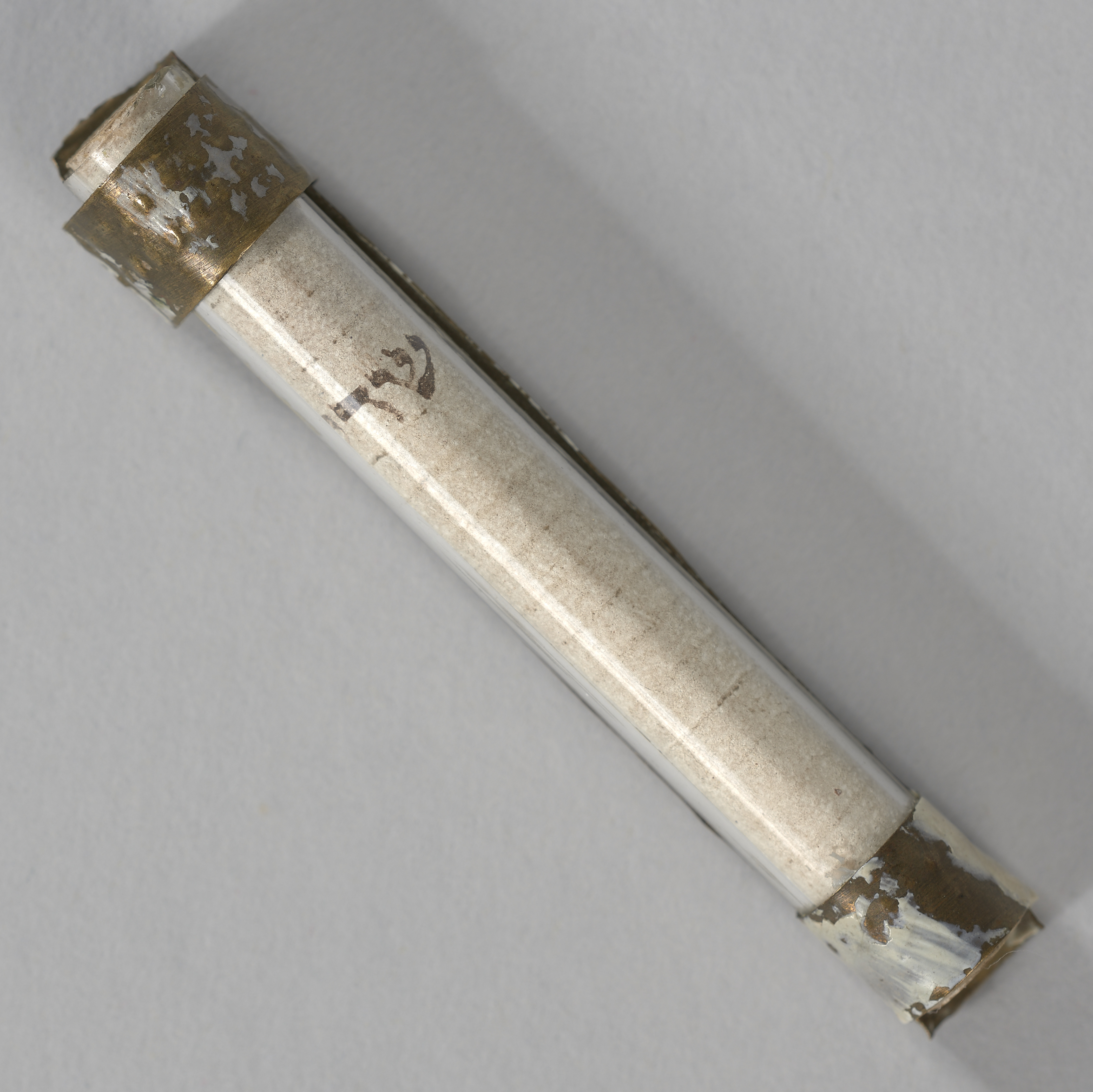
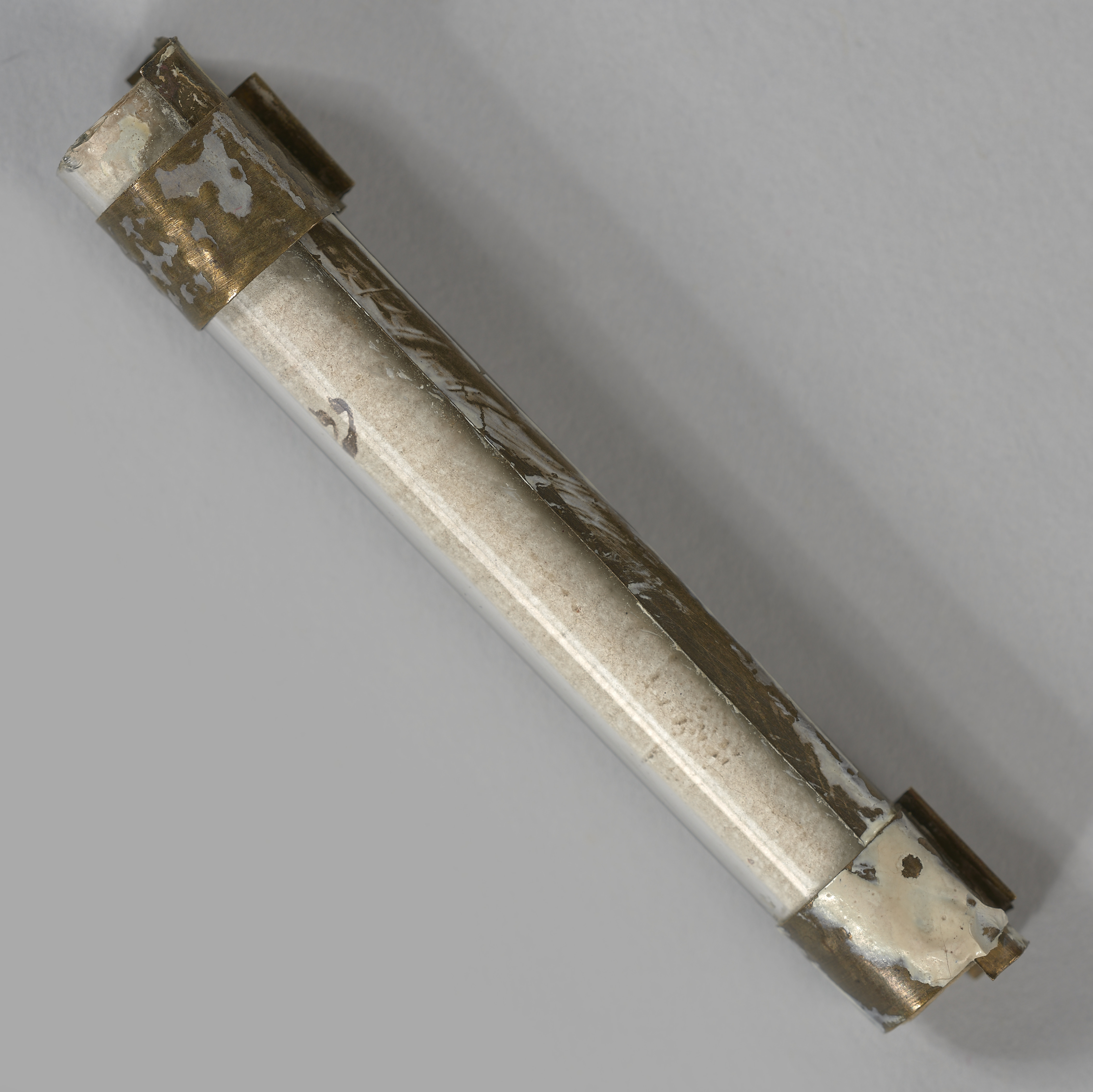
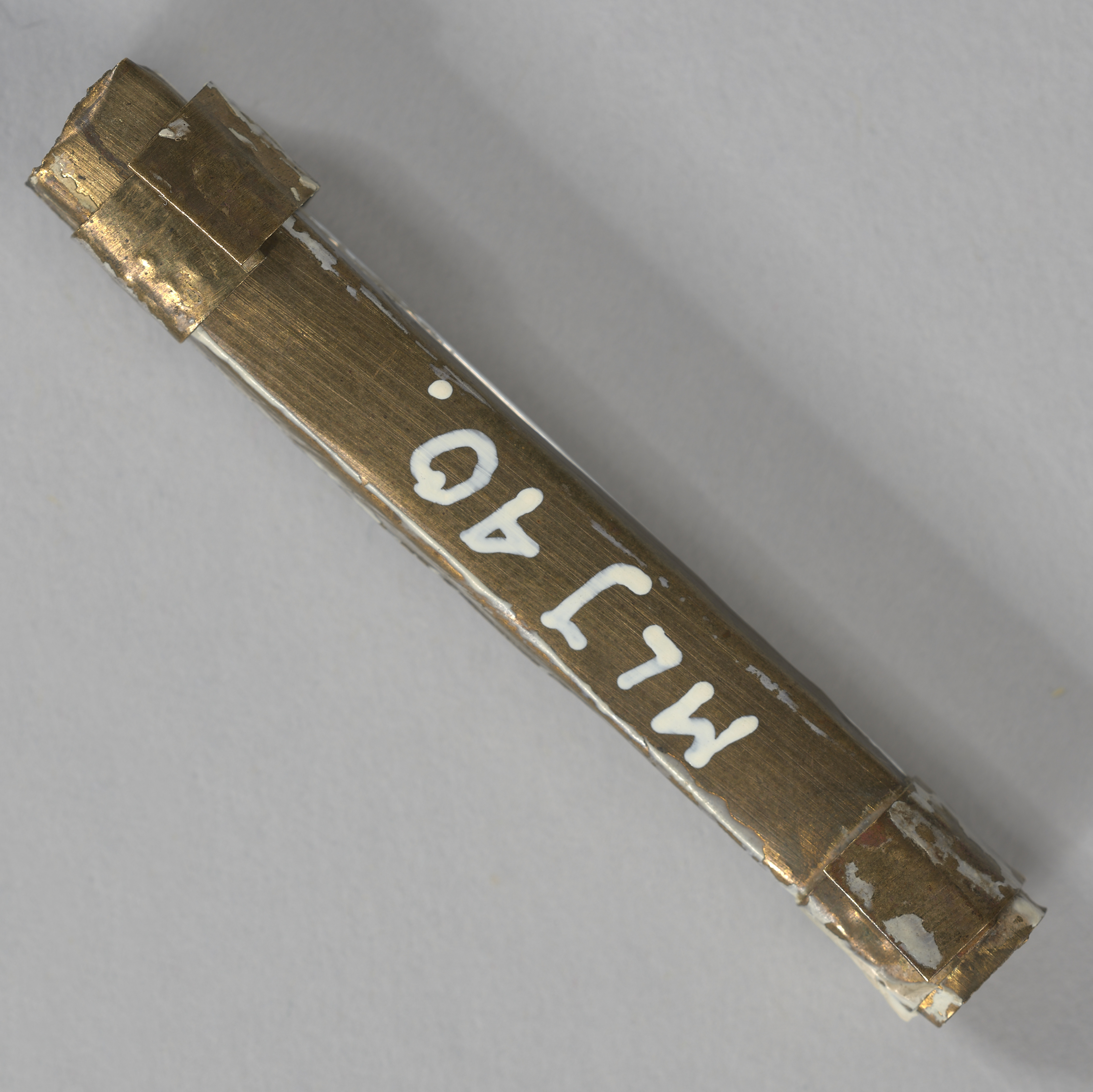
Mezuzah (Hebrew: door-frame) is a parchment scroll containing two portions of the Torah, including the text of the Shema Yisrael prayer (Hebrew: "Hear O Israel!"). It is placed in a case attached to the right doorpost. The biblical commandment to inscribe the name of God is found in the Deuteronomy. Devout Jews touch the mezuzah with their fingers when entering or exiting a home and then bring their fingers to their lips. This gesture serves as a reminder to refrain from sinning. Mezuzah is often regarded as a protective talisman. Miniature versions of mezuzahs are currently worn as amulets on neck chains (see A. Unterman, Żydzi. Wiara i życie, Lodz 1989, pp. 240-241; A. Unterman, Encyklopedia tradycji i legend żydowskich, Warsaw 1994, pp. 178–179).
Mezuzah cases are made from various materials. The parchment scrolls are placed in cases made of wood, bone, glass, silver, brass, or other metals.
Mezuzah in the collection of the District Museum in Leszno is a glass tube mounted on a strip of brass plate. Inside the tube, there is a parchment scroll in a square shape, with inscribed texts from the Deuteronomy (5 Book of Moses 6:4-9 and 11:13-21). On the reverse side of the parchment, the Hebrew word "El Shaddai" (Almighty) is placed. The text was handwritten in black ink and arranged in 22 lines. The parchment is lined, with small margins preserved on all sides.
The mezuzah was purchased in 1995 from Magdalena Kępska of Kłoda near Rydzyna. The owner could not indicate the origin of the object. It was said to have been passed on by one of the Jewish prisoners of the slave labour camp in Kłoda, which existed there from 1941 to 1943.
Dariusz Czwojdrak