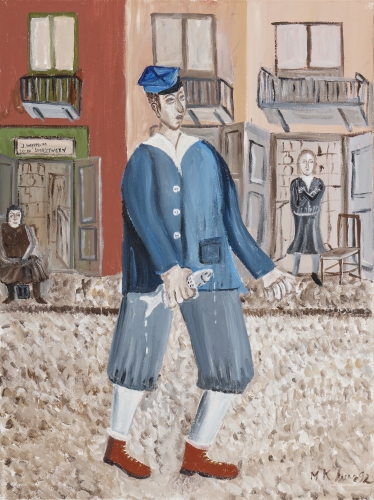
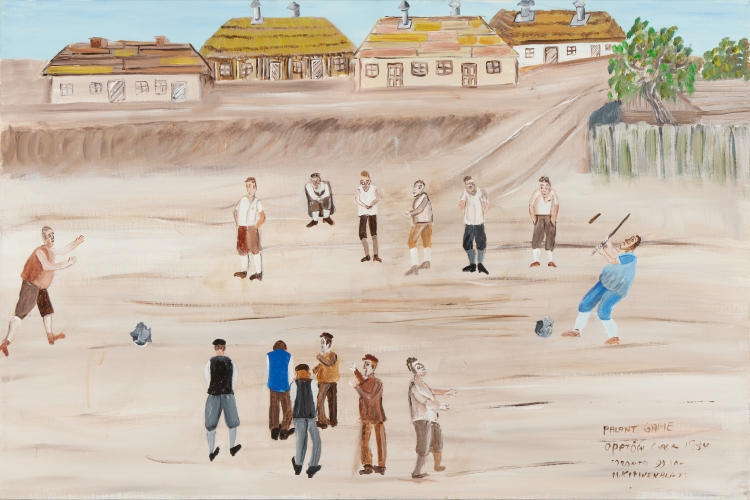
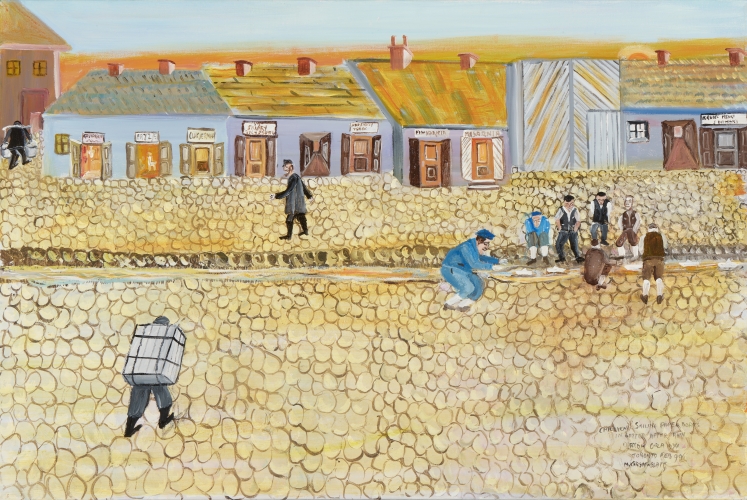
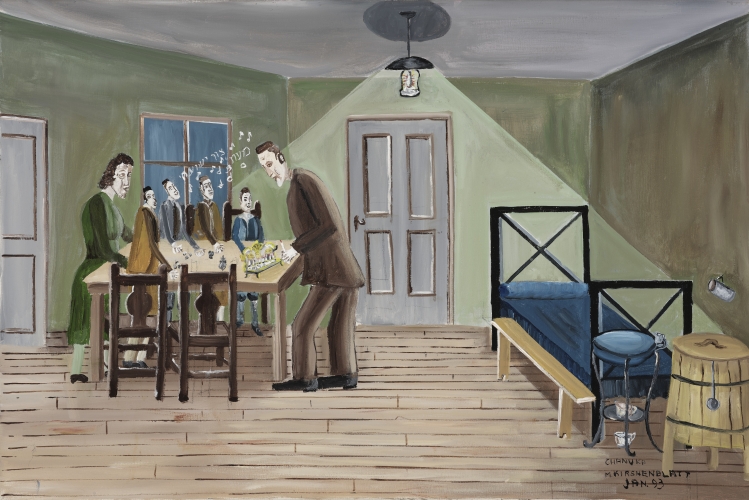
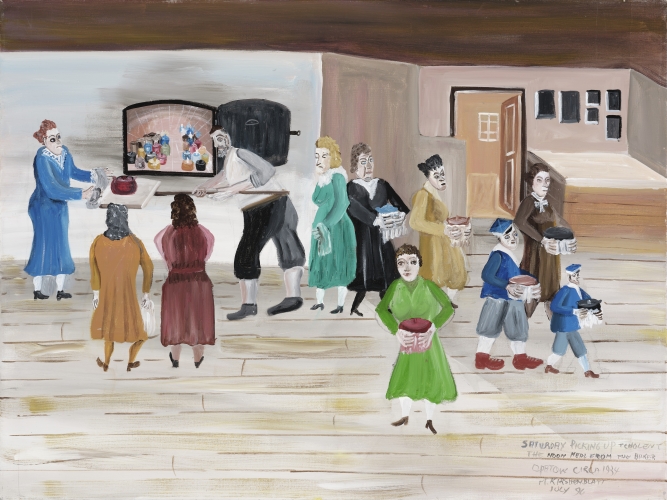
POLIN Museum has received a donation of almost the entire patrimony (nearly 400 paintings, drawings, prints) of Mayer Kirshenblatt. Some of the pieces were displayed in the museum in 2024 as part of the exhibition ‘(post)JEWISH... Shtetl Opatów Through the Eyes of Mayer Kirshenblatt’. The collection comprises over 200 paintings as well as works produced on paper in different techniques – both self-standing compositions and draft sketches for later paintings.
The collection is a colourful chronicle of the pre-war shtetl in Opatów (Yiddish: Apt), a world that disappeared in the Holocaust and which the artist remembered only in snapshots. However, his daughter, Prof. Barbara Kirshenblatt-Gimblett, argues in her analysis of her father’s journals and artistic output that paradoxically, ‘Whatever their relation, the paintings and stories treat time differently. […] Many of the paintings are inscribed “Opatów, 1934,” including scenes that occurred repeatedly over the course of many years, as if to say that the clock stopped in 1934, the point beyond which there would be nothing to remember. Virtually all of Mayer’s seventeen years in Poland seem to be compressed into the year of his departure; even a domestic scene that includes his father, who left Poland in 1928, is dated 1934” (B. Kirshenblatt-Gimblett, “The Shtetl as Memory Palace”, in the catalogue: (post)JEWISH… Shtetl Opatów Through the Eyes of Mayer Kirshenblatt, Warsaw 2024).
Mayer Kirshenblatt’s output represents amateur art, called ‘primitive’ or ‘naïve’. However, his reason for painting differed from those motivating most other representatives of this current. He did not feel a strong, spontaneous urge to create, satisfied despite lacking former training; instead, he wanted to illustrate his own stories and make a visual reconstruction of the reality he witnessed as a child and teenager, before migrating to Canada. Additionally, the need to put to canvas and paper the events, people, and customs from a small town before the Holocaust did not arise in him spontaneously; he actually gave in to repeated instigations for him to create a record of his outstanding memory and immortalise this invaluable testimony of this Jewish community’s life (this subject is discussed in more detail by Ewa Klekot in her essay published in the Stories tab: “Wokół tak zwanej „sztuki naiwnej”; for more information on the painter’s life, see his biography on the Virtual Shtetl portal: https://sztetl.org.pl/pl/biogramy/5369-kirszenblat-majer).
The scenes from the daily life of Opatów residents’ depicted in the paintings, often quite surprising, have immense potential for education – they prompt the audiences to discover the history and culture of the Jewish people who lived in this town and in hundreds of other shetls – small localities scattered around the entire territory of pre-war Poland.
Małgorzata Bogdańska-Krzyżanek