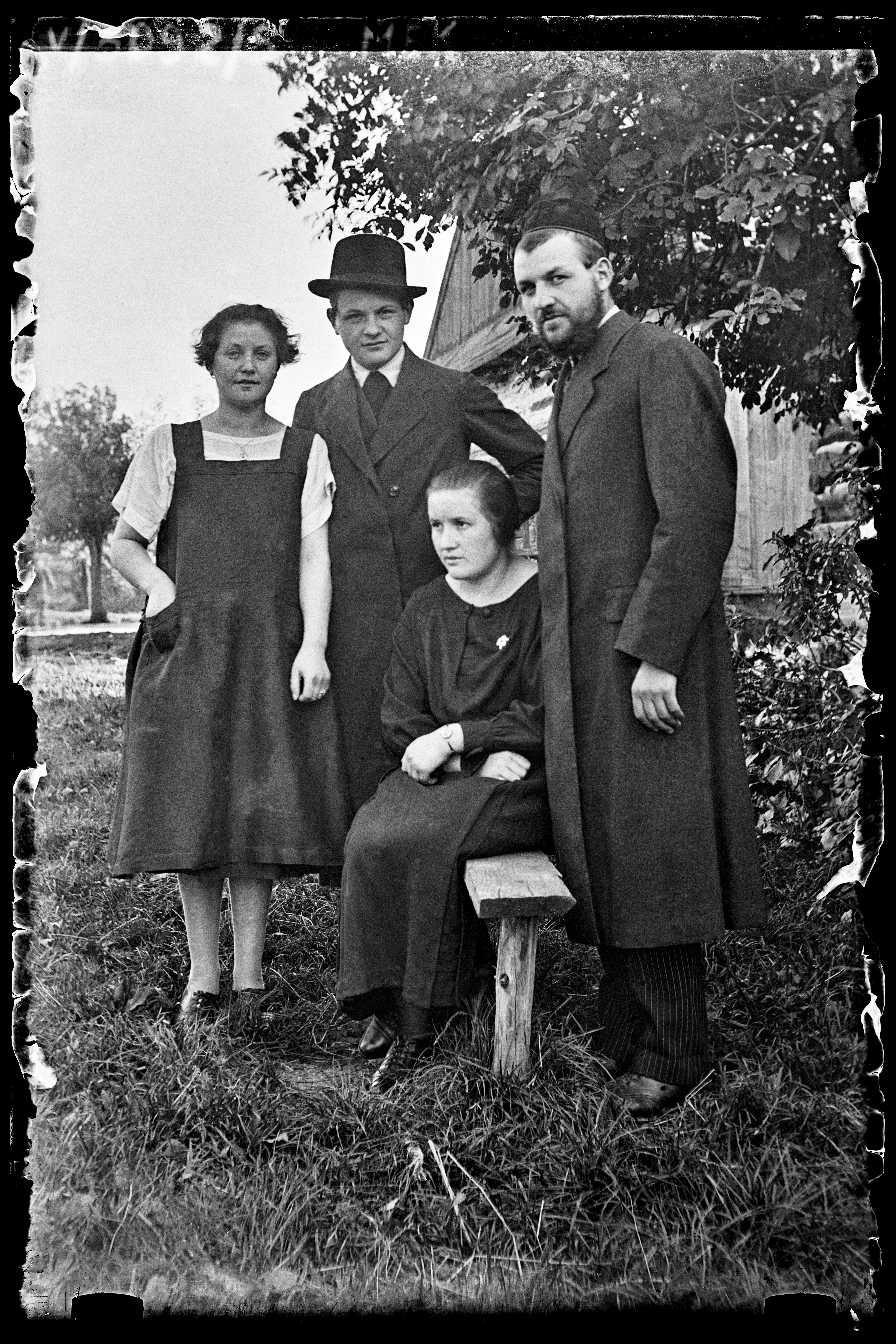
The photograph was taken in the 1920s or 1930s . in Myślenice or one of the neighbouring towns. It belongs to a collection of approximately three hundred individual and group portraits from the Myślenice area, captured as gelatin silver negatives on glass plates. Twelve of them depict Jews, almost exclusively men. It is difficult to definitively determine the author of the photos but some of them may be related to the photographic studio of Stefania and Adam Janowski, who operated in Myślenice during the interwar period. It is unclear whether they took portraits of Myślenice residents as part of their business and on clients' orders or on the commission of a local ethnographer or folklorist interested in the culture, as suggested by the nature of the frames.
The circumstances of acquiring the collection of Myślenice photographs by the Ethnographic Museum in Krakow are not entirely clear but it is certain that it happened during the tenure of its first director, Seweryn Udzieli (1857–1937). The glass plates, stored in specially prepared wooden boxes with Udzieli's original descriptions, are still kept in the museum's archive. From 2018 to 2021, they underwent professional conservation and digitization and were made available online.
The influx of the Jewish community to Myślenice began relatively late, in the 1860s, due to the existing restrictions (privilegium de non tolerandis Judaeis) . At the beginning of the 20th century, when the described photographs were taken, the city was home to 675 Jews who constituted almost one-fifth of the total population. They had their own cemetery, synagogue, mikveh, and schools. They were mainly engaged in trade and craftsmanship. The events of 22/23 June 1936, known as the "march on Myślenice," had a wide impact throughout the country. Nationalist paramilitary groups, led by the owner of the estate in nearby Chorowice – Adam Doboszyński, marched on the city, cutting it off from telephone lines along the way. After disarming the local police station, the armed mob, wielding revolvers, clubs, and axes, attacked Jewish shops. Goods looted from the vandalised premises, mainly clothing materials, were set on fire with gasoline in the Myślenice market square. Several Jews were severely beaten, and there was an unsuccessful attempt to set the synagogue on fire. The history of Jews of Myślenice concluded with tragic events in the summer of 1942 when most of them were deported to the transit camp in Skawina, where some were killed, and others were sent to the extermination camps in Bełżec and Treblinka.
The photograph is a group portrait of four Jews from Myślenice, taken outdoors. One of the two women is seated on a wooden bench with her hands crossed at waist level. She is middle-aged, wearing a long ankle-length dark dress with pleating in the front and two buttons at the top. Just below, she has a white (silver?) flower-shaped brooch pinned. Her hair is smoothly combed and tied at the back of her head. A watch is visible on her left hand. She faces the camera with a left three-quarter view, directing her gaze into the distance. Three figures are standing around her. The first figure on the left, possibly a female teenager, is wearing a white blouse with short sleeves and a long dark dress with wide straps, reaching to her knees. She is holding her right hand in the pocket of the dress, wearing a ring on her left finger. She is also wearing a necklace and earrings. There is a young man with short payot who is standing to her left, wearing a hat. He is dressed in a traditional long, single-breasted coat with pockets, known as a gaberdine (Yiddish: kapote), fastened to the left side. A fragment of a dark jacket (?) and a white collar protrude from under the gaberdine. The man is holding his left hand to his side. Both he and the standing young woman pose for the photograph in a full-frontal view looking directly into the lens. The last of the four individuals is a middle-aged man standing on the right side. He is captured, like the seated woman, from the left three-quarter view. He is also wearing a traditional dark gaberdine, black trousers with light stripes, and a velvet yarmulke on his head. He has a short beard but no payot. All of them pose on the grass in a garden. There is a visible part of a wooden house on the right side of the frame, and the upper right corner is occupied by the crown of a decidous tree. A similar tree is also present in the background on the left side.
The younger man is also featured in an individual portrait with asset no. V/212/S MEK.