
Krakow under the title War (Maski 1918, issue 11, p. 213). This universal title referred to the Great War, which had lasted four years and had claimed millions of lives. But the theme of this work is one of a very real violence, violence against Jews. S. An-ski, the writer, during his travels around Galicia observed the changes of the fronts, marches of troops and pogroms organised at that time by soldiers of the Russian army. While describing cities and towns, he presented not only the tragic fate of Jewish refugees, but also the ruin of their homes and the desecration of synagogues (S. An - ski,Tragedia Żydów galicyjskich w czasie I wojny światowej. Wrażenia i refleksje z podróży po kraju, Przemyśl 2010).
Pogroms of Jews in 1915-1919. So tragic, but they weren't the first. In 1881, a wave of pogroms against Jews passed through the lands of the Russian Empire, including the Kingdom of Poland. The beginning of the 20th century brought new ones, incl. in Kishinev (1903), Odessa and Żytomierz (1905), Białystok and Siedlce (1906). However, the wartime pogroms were events that exceeded the scale of violence of the previous atrocities against Jews – not only were people killed, but houses, workshops and shops destroyed, the entire Jewish world that had existed up until now was wobbling and disappearing, and panic escapes severed neighbourly and family ties.
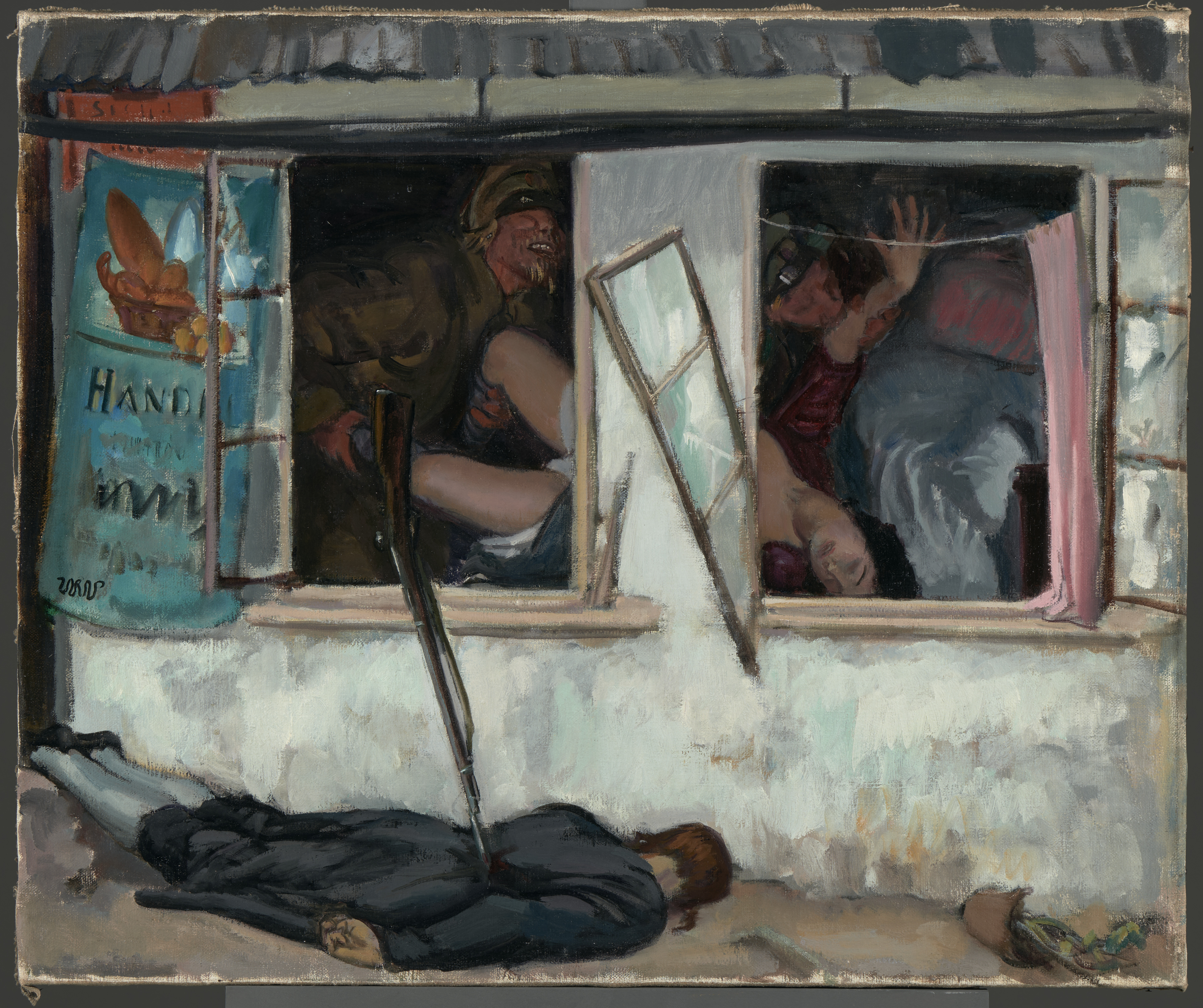
Wojciech Weiss (1875–1950), a painter, draftsman and graphic artist, born in Leorda in Bukovina (now Romania), from 1890 lived in Krakow. He studied at the local School of Fine Arts, also in Paris and Italy. "Pogrom" is a unique picture amongst the works of Wojciech Weiss, painted c.a. 1918, probably in response to the events that took place during the Russian occupation of Galicia. The painter openly pointed to the direct perpetrators of the crime (they were the Cossacks under the Russian service). This scene of violence and rape, pictured in detail, in a naturalistic way, takes place in a narrow space, limited to a house on which a crooked blue sign with a poorly legible inscription: TRADE OF GOODS and a picture of bread – a narrow roll, round rolls, bagels – arranged in a wicker basket, are hanging. A killed Hasidic boy is lying in front of the house, stabbed in the back by a rifle with a bayonet. A shocking rape scene is taking place deep inside the house, visible through the open windows.