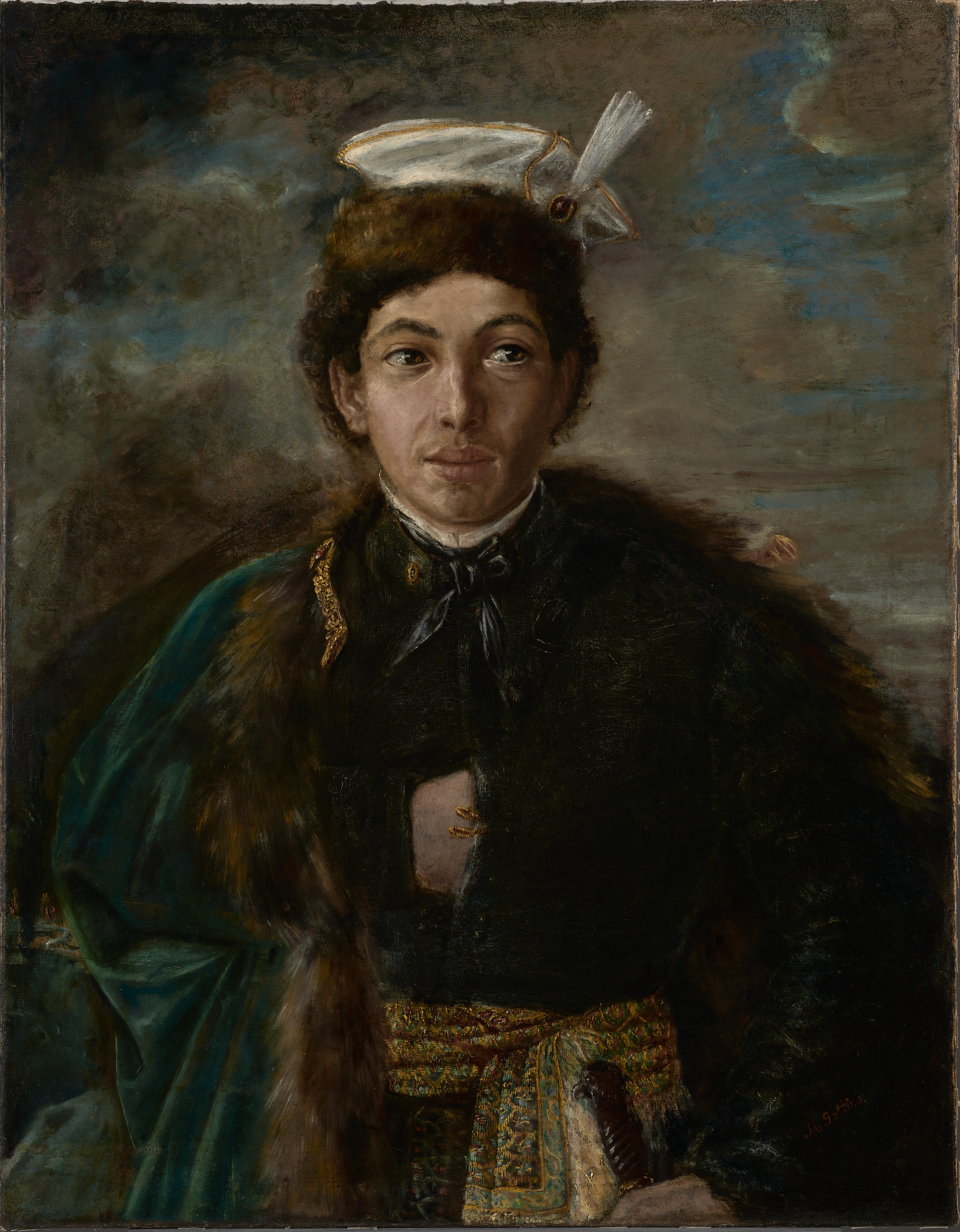
When Maurycy Gottlieb died, he was only twety-three years old. He left behind a dozen or so self-portraits. The first of them - Self-Portrait in the Costume of a Polish Nobleman, dated 1874 (on permanent display at the POLIN Museum) - may be called, following Mieczysław Wallis, “a dream of himself”.
The painter’s attire is no surprise as, in the 19th century, it was commonly believed that the nation was embodied by the nobility - the class which had once ruled and still dominated the country’s public life. The costume Gottlieb chose was meant to testify to his belonging to the Polish nation. Yet there is no joy on his face - perhaps he sensed that he would never truly be accepted as a Pole.
In another self-portrait - Ahasuerus (1876, in the collection of the National Museum in Kraków) - Gottlieb depicted himself as the Persian king Ahasuerus, of whom the biblical Book of Esther tells that, out of love for the Jewish woman Esther, he became the liberator and protector of her people. This time, the painter portrayed himself as a king to whom the Jews owe not only their lives, but also respect and recognition.
The painter portrayed himself with the openness and sensitivity characteristic of youth, revealing his soul and emotions. His self-portraits explain many facts from his life. They are, in a sense, a painted commentary on it. Gottlieb’s life and work are inseparably intertwined. In his figure, we find the legend of an artist, torn between Polishness and Jewishness, searching for his own identity - not only national, but also artistic.
Maurycy was the eldest of eleven siblings. His father, Izaak Gottlieb, the owner of a refinery in Borysław, decided to give him a secular education. In 1863, he enrolled him in a school run by the Basilian monks (with German as the language of instruction).
Regarding the Franciszek Józef Real Gymnasium in Drohobycz, the future painter wrote:
“It happened. I was enrolled in the gymnasium. True, other fathers also enrolled their sons, but we formed such a minority that the Christian boys gave us quite a hard time.”
Already during his school years, as he recalled, his
“fame, as a draftsman, was well established in our hometown. Even the Christian boys stooped to inviting me [to draw].”
His parents, especially his father, supported his artistic ambitions. While studying in Lwów, Maurycy took private lessons from Professor Michał Godlewski and, from 1872 to 1874, he was a student of Karl Mayer at the Academy of Fine Arts in Vienna. It was in Vienna that he first saw Jan Matejko’s paintings, Rejtan, Batory at Pskov, and Skarga’s Sermon.
Encountering Matejko’s works was an overwhelming experience for the young painter. He admired their technical mastery, skill and precision, but above all he was captivated by what he called the “maniacal love for everything that was a form of the nation’s past”.
Looking at Matejko’s canvases, he understood that historical painting was not a mere illustration of events. The painter, according to Master Jan’s words, ought to be “an artistic chronicler, a judge, in a sense, both of the fact itself and of all the forces and elements acting within it”.
After arriving in Kraków, Maurycy - fascinated by Matejko, by Poland, its history, and its culture - began to learn the Polish language. To his sister Anna, who was closest to him in age and was the confidante of his thoughts and dreams, he wrote in Polish:
“Dearest Sister! (…) I am very grateful to you for the books which you sent me (…) and you will see that I will make use of them when I come to our parents for a few weeks, to rest in the quiet of our little town and to speak with you, like a Pole, in Polish.”
It was during his stay in Kraków that he painted the Self-Portrait in the Costume of a Polish Nobleman.
But it was also in Kraków, Gottlieb recalled, that he was cruelly reminded of his origins:
“A bitter awakening took hold of me, when one of my classmates, with whom I had quarrelled, brutally hurled at me that I was a Jew by birth, called me a pariah on society, a wretched worm whom anyone, if he so wished, could crush under his foot, who should be grateful merely to be allowed to crawl in the dust.”
In 1876, equipped with a letter of recommendation from Matejko, he left for Munich to continue his studies at the Academy of Fine Arts, under the esteemed teacher and historical painter Karl von Piloty. In Munich, he began working on one of his most important canvases - Jews Praying in the Synagogue on the Day of Atonement (Yom Kippur) (1876–1878, now in the collection of the Tel Aviv Museum of Art).
It was also there that he read Heinrich Graetz’s History of the Jews. To Gottlieb, this revealed not only the great past of the people of Israel, but also became a source of a new outlook on Judaism and Christianity. It inspired the creation of two paintings: Christ Before the Judges (1877, Israel Museum, Jerusalem) and Christ Preaching in the Synagogue at Capernaum (1879, National Museum in Warsaw).
Portraits are the most fascinating part of Gottlieb’s works, even though it appears that the painter did not attach great importance to them. In a letter to his friend and fellow painter Walerian Kryciński, he wrote that he had:
“finished two portraits for the ‘figures’ of Drohobycz, which caused a sensation, were greatly admired and even prompted an attempt to obtain a scholarship of 600 gulden that the city wished to grant me”.
Each of Gottlieb’s portraits is a complete, self-contained work. He was primarily concerned with the psyche and inner life of the person whom he portrayed. Titles, honours or the sitter’s social background did not interest him. When he painted Ignacy Kuranda (1878), his protector and patron, president of the Jewish community in Vienna, he created a modest yet striking likeness of a weary, old man (in the collection of the National Museum in Kraków). The artist noticed every wrinkle, the sagging of the skin, the puffy eyes and the sitter’s large, fleshy nose.
In October 1878, Gottlieb travelled to Rome. There, he again met Matejko, became acquainted with Henryk Siemiradzki and was warmly welcomed by both. Once more, the hope arose that Poland might become his homeland. From Rome, on 14th December 1878, he wrote to Kryciński:
“How eagerly I would eliminate the hatred hovering over a suffering nation. How gladly I would reconcile Poles with Jews, for the history of both peoples is a history of suffering!
Is it not rather an immodest claim that I feel called upon to be an apostle? Even if I lack sufficient strength to accomplish this goal, the sympathy shown to me by my compatriots and the descriptions of my personality in Polish newspapers show that, at least, I am on the right path towards achieving it”.
In the spring of 1879, Gottlieb returned to Kraków to continue his studies under Matejko, who, with his vision of Polish history and his sense of the artist’s responsibility to society, was a true mentor to Gottlieb.
The sudden, dramatic death of Gottlieb on the night of July 16th–17th 1879, was a shock. Matejko wrote to his wife:
“It is a pity. Besides his extraordinary talents, he was a man full of noble impulses, a nature captivating in its goodness and selflessness.”
Gottlieb’s funeral took place on Friday, 19th July 1879, at the New Jewish Cemetery in Kraków. Matejko recalled:
“It was the first time in my life that I attended a Jewish funeral. There, I saw the father, the old Gottlieb. The poor man could not cry, he was numb. (…) Rain with thunder, the likes of which I had not seen for a long time, concluded the sad ceremony.”
Speeches were cut short and most attendees dispersed. Only Matejko and Siemiradzki remained until the end.
Born in Drohobycz to a Jewish family, in the Austrian partition, Gottlieb decided to become a Polish artist under the influence of Jan Matejko’s painting. Later, his experience of antisemitism, as well as reading Graetz’s History of the Jews, directed him towards Jewish themes. In his art, Polish and Jewish motifs constantly intertwine. In the POLIN Museum’s permanent exhibition, Gottlieb stands as an example of acculturation - embracing Polish identity without abandoning his religion and Jewish world, continuously seeking his own place in European culture and art.
Text by Renata Piątkowska.
Selected bibliography
• Guralnik, N., In the Flower of Youth. Maurycy Gottlieb 1856–1879 [exhibition catalogue], The Tel Aviv Museum of Art, National Museum in Warsaw, Tel Aviv 1991.
• Konstantynów, D., “Znakomity malarz i ożywiony najlepszymi chęciami obywatel”. Maurycy Gottlieb w oczach prasy polskiej (1877–1880), Biuletyn Historii Sztuki, 2014, no. 1, pp. 113–161.
• Malinowski, J., Maurycy Gottlieb, Warsaw 1997.
• Maurycy Gottlieb. W poszukiwaniu tożsamości / In Search of Identity [exhibition catalog], ed. M. Milanowska, National Museum in Kraków, Museum of Art in Łódź, Kraków–Łódź 2014.
• Mendelsohn, E., Painting a People. Maurycy Gottlieb and Jewish Art, Hanover and London 2002.
• Piątkowska, R., Maurycy Gottlieb (1856–1879), Biuletyn Żydowskiego Instytutu Historycznego, 1991, no. 2, pp. 45–64.
• Rogoyska, M., Maurycy Gottlieb, Przegląd Artystyczny, 1954, no. 3, pp. 5–15.
• Ryszkiewicz, A., Gottlieb Maurycy, in: Słownik artystów polskich i obcych w Polsce działających, vol. 2, Wrocław–Warsaw–Kraków–Gdańsk 1975, pp. 430–431.
• Sandel, J., Maurycy Gottlieb – uczeń Matejki, Biuletyn Żydowskiego Instytutu Historycznego, 1953, no. 4, pp. 97–142.
• Sołtysowa, Z., Dzieło Maurycego Gottlieba, Rocznik Krakowski, 1976, no. 47, pp. 149–182.
• Waldman, M., Maurycy Gottlieb 1856–1879. Biografia artystyczna, Kraków 1932.
• Wiesenberg, J., Maurycy Gottlieb (1856–1879). Szkic biograficzny, Złoczów 1888.