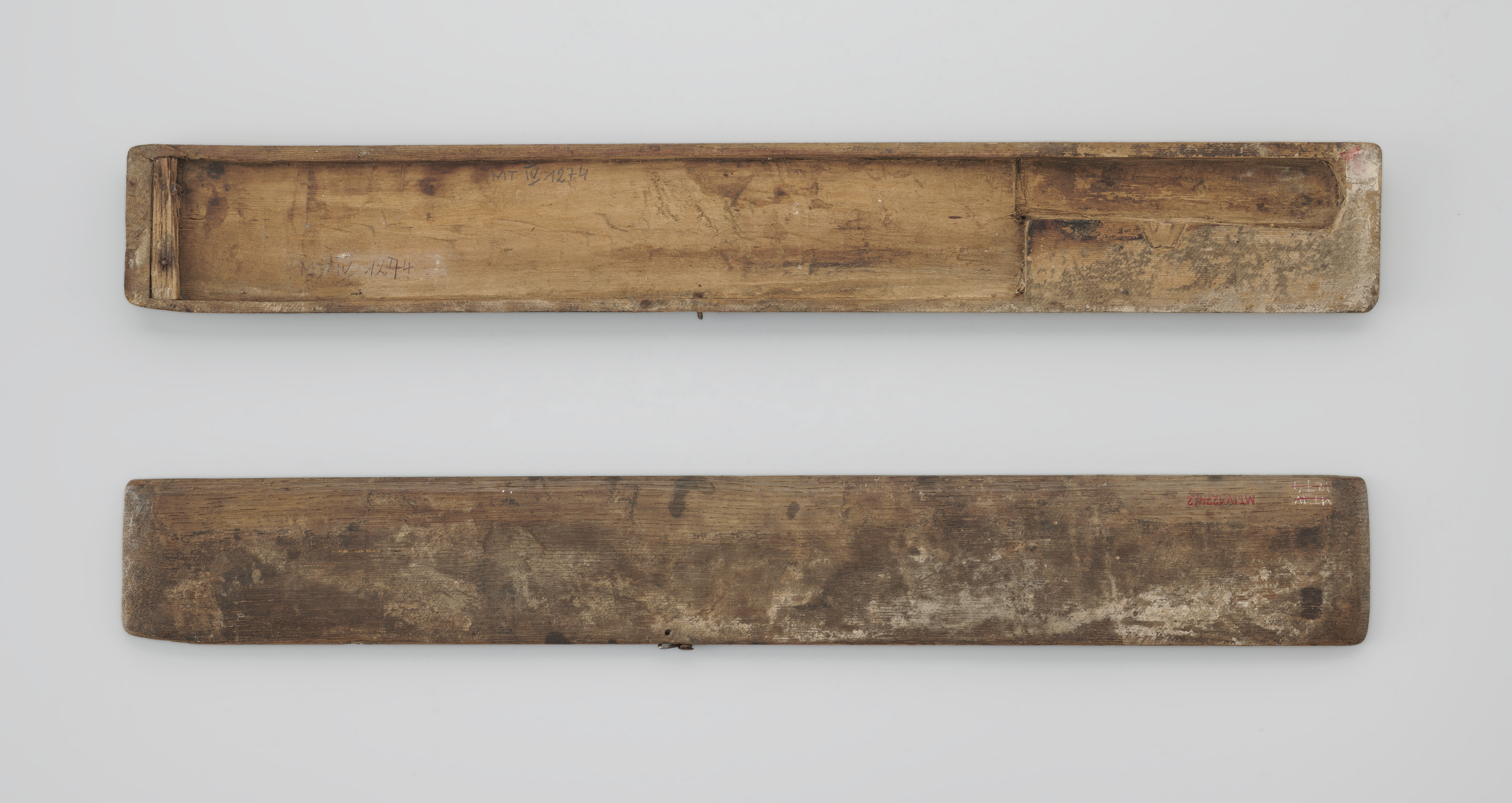
The wooden case from the collection of the District Museum in Tarnów is a set with a shechita (ritual slaughter) knife (inventory no. MT.IV.1274/1), which was stored in it. It has the shape of a flattened rectangular box closed with an iron hook attached to the longer side. The inner textile veneer serves as a hinge for the lid, which opens along the long edge and is covered with red paper on the bottom. There are illegible handwritten inscriptions on it. The lower part of the case is made of hardwood, the upper part is made of oak. Originally, the wood was covered with linen, currently not preserved. Inside the lower part of the case there is a recess corresponding to the shape of the knife. A knife with a handle adapted to the owner's hand was a valuable item. In order to keep the blade in perfect condition, it was stored in a case.
Kosher, i.e. meat of mammals and birds suitable for consumption, comes from ritual slaughter. One of the most important stages of slaughter is a thorough examination of the knife, which must be very sharp, perfectly smooth, without any chipping or damage. The blade should be twice as long as the width of the throat of the animal being slaughtered with it. After slaughter, the knife is examined again. If any damage occurs, such as a chipped blade, the meat is not fit for consumption (it is considered not kosher).
A well-balanced and maintained knife is the property of a shochet (Yiddish: shochet, Hebrew: shokhét), who rigorously applies the applicable slaughter rules. He must not interrupt the movement of the knife, the blood vessels must be cut, not severed. Correctly performed cutting results in a quick (within one minute) and possibly painless death of the animal. The rabbinate and an inspector (Hebrew: bodek) supervise compliance with the rules of ritual slaughter. Number of conditions must be met to become a shochet. A shochet must be at least 18 years old and have an impeccable reputation, must demonstrate religiosity, piety, knowledge of the Talmud, religious law and tradition. The prerequisite for performing ritual slaughter, in addition to the necessary knowledge and practice confirmed by examination and obtaining a diploma (Hebrew: kabala), is good health. The elderly cannot engage in it due to trembling hands, as cannot the deaf or mentally disabled. The shochet enjoys great authority and respect from the Jewish community. Without this role, the community cannot function properly.
The case along with the knife was purchased by the District Museum in Tarnów from a private individual in 1978. Its original origin is unknown.
Barbara Bułdys