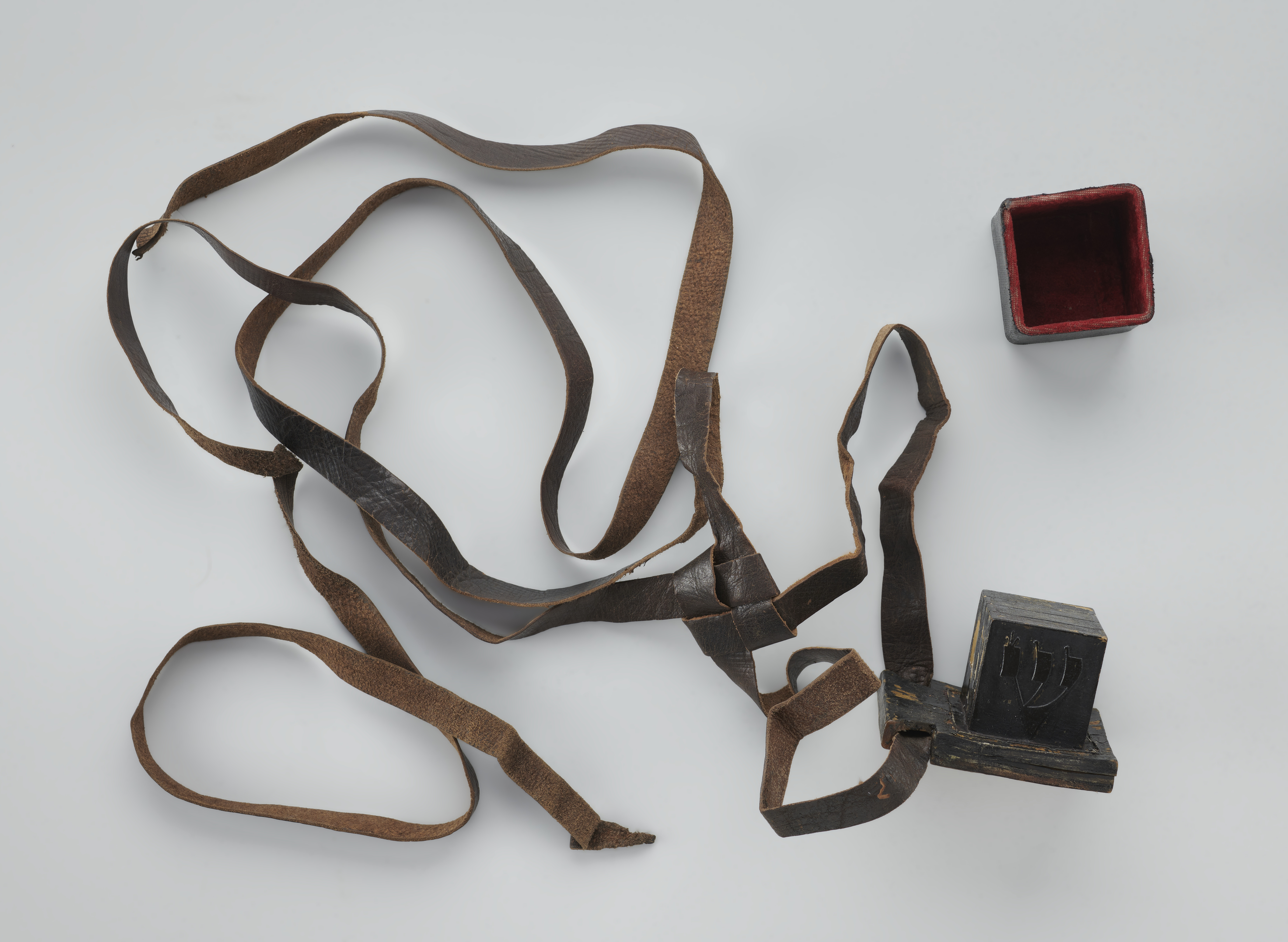
Tefillin (Hebrew: "prayer items"), or phylacteries, are two leather boxes that men wear on their foreheads and hands during the morning prayer called shacharit according to Jewish tradition. The command to wear them is contained in the Torah, in a verse referring to God's command: "You shall bind them for a sign on your hand, and they shall be for frontlets between your eyes" (Deut. 6:8). Tefillin are used only on weekdays. Sometimes they are stored in decorative cases with floral and geometric ornamentation (see more at: https://www.jhi.pl/artykuly/tefilin-swiete-przedmioty,2314, accessed 1.09.2023).
Tefillin from the collection of the District Museum in Tarnów is a leather box in the shape of a cube, made from a single piece of black-painted leather of a kosher animal. Leather straps are attached to it. It is designed to be worn on the head (Hebrew: tefilin shel rosh), so it should contain four scrolls of parchment, placed in separate compartments, with verses from Exodus and Deuteronomy handwritten by the sofer (scribe). The Hebrew letter "shin", which is the initial of one of the names of God (Shaddai – Almighty), is embossed on two opposite walls. The letters are not identical: one of them has three arms, while the other has four, which probably had a magical and symbolic meaning. There are visible defects on the sides of the head phylactery, the external face of the black leather is slightly peeling. Tefillin, along with the cover, are stored in a velvet pouch.
The set, which includes a tefillin with cover and velvet pouch (inventory no. MT.IV.2488/2), was donated to the District Museum in 2015 by Shoshana Tancer, daughter of Tarnów-born Salo Wittmayer Baron (1895-1989), one of the most prominent Jewish historians of the 20th centuryand a lecturer at Columbia University from 1930. and a lecturer at Columbia University from 1930. As the inscriptions on the tefillin and pouch indicate, the item was used by Baron.
Barbara Bułdys