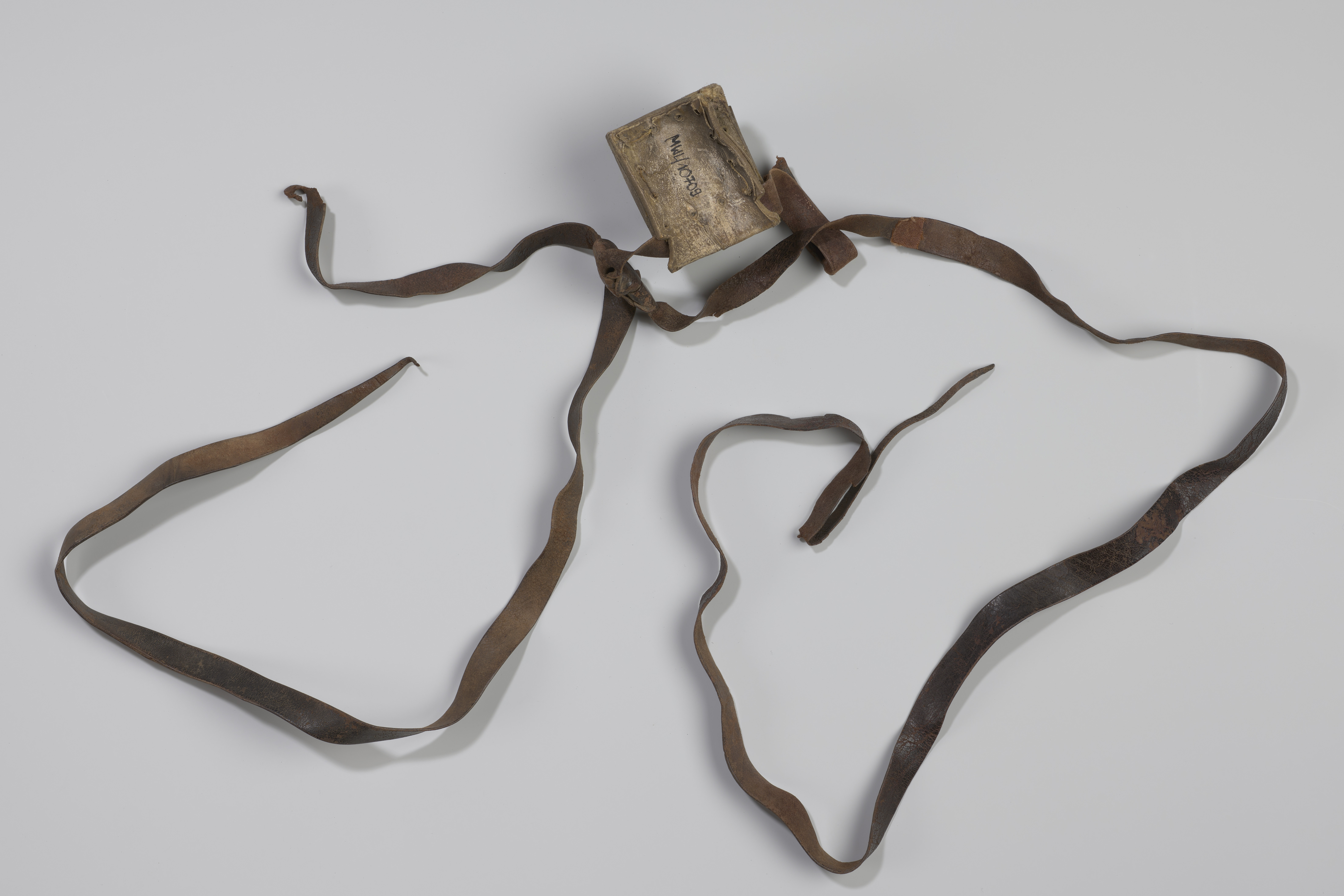
Tefillin (Hebrew: "prayer items"), or phylacteries, are two leather boxes that men wear on their foreheads and hands during the morning prayer called shacharit according to Jewish tradition. The command to wear them is contained in the Torah, in a verse referring to God's command: "You shall bind them for a sign on your hand, and they shall be for frontlets between your eyes" (Deuteronomy 6:8). Tefillin are used only on weekdays. Sometimes they are stored in decorative cases adorned with plant and geometric motifs. They were made from the skin of a kosher animal, usually cowhide (see more at: https://www.jhi.pl/artykuly/tefilin-swiete-przedmioty,2314, accessed 15 December 2023).
The tefillin from the collection of the Lublin Village Open Air Museum is intended to be worn on the head (Hebrew: tefillin shel rosh). It was placed on the forehead and tied with a strap at the back of the head. It takes the form of a cube-shaped leather container attached to a base sewn together from several layers of leather. The container is made up of four segments, each containing a scroll of parchment with a Hebrew Torah fragment (Exodus 13:1-10, Exodus 13:11-16, Deuteronomy 6:4-9, Deuteronomy 11:13-21) containing a religious injunction relating to their use. The Hebrew letter "shin", which is the initial of one of the names of God (Shaddai – Almighty), is embossed on two opposite walls. The letters are not identical: one of them has three arms, while the other has four, which probably had a magical and symbolic meaning. The item is one half of a set consisting of two separate containers (Hebrew: batim) with straps, one of which was attached to the head and the other to the arm. The tefillin on display shows remnants of black paint. Strips of strap are threaded through the edge of the base.
The item was donated to the Lublin Open Air Village Museum in 1987 by a resident of Markuszów (Puławy County, Lubelskie Province).