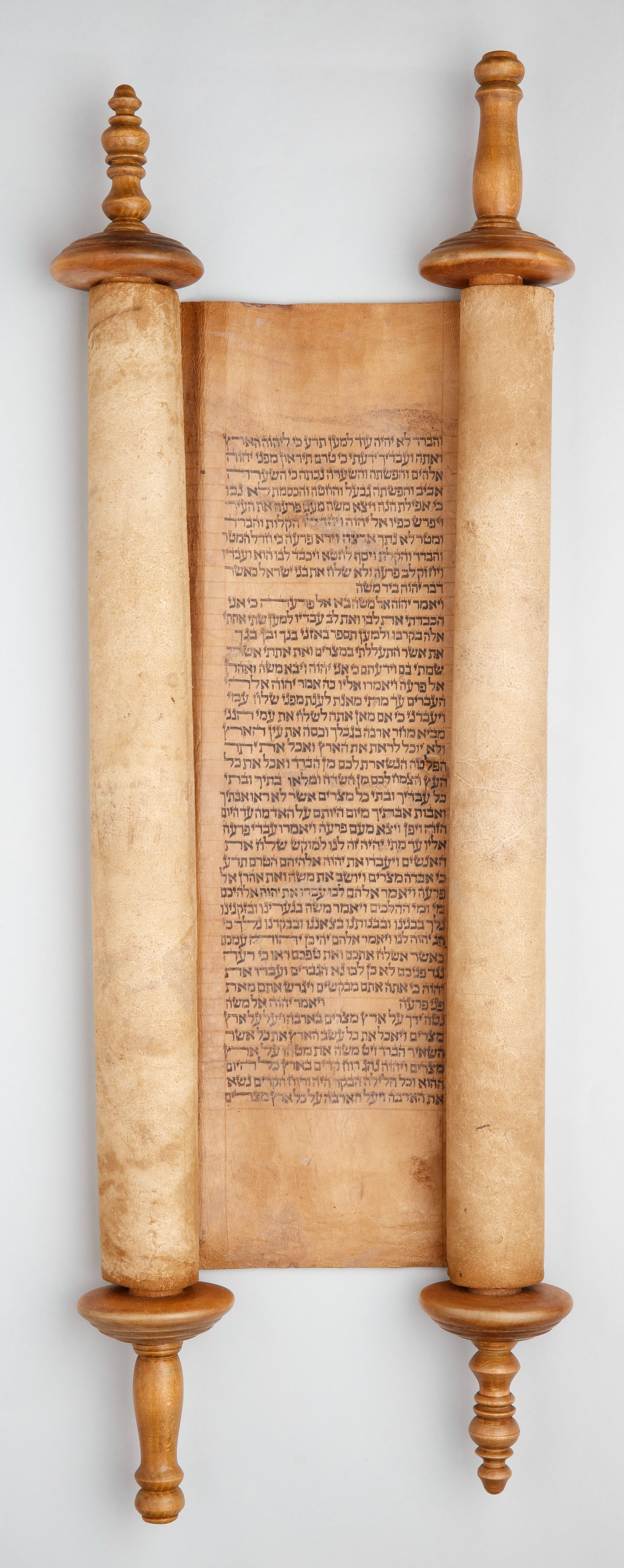
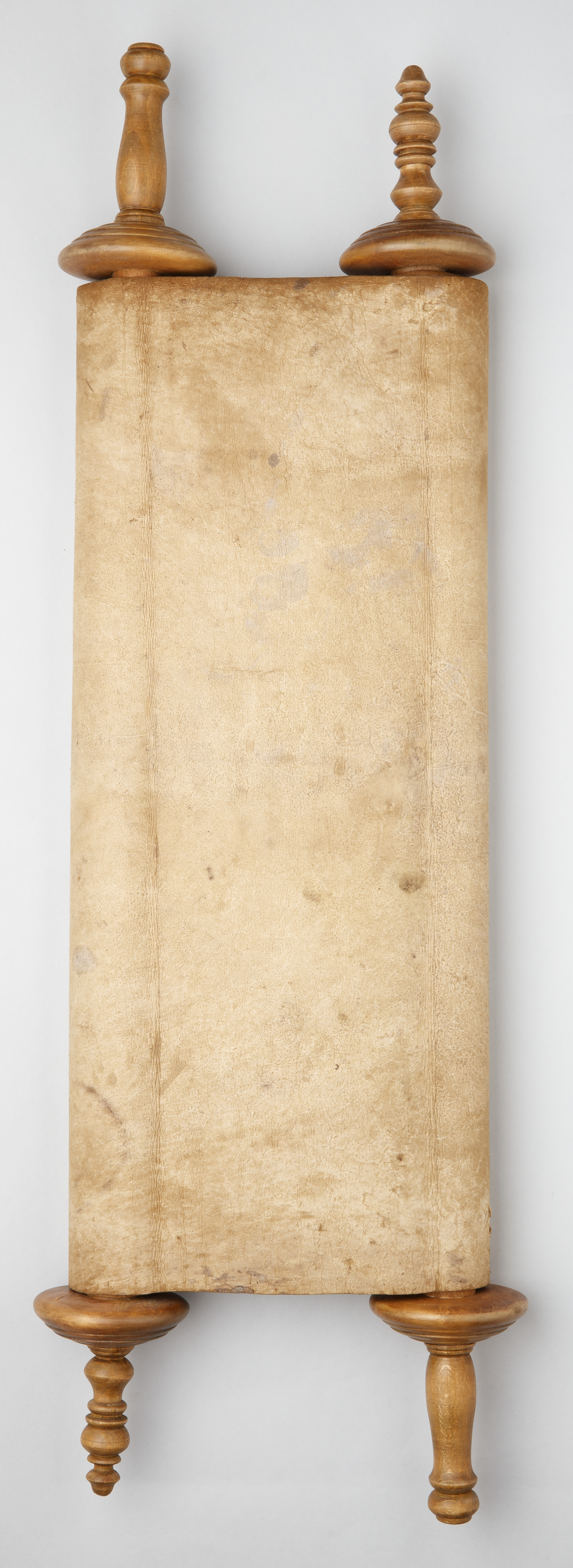
A fragment of a Torah scroll from the Education and Museum Centre "Świętokrzyski Sztetl" collection was handwritten in black ink on goatskin. It contains five columns of 42 lines.
The Torah scroll (Hebrew: Sefer Torah), also known as rodale, contains the original Hebrew text of the Five Books of Moses and is kept in the aron ha-kodesh, i.e. holy ark, in every synagogue . The scroll is wound around two wooden poles (Hebrew: ēṣ haḥayyīm, meaning tree of life), often made of precious wood. The parts extending beyond the parchment are usually richly decorated with carving and inlay and a pair of applied ornaments called rimonim (Torah finials) (Hebrew: pomegranate fruit). The scroll is tied with a long, narrow fabric sash adorned with embroidery. It is placed in a cover known as a mantle (Hebrew: me'il), adorned with decorations made of precious metals (Hebrew: kele kodesh , meaning sacred vessels).
The word "Torah" (Hebrew: "teaching, instruction, law") in a narrower sense refers to the Five Books of Moses (Hebrew: Chumash, Greek: Pentateuch), which are the initial five books of the Hebrew Bible (Old Testament). These are: Genesis (Hebrew: Bereshit), Exodus (Hebrew: Shemot), Leviticus (Hebrew: Vayikra), Numbers (Hebrew: Bamidbar), and Deuteronomy (Hebrew: Devarim). In a broader sense, the term "Torah" encompasses the entire Hebrew Bible, and in the broadest sense, it refers to the entirety of Jewish tradition, which consists of the Written Law (Hebrew: Torah Shebichtav) contained in the Hebrew Bible, and the Oral Law (Hebrew: Torah Sheba'al Peh), which is the oral tradition subsequently recorded in the Mishnah and Talmud. According to Rabbinic tradition, both Laws were revealed to Moses simultaneously and are equally important (S. Krajewski, Tora [in:] Polski słownik judaistyczny, Warsaw 2003, vol. 2, pp. 720–721).