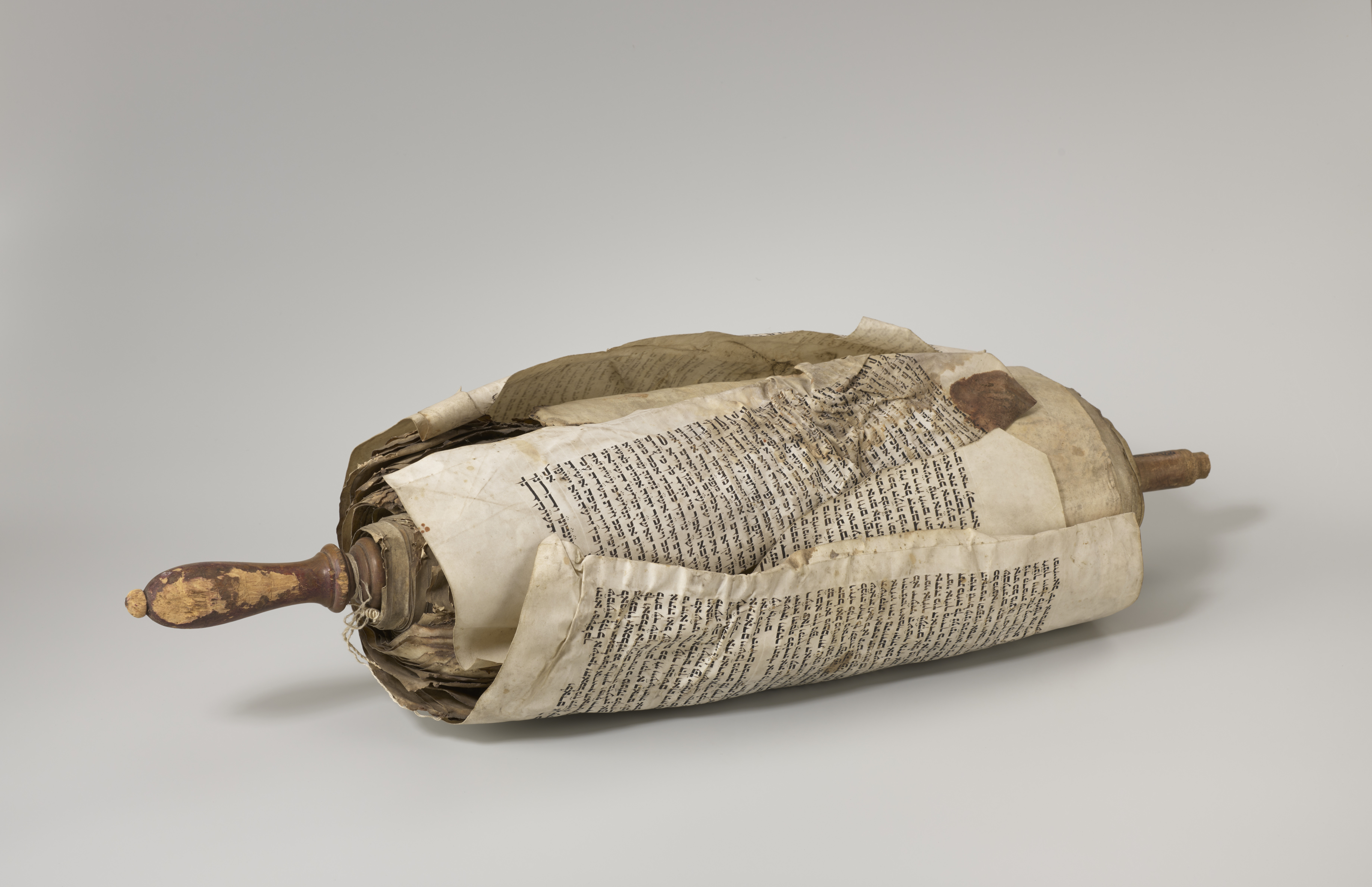
The preserved portion of the Torah scroll begins in the middle of verse 1:4 of Leviticus. It is wound on a single wooden roller with a turned baluster-shaped handle at the bottom. The top end of the roller has been broken off. The right-hand roller with the remaining initial part of the parchment scroll is missing – it is deeply burnt on one side, almost all the way through. The parchment also shows traces of cutting with a sharp tool.
The item was purchased for the collection of the Lublin Open Air Village Museum in 1976 from a resident of the village of Żółkiewka (Krasnystaw County, Lubelskie Province).
The Torah (from Hebrew: "instruction", "guidance", "law") is the fundamental book of Judaism written in Hebrew. It consists of five books (in the Christian tradition, these are the first books of the Old Testament: Genesis, Exodus, Leviticus, Numbers and Deuteronomy) and is sometimes referred to as the Pentateuch, Five Books of Moses. A Torah scroll for synagogue use is inscribed by hand on sewn sheets of parchment made from the skin of a kosher animal. It takes the form of a scroll rolled up on two rods and is kept in the aron ha-kodesh, also called the holy ark. The Torah forms the basis of Judaism – both in terms of its content, from which religious law is directly derived, and in terms of its physical nature. Therefore, the Torah scrolls are treated with great reverence and are accompanied by special rituals. If their condition no longer permits their use (e.g. due to damage), they are not destroyed, but solemnly buried in the ground