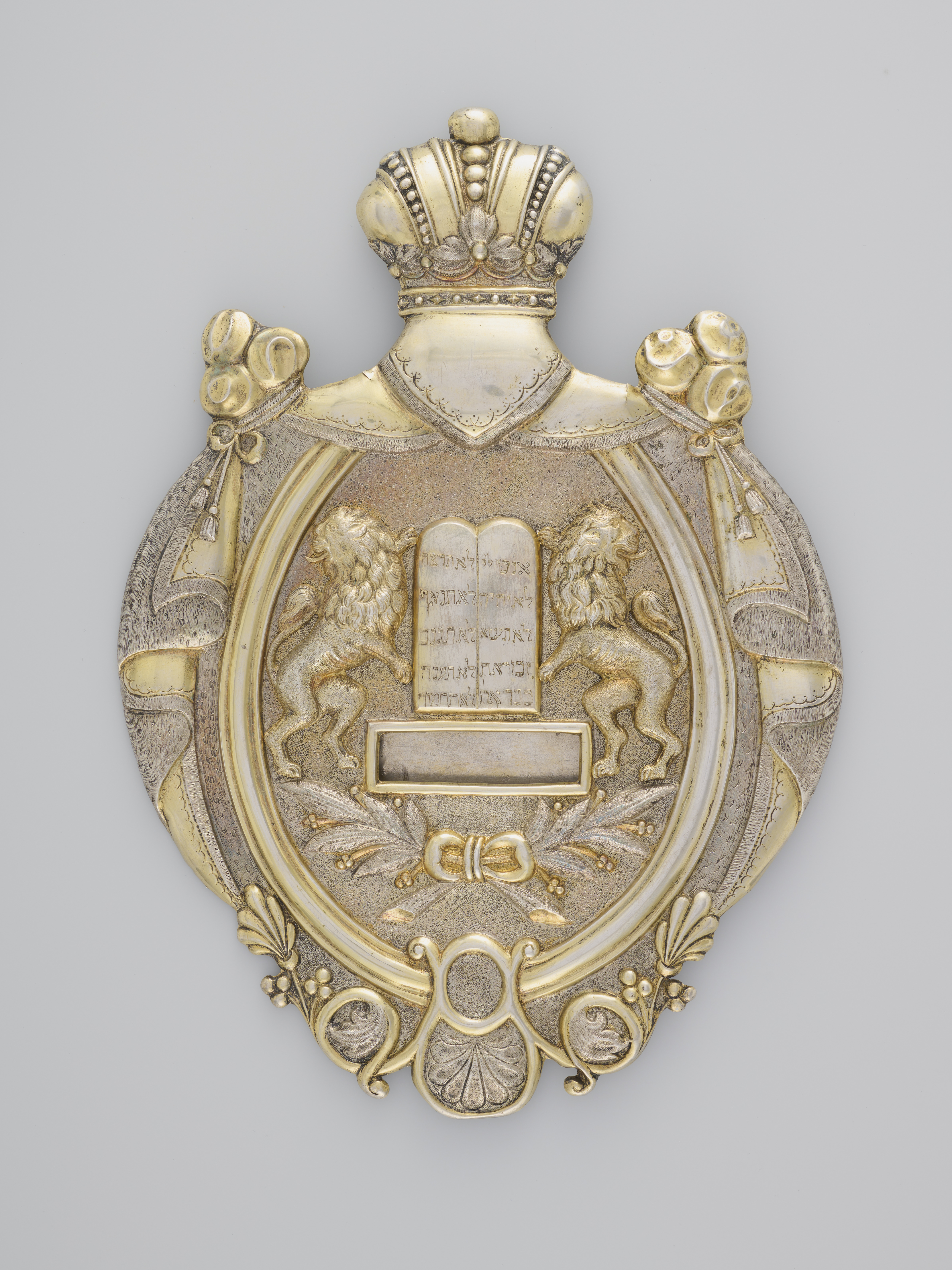
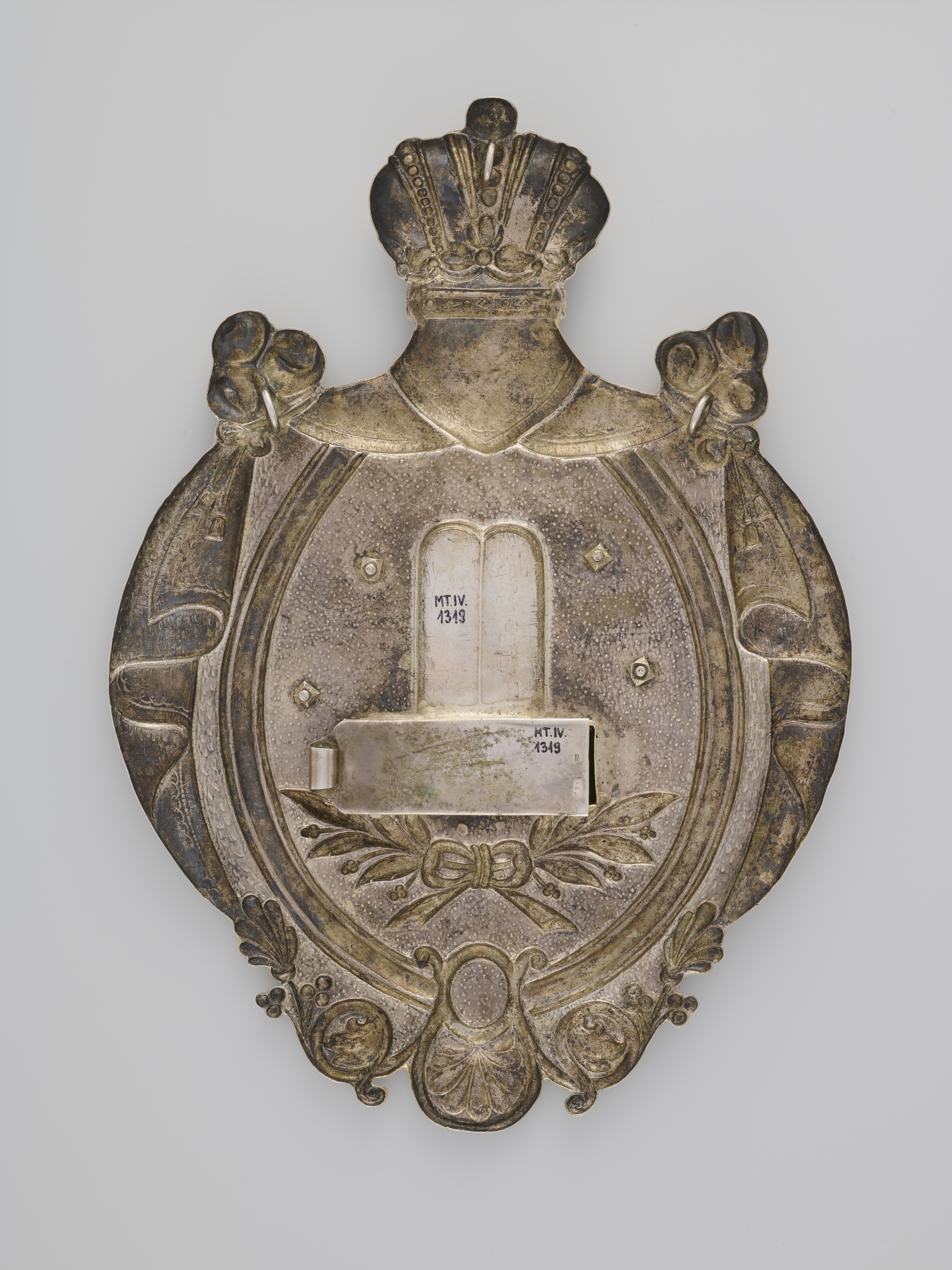
The Torah shield (Hebrew: tas) is one of the decorations placed on the Torah scroll, clothed in the so-called mantle (Hebrew: meil). The shield from the collection of the District Museum in Tarnów was made in the form of a repousséd, partially gilded cartouche, with decoratively tied curtains (drapery curtains) at the top – on the axis with the crown topping the composition. At the back, in the upper part of the shield, there are three jump rings enabling the shield to be attached to a mantle put on the Torah scroll.
In the center of the shield there is a horizontal rectangular hole with a small box, enclosed in a gilded frame, closed from the back with a latch. To save time, the Torah scroll should not be scrolled in the synagogue. Therefore, in order to prepare for reading and avoid mistakes, the day before the actual scroll was marked with tablets with the names of the holidays, for which a box on the shield was used. Above it there are two rectangular, arched tablets inscribed with the Ten Commandments. They were engraved with inscriptions in Hebrew (the first two words of each commandment). The tablets are supported on the sides by two gilded, antithetically placed lions (the symbol of the tribe of Judah, from which King David came and the Messiah will come), standing on their hind legs.
The shield has goldsmith's marks: on the obverse below the hole: 1. Austrian basic hallmark for silver fineness of "3" from the Vienna Assay Office, used in the years 1872–1922; 2. goldsmith's name mark: in a horizontal, rectangular field with truncated corners – initials "CW". On the latch: 3. another personal hallmark; 4. a feature of the Vienna Assay Office for marking minor parts of larger silver products – the letter "A" in a vertical rectangle with truncated corners; 5. repeated hallmark for marking minor parts (its double stamping denoted silver fineness of "1", "2" or "3").
The shield was purchased for the District Museum in Tarnów in 1978 from a private person. Its original origin is unknown.
Barbara Bułdys