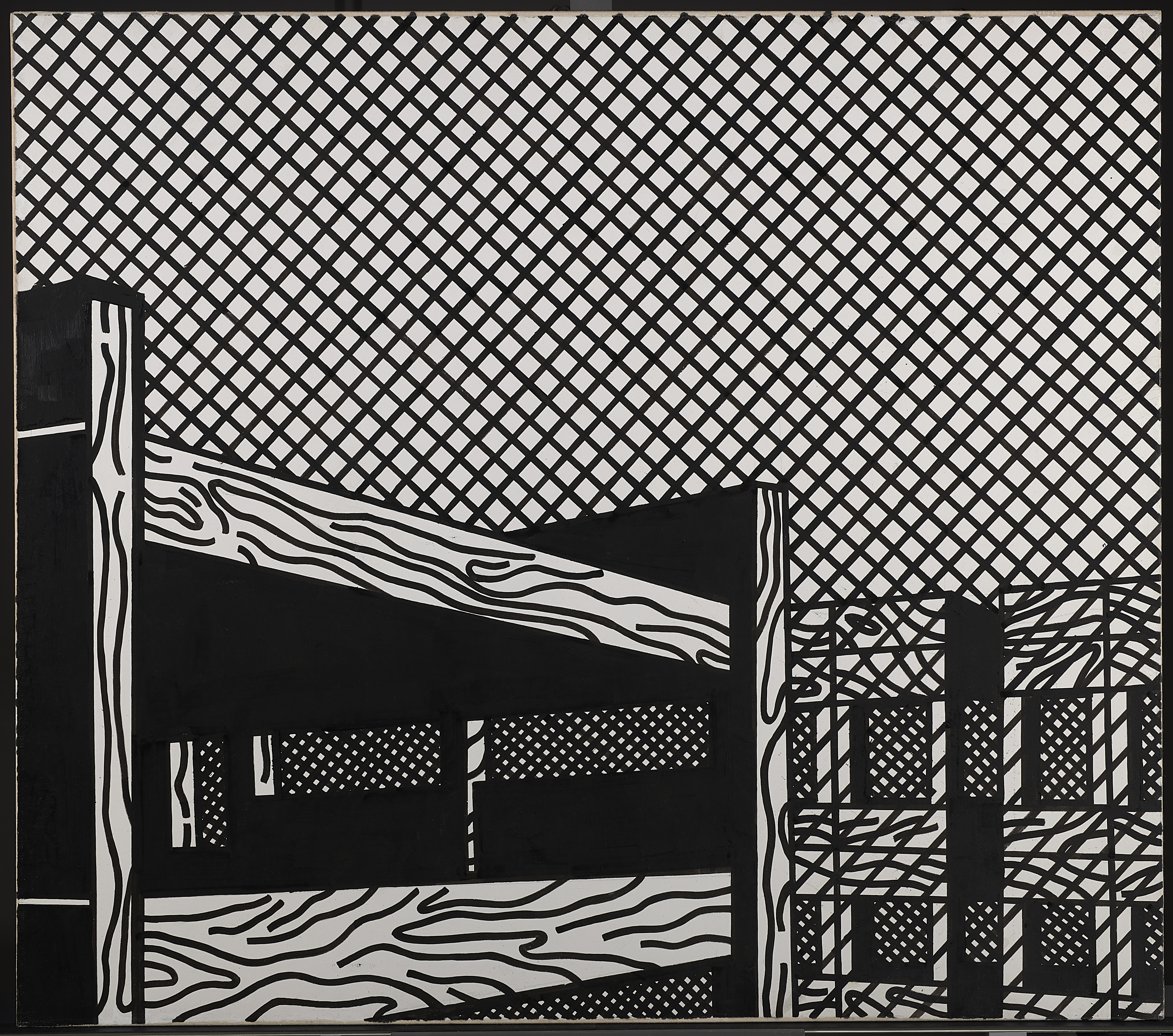
Depiction of camp bunks in the barracks at Auschwitz concentration camp, inspired by the representation of a barrack interior in Maus by Art Spiegelman (from Volume 2). One may identify the exact fragment of the comic that served as inspiration: the page on which the interior of the barrack is shown for the first time. In its two upper panels, the narrating protagonist, Władysław Spiegelman, speaks about the beds and sleeping conditions in the barracks (“It was so crowded that it was hard to move,” p. 30 in the first Polish edition from 2001, translated by Piotr Bikont). In his painting, Wilhelm Sasnal depicts only the space from the comic panel, without figures, narrative frames, or speech bubbles. The visual motif of the distinctive “grid” corresponds to the comic’s hatching used to suggest shading (although in these particular comic panels the hatching lines are rather vertical; on other pages, however, the shading is sometimes diagonal as well).
This is one of the five paintings in the “Maus” series, created between the late 1990s and the first decade of the 21st century. It was a critical period in Polish-Jewish relations, marked by intensified public debate in Poland concerning the participation of Poles in crimes committed against Polish Jews during the Second World War under German occupation. Initially, the discussion centered mainly around the book Neighbors by Jan Tomasz Gross, which described the massacre in Jedwabne on 10 July 1941. Later, the debate also involved Spiegelman’s “Maus,” which was published in Poland (with considerable delay compared to the original edition) precisely during this period (2001). At that time, Sasnal began painting intensively on the subject of the Holocaust and its memory (including works inspired by the stories of Tadeusz Borowski and the film Shoah by Claude Lanzmann). In one of his self-commentaries, however, he admitted that his first painterly attempts approaching this subject matter and its treatment had come much earlier: “While still at art school I painted two pictures: one showed a bar of grey soap we used to clean our brushes, the other a man standing in front of a house in a winter landscape. It was still very intuitive, but even then I had Birkenau in mind, the premonition of drama, its ordinariness. I was trying to speak about it without literalness” (J. Banasiak, 15 stuleci. Rozmowa z Wilhelmem Sasnalem, Czarne: Wołowiec 2017, p. 69).
In the context of the fourth painting inspired by “Maus,” Sasnal’s own commentary on the creative process appears especially significant, revealing aspects of his emotional experience of the painted space: “My great-grandmother died in Auschwitz. When I was painting one of the works from the ‘Maus’ series — the one depicting the bunks — it was very important to me that she must have slept on bunks like these. I thought about it a lot” (the interview with J. Banasiak cited above, p. 69).
Przemysław Kaniecki