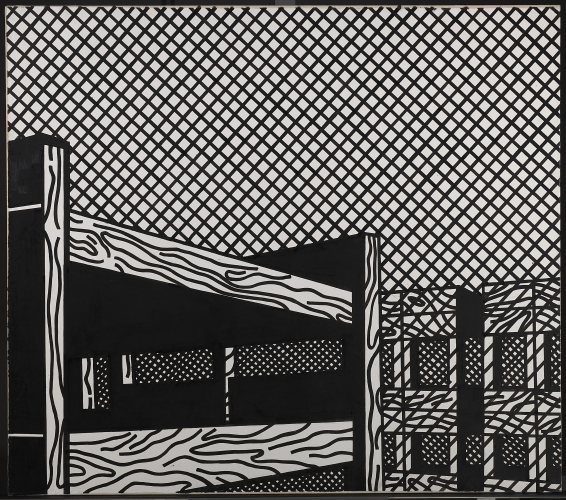
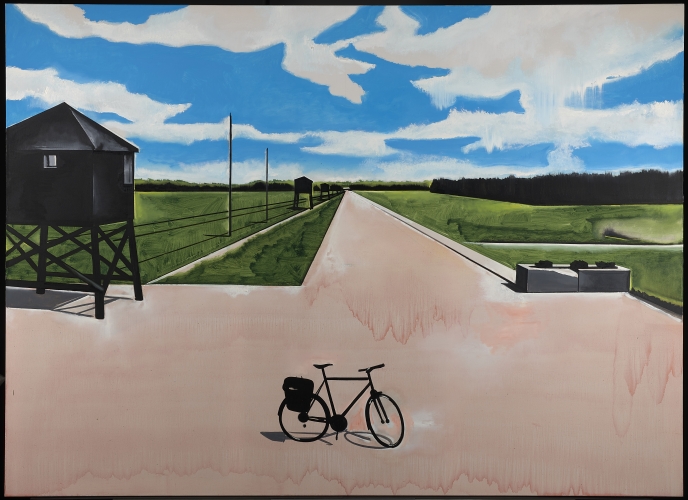
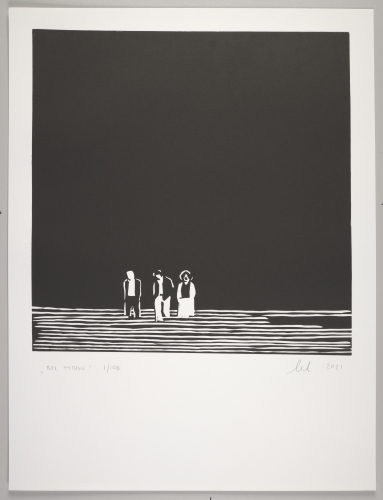
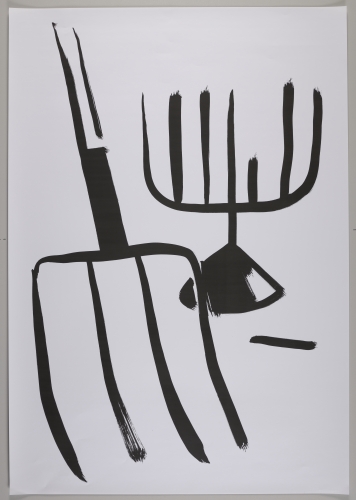
Wilhelm Sasnal (b. 1972, Tarnów), painter, graphic artist, illustrator, filmmaker. From 1992 to 1994, he studied architecture at the Krakow University of Technology, from where he transferred to the Faculty of Painting at the Academy of Fine Arts in 1994. There he obtained his diploma in the atelier of Professor Leszek Misiak (1999). In the year of his graduation, he won the Grand Prix at the Bielska Jesień Painting Biennale.
In 1996, together with Rafał Bujnowski, Marek Firk, Marcin Maciejowski and Józef "Kurosawa" Tomczyk, he founded the Ładnie Group, which was active until ca. 2001. It drew on the neo-pop trend by using analogous reworkings of popular visual culture content that spread rapidly and widely to post-socialist Krakow of the 1990s. The group's activity was a contestation of sorts of the teaching methods applied at the Academy of Fine Arts and a deliberate departure from the committed critical art of the time, which was well illustrated by the ironic name of the formation. After the group disbanded, the author abandoned what he referred to as "cheerful, uncritical creativity", and focused instead on conveying emotion and mystery, which he claimed to be the foundation of painting.
Sasnal's work is difficult to classify unequivocally. As Fabio Cavalluci writes, "the artistic means he used could be attributed to various artists" (Fabio Cavalluci, "Obrazoburcze malarstwo", in: "Wilhelm Sasnal. Lata walki”, ed. Maria Brewińska, exhibition catalogue, Zachęta – National Gallery of Art, Warsaw 2007, p. 40), yet the common denominator here is the artist's abiding interest in the process of individual perception of reality. A wide variety of sources served as inspiration for Wilhelm Sasnal's paintings. As he himself emphasises, these include music, comics, photographs, remembered frames and landscapes, both personal experiences and autobiographical facts, as well as historical and universal references, including literary ones, often pertaining to difficult and socially significant topics such as World War II, the Holocaust and Polish-Jewish relations, especially anti-Semitism. The artist's depiction of challenging subjects finds its justification in his understanding of painting as a medium of understatement, which "corresponds with the problem of memory as a framework for relative representation" (Andrzej Szczerski, "Reprezentacje pamięci”, in: ibid, p. 35).
The artist also paints portraits and silhouettes of specific people, both close and well-known, politicians and historical figures, often with distorted faces or completely faceless, which he attributed to the symbolic or figurative capturing of the image. Sometimes he redoes them multiple times. In fact, he repaints other paintings which he considers unsatisfactory and does not want to leave in their original form. The painter very often works in series, which reflects his desire to comment more extensively on the addressed topic. The series include: "Mościce", works based on the comic book , "Tytus, Romek and A'tomek", "Untitled (Maus)" and "Shoach".
Despite the artist's diversity, he has developed a distinctive style based largely on flat and contoured compositions, often geometric, occasionally bordering on abstraction, and featuring a limited colour palette, which he frequently uses to create monochrome or nearly monochrome paintings.
While he is generally known as a painter, the artist also produces film projects and places great importance on this aspect of his work. This is demonstrated, among other things, by the decision to screen the films themselves in an exhibition of artists nominated for the Vincent van Gogh Award in 2006 at the Stedelijk Museum as well as the regular inclusion of film works in his exhibition projects. For a long time, he was faithful to traditional 8mm and 16mm film, opting for the digital technique in time as well, particularly for his feature-length projects such as the 2016 picture , "Słońce, to słońce mnie oślepiło" ("The Sun, the Sun Blinded Me"), based on Alfred Camus' novel , "The Stranger".
Sasnal's record – whether photographic, cinematic or painting – is thus a kind of conquest that brings everything to a personal, "tangible" dimension, lending the cold, reproduced image the warmth derived from its links to everyday life" (F. Cavalluci, op. cit., p. 40).
Wilhelm Sasnal has gained international recognition. A monographic show of works at Art Basel in 2002 marked a turning point as an international artist. The event was organised by the Foksal Gallery Foundation, one of the first commercial galleries on the burgeoning art market in Poland. The artist began collaborating with the gallery in the late 1990s and is associated with it to this day. He was recognised almost immediately by international critics and curators alike – in 2006, he received the prestigious Vincent van Gogh Award and he now frequently takes part in international group exhibitions, he has starred in several solo shows, and his pieces are included in the majority of the most significant collections of contemporary art around the world.
Małgorzata Bogdańska-Krzyżanek