
What is kosher? What does parve mean?

The term kashrut (Hebrew: suitability) refers to the proper selection, preparation, storage, serving and consumption of food. The principles of kosher law come from biblical categories and the indications of "clean" animals and plants, which are permissible for consumption, as well as those that are prohibited, commonly referred to as treif (Yiddish: trefne), which originally referred to the meat of animals that had been torn apart and were forbidden to eat.
Over time, this term began to refer to any non-kosher food. For kosher cuisine, the fundamental division, developed in oral tradition, is into three categories: meat (Hebrew: basar, Yiddish: flejszig), dairy (chalav / milchig), and neutral (parve / parew) foods.
Kosher meat and other animal products (such as eggs, milk, fats, etc.) come from domesticated farm animals, including four-legged ruminants (who chew their cud) with cloven hooves and poultry. As a result of the absolute prohibition of consuming blood in the Torah, there is shechita (Hebrew: ritual slaughter), which is a highly precise, individual slaughtering of each animal, aimed at its swift death and thorough draining of blood. This process is carried out by a specially trained slaughterer (Hebrew: shochet). After slaughter and portioning, the meat undergoes a process of koshering, which removes any remaining blood.
Long ago, portions of meat, right after the shechita of larger animals or whole freshly slaughtered kosher chickens, geese, or ducks, were koshered in households. Over time, butchers and their assistants assumed the responsibility of koshering and, after the rabbinic certification of its kosher status (hechsher), such meat was permitted to be sold. In the collections of the POLIN Museum, there are objects relating to the activities of the public slaughterhouse in Łańcut, where the regulations referred to matters related to ritual slaughter.

In religious households, meat dishes are strictly separated from dairy ones - they are prepared, stored and served separately at appropriate intervals. This means having separate dishes and cutlery, specifically for meat and for dairy. Over time, the Ashkenazi custom has developed that, after eating meat and its derivatives, you should wait six hours before eating something dairy. After a dairy meal, depending on the custom, one waits thirty minutes or an hour before eating something meat-based, or this can be done more quickly if something pareve is eaten in between meals, or if the teeth are rinsed.
When preparing a meal, a significant role is also played by the koshering of products other than meat. This applies to eggs. Each egg must be cracked open and checked for embryos before use. Due to the prohibition on consuming insects, flour must be thoroughly sifted and any insect-infested parts of fruit must be removed (or the fruit thrown away entirely). Additionally, vegetables - especially leafy and flowered ones - must be carefully washed.
Furthermore, the rules of kashrut require that bread have the status of pat Israel/pas Isroel, meaning that its baking has to be supervised by a religious person. The eating of bread, in its various forms (loaf, roll, challah, matzah), constitutes a Jewish meal. Blessing and breaking bread plays a special role, especially in observing Shabbat and Jewish holidays.
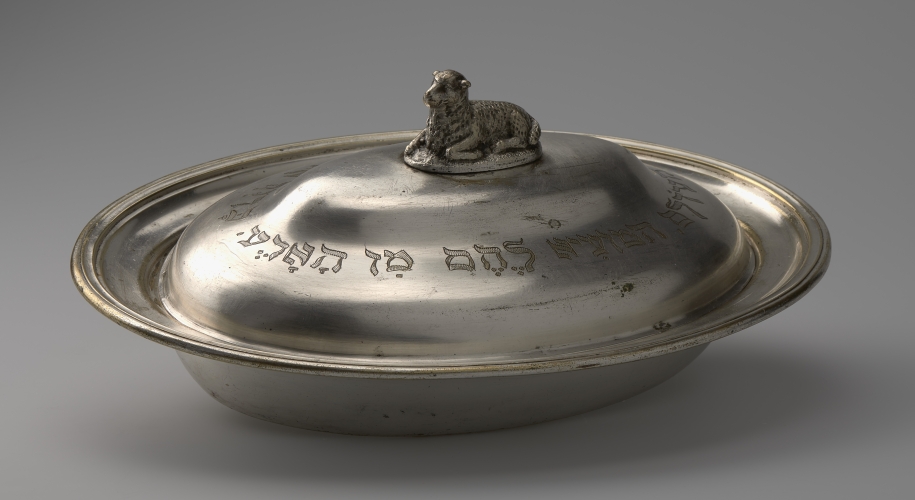
So, in the Museum's collection, on the lid of the silver platter, there is a blessing recited before eating bread (in Hebrew): "Blessed are You, Lord our God, King of the Universe, who brings forth bread from the earth".
Before eating bread, one must ritually wash their hands (in Hebrew: netilat yadayim), usually using a special two-handled vessel (known in Hebrew as kli, or kwarta. The POLIN Museum's collection includes such copper quartas).
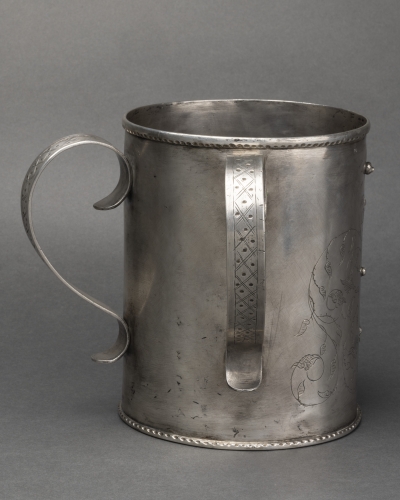
After finishing a meal with bread, it is customary for those at the table to recite the full blessing after eating, birkat ha-mazon.
Halacha also outlines specific rules for milk. It is recommended that it have the status of chalav Yisrael/cholov Yisrael, meaning it must come from milking performed or supervised by a religious person.
Another product subject to special kosher requirements is wine. For religious purposes (such as kiddush, the prayer over wine that sanctifies Shabbat or a holiday - see the decorative silver kiddush cups in the Museum’s collection), as well as for regular consumption in homes and at community events, religious families and individuals only use wine that is certified kosher, with a reliable rabbinical certification.
Piotr Kowalik