
About the items from the former ghetto
What remains of the Holocaust is the ashes of the murdered Jews and the Jewish belongings that, as it were, have 'outlived' their owners.
These are items mixed with ashes and remnants of burnt bones, as the victims had them on their persons at the time of execution, unearthed from the burning pits at the death camps. Dental gold also belongs to this category. This is the sort of thing that groups of 'diggers' used to go out for. There are items excavated from mass graves located somewhere in the forest outskirts, in hollows, sinkholes, and other secluded places, unmarked and forgotten. Some of these are only being discovered recently, having been shrouded in mystery.
The locals knew, but this knowledge hardly made it outside the neighbourhood circle (see the work of R. Sendyko). There are things lurking in the remnants of basements of rubble-strewn houses, in the hiding places, bunkers, and shelters painstakingly built by the Jews. They rest under rubble and soil because they were hidden in secret places by the victims themselves or abandoned in trepidation, in haste, in disorder. Other items simply contributed to the material substance of houses, flats, cupboards, shelves, drawers.
Covered with earth, they become the substrate of new settlements, built on the ruins of the ghetto, like Warsaw's post-war Muranów. Underground Muranów is a unique depository of the Holocaust. It consists of different types of artefacts; material remains, fragmented items, destructs, debris (pieces of bricks, remains of housing structures and other building elements), material remains constituting larger structures (fragments of foundations, cellars, vaults, etc.).
The POLIN Museum of the History of Polish Jews stores various objects excavated from the site of the Museum building and its immediate vicinity. These finds come from archaeological investigations carried out over two periods.
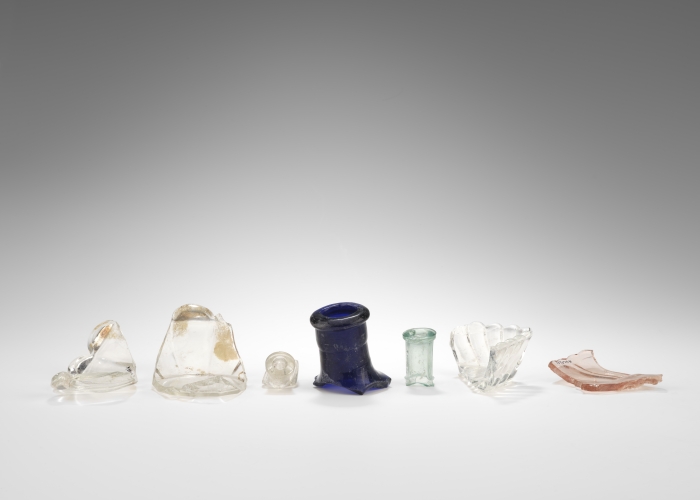
During the first, from 15 September to 31 October 1998, 12 longitudal digs were made on the site of the former Horse Artillery Barracks and three additional ones were made at former Dzika (Zamenhofa) Street. The artefacts excavated at that time made up a total of 87 inventory items, comprising 4638 separate units, expertly described as 'movable archaeological artefacts', dating from the mid-17th to the mid-20th century.
Second archaeological survey was carried out between 12 August and 9 October 2009. The dig site covered the area of the former Gęsia and Dzika Streets. The movable archaeological material acquired comprises a total of 62 inventory items (467 archaeological artefacts; for more on this research, see the text by Katarzyna Reszka "Objects from archaeological research in the area of the former Crown Artillery Barracks and Dzika Street").
The excavated items in POLIN's collection can be divided into two categories.
The first one consists of so-called separated monuments, i.e., objects that are whole and with minor defects, as well as those parts and fragments of objects from which it is possible to quantitatively and qualitatively identify originally whole objects. We are mainly dealing with ceramics (dishes, tiles and objects), glass (dishes and objects), objects made of stone, plastic, wood, coloured metal and iron, fabric, and leather.
Kitchen utensils, such as pots, pans, mugs or baking trays also belong to this group The durability of such seemingly fragile glass is particularly astonishing. Many whole bottles, jars, and pharmaceutical vials have been preserved.
Second category comprises of so-called mass monuments. They occur in small fragments that do not allow the whole to be reconstructed. These are those categories of artefacts for which no clear quantitative identification is possible, such as fragments of broken pottery, glass or animal bone. In this case, the concrete object has been so extensively destroyed that its remains are amorphous enough to not allow the reconstruction of its original shape.
All these things, whole and broken, recognisable in their forms and so damaged as to be already amorphous, constitute the preserved heritage of Warsaw's Jews and those few Poles who lived with them in the northern part of Warsaw.

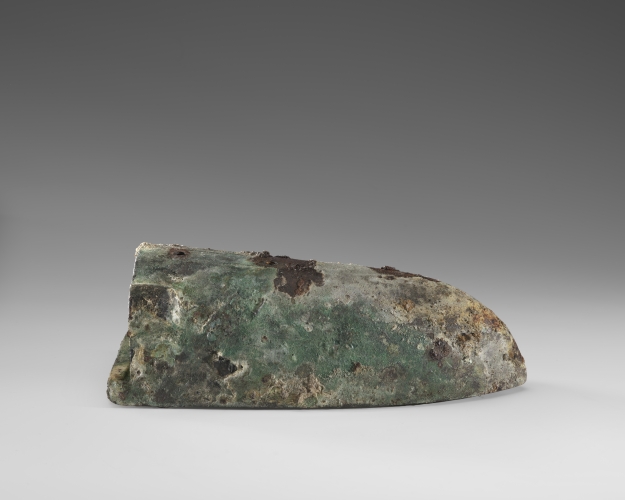
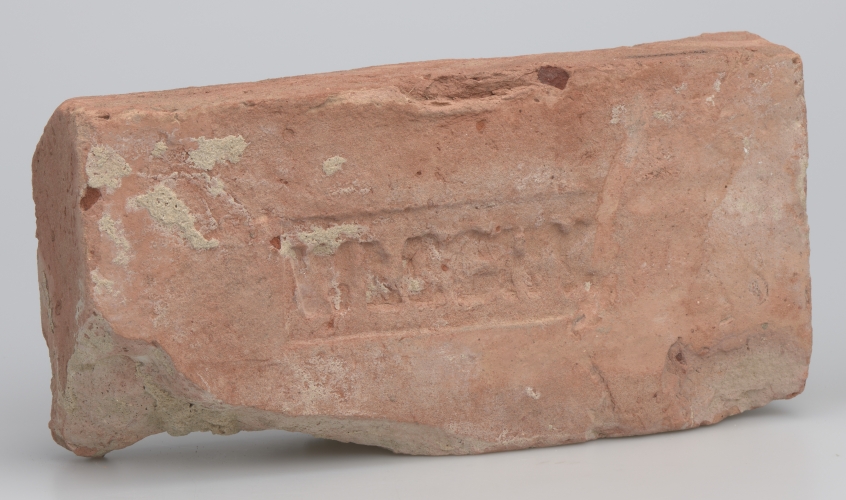
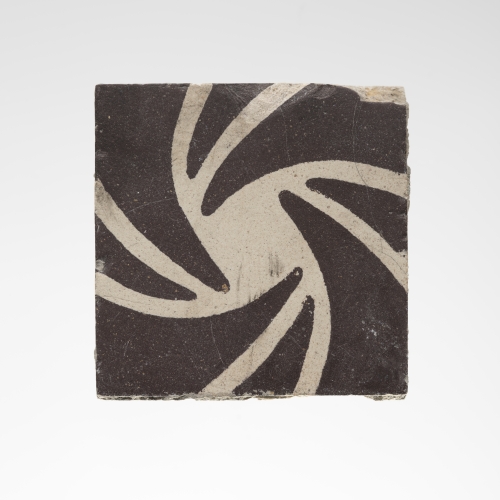
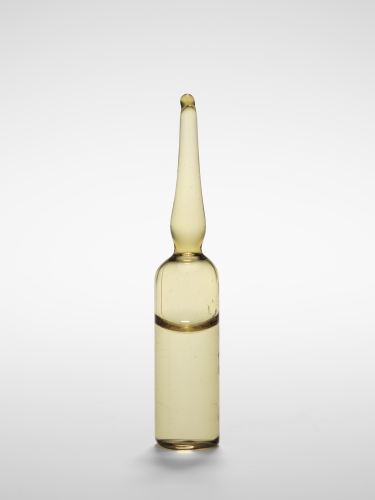
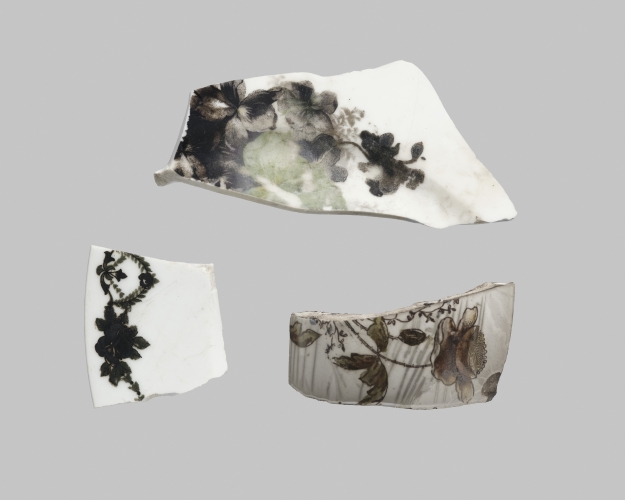
The journey of the Warsaw Jews and of the things they took with them can be divided into four main stages.
Stage one: from 1483 (the first expulsion of the Jews) until the fall of the Commonwealth in 1795. During the Prussian occupation of Warsaw (January 1796-November 1806), the stay of Jews in the city was legalised on condition that they paid the so-called ticket and kosher fee that were already introduced, but restrictions multiplied.
Stage two: a period of forced relocation from place to place and the slow formation of a Jewish district in the northern part of Warsaw. It lasted until 5 June 1862, when a tsarist decree abolished housing restrictions for Jews (the so-called 'exempted streets').
Stage three: when Jews achieved the de iure right to freely choose their place of residence and when the Jewish quarter in Warsaw, known as the Northern District or Nalewki-Muranów District, was finally formed. This period ended with the outbreak of the Second World War.
Fourth and final stage: the time of the Holocaust, marked by three climaxes: the closing of the ghetto on 16 November 1940, the great deportation to Treblinka between 22 July and 23 September 1942, and the Uprising lasting from 19 April to 12 May 1943.
The area of Warsaw, marked by the history of several hundred years of Jewish presence until the final annihilation of people and houses, is in itself a special type of a material and spiritual testimony which demands not only to be commemorated, but above all to be known and understood. One unique type of testimony has the form of the artefacts of various kinds, mostly everyday items, unearthed during the construction of the POLIN Museum building, which, buried during the destruction of the ghetto, remained hidden in the ground for more than half a century, until the first archaeological digs were made in the area in 1998 (I am not referring here to the hordes of diggers of various provenance and people looking for Jewish gold who were digging in the Muranów district during the occupation and in the first years after the war).
These remarkable testimonies needed to be extracted, compiled and made available.
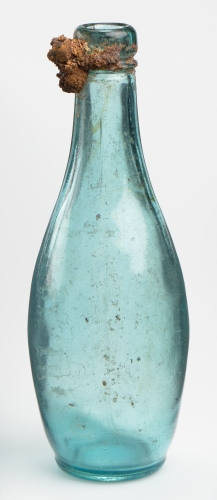
Things dug up in Muranów have a special value. They bear witness not only to the people who owned and used them, to their lifestyles or to their daily employments. They also bear witness to themselves, for it is possible to see a kind of 'life after life' written in their material shape, in their substantiality.
The years of being in the ground have left an indelible mark, a sort of a Holocaust stigma.
This manifests itself both in mechanical damage and in traces of of organic substances such as various types of lichens, fungi or parasites that left their impact. Items from Muranów bear the writing of the Holocaust which demands to be deciphered. A writing from another planet, a writing alien to human language, invading our view in its alienness.
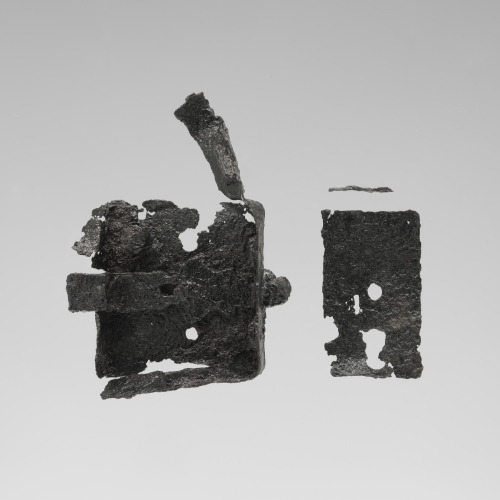
The collection stored in the warehouse of the POLIN Museum include the three iron cassette door locks.
All of them were manufactured in the first half of the 20th century. One of them, inventoried under the number MPOLIN-ZA659, was excavated on the lot located at 21 Dzika Street (what in 1930 was a section from Nowolipki to Stawki Street that was renamed Zamenhofa Street). It was stuck in the bedding layer, in humus, i.e., organic debris produced in the process of decomposition of the organic matter. It is square in shape, with a keyhole. One of the side edges of the lock is bent away from the whole body. At one side there is a protruding cylindrical pin with an octagonal head, perpendicular to the body of the lock. There is also a protruding rectangular element at the other side. One surface of the lock there is a keyhole and an additional circular hole. The other surface has been heavily damaged, the loose part of the plate is held by a pin with a flat round head. A keyhole is also visible in this plate.
The lock with the inventory number MPOLIN-ZA1181 comes from the property at 19 Dzika Street.
The shape of the body is rectangular, its outer corners are damaged. The keyhole is only visible on the back of the box. On one side, a rectangular, flat strip protruding at the bottom beyond the end of the body is attached to the lock. The narrow, handle finished with a semicircle and the sharply pointed pin protruding from the other side have survived.

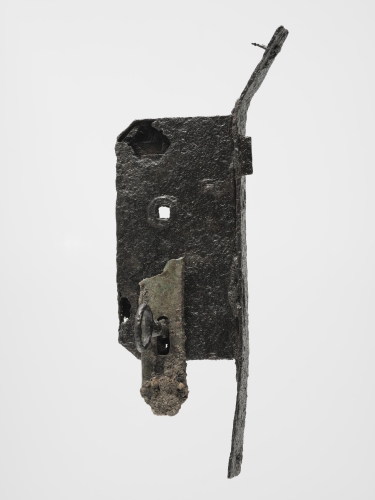
In the lock listed in the museum's storage register under the number MPOLIN-ZA221, excavated on the property at 34 Dzika Street, traces of slightly burnt wood were visible on a surviving fragment of the mounting strip. This means that the lock had been installed in a door that was burned down. The whole item was covered in a thick layer of rust, lichen, organic debris, and root remnants.
It is also quite unusual as the key is still stuck in the lock. A piece of copper signboard, oblong in shape, rests against the key. The key has a hole, an oval head, and a thickened shank under the head.
In the testimonies recorded during the existence of the Warsaw Ghetto (primarily from the Ringelblum Archive), artefacts related to everyday life during the Holocaust, such as locks or keys are a special kind of historical items.
The authors point to theiŕ utility value, as they are used for closing and opening. If something is locked, it means that it is valuable or otherwise important to the owner and is therefore protected. Property is protected from theft, and privacy is guarded against the intrusion and violation of intimacy. Every inhabitant of the ghetto had locked doors, wardrobes, drawers, and chests at home. Locks and hinges were manufactured in the closed-off quarter, and keys were made in craftsmen's workshops. Locks and keys are necessary, you need to have them, and if they break, they need to be repaired (locksmith workshops were located on 38 Grzybowska Street, 78 Okopowa Street, 8 Leszno Street, and on Zamenhofa Street there was a locksmith-mechanic workshop of A. Rozenmajer) or to buy them (at bazaars or in a shops selling metal goods and iron products, such as those at 14 Grzybowski Square or at 24 or 73 Leszno Street).
During the great liquidation action, the Jews driven to the Umschlagplatz and taken to Treblinka locked the doors of their flats, believing that they would return. That is why they wanted to keep the keys with them. These keys were found after the war at the site of a demolished Treblinka camp, similar ones were discovered at Chełmno nad Nerem (German: Kulmhof), Bełżec, Treblinka, and Auschwitz-Birkenau II (they are on display in the museums there; in the case of the Auschwitz-Birkenau museum, items unearthed during archaeological work in 1967 were found in 2016 in the warehouses of the Polish Academy of Sciences).
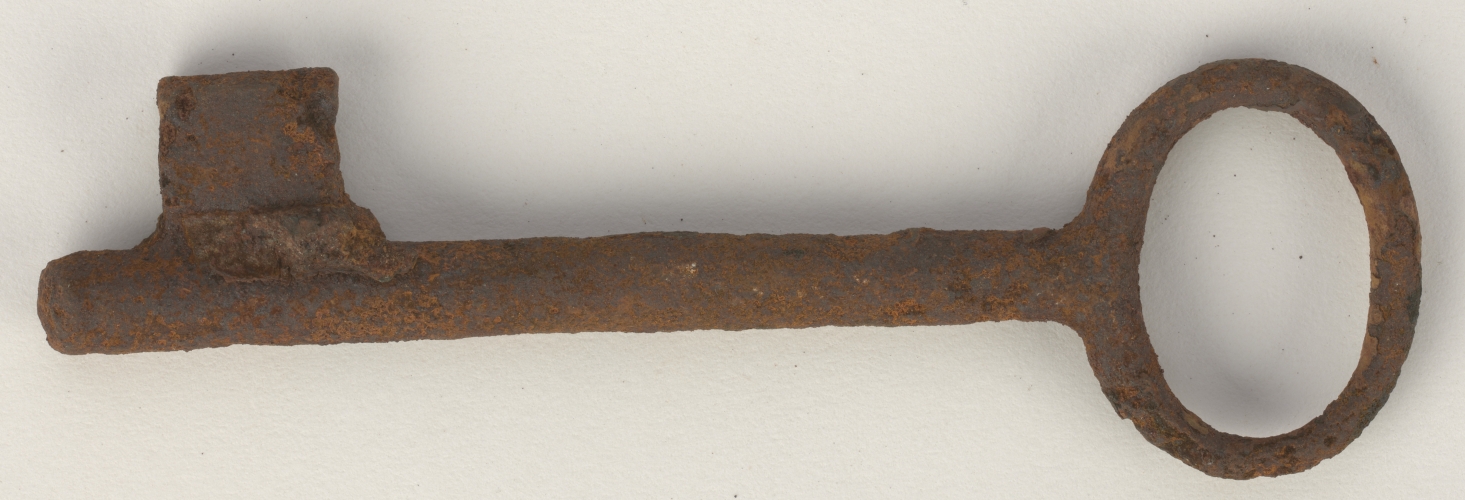
Houses, locked by the victims who had been led away to their deaths were broken into and looted. A motif frequently recurring in the accounts of the deportation action in the Warsaw Ghetto, is one of smashing locks, padlocks and doors with axes. The surviving Jews were also breaking into into the abandoned flats, looking for food or things necessary for their continued existence in the ghetto. Closed doors were also broken down by Polish looters. Their were stealing things that were left by expelled inhabitants. But despite the systematic large-scale robbery and looting, there were still many items left in the houses and on the streets of the closed-off district.
After the final destruction of the ghetto, these things went underground, so to speak. Covered with rubble they remain there to this day.
Things excavated from Muranów soil attracted the interest of museum professionals and artists. Six months after the inauguration of the POLIN Museum, the exhibition 'Biographies of Things' opened, displaying a selection of donations and deposits, including items unearthed in the Muranów area (but also from elsewhere in Poland) which have no artistic value but document everyday life, often amounting to trivial shards of banality. The exhibition, which ran from October 2013 to February 2014, was accompanied by a series of meetings, seminars, and discussions.
In September 2015, artists Aslı Çavuşoğlu with Malgorzata Kuciewicz and Simone De Iacobis from the Centrala design group exposed the ground in the courtyard at Karmelicka Street, near the former site of the Evangelical Hospital. "In addition to the incomplete furnishings of Jewish houses: pieces of bricks, floor tiles, vessel fragments (...) [they found - JL] several objects of symbolic significance, such as a badge with a depiction of bicycle and a Star of David, a silver fork, a pharmaceutical vial", writes Beata Chomątowska ('Okruchy pamięci', Znak 2017, no. 745).
In the spring of 2017, Patrycja Orzechowska, visual artist, portrayed a selection of former Jewish objects on light-sensitive material as part of her residency at the POLIN Museum. "Exposing objects from the collection in a darkroom arranged on site at the POLIN Museum, invisible to staff or visitors, I felt that although most of them have no collector's value, they contain a powerful emotional charge. (…) I was anxious not to accidentally damage anything in that darkness, even a simple tile from the debris, because if it crashes on the floor, it can't be replaced by another one" (quoted from the article by B. Chomątowska).
In April 2017, Daria Siwak, a jewellery maker, posted photographs of three rings found in Muranów on a local online forum. They were not for sale. In her workshop, she preserves objects excavated from the ground, such as pieces of sooty bricks or rotten wood. She immerses them in a transparent resin that enhances their shape and colour. They then take on new life, according to Daria Siwak.
A temporary exhibition 'Tu Muranów' ('Muranów here') had been opened in 2020 at the POLIN Museum of the History of Polish Jews . In the conceptual plan for the exhibition, items unearthed during the archaeological excavations during the construction of the POLIN Museum building played a key role. They appeared in two locations.
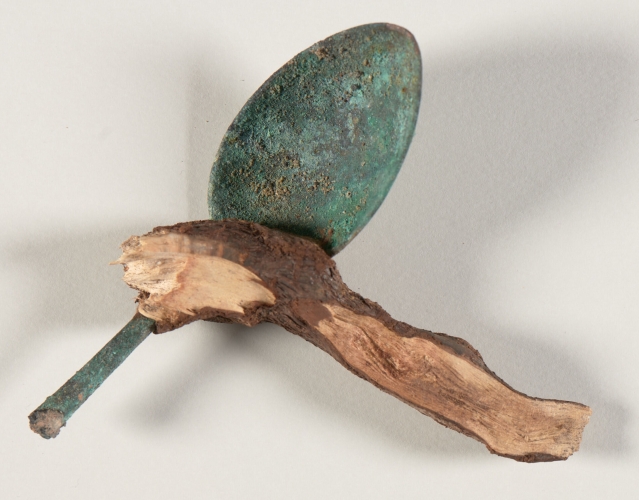
At the very beginning, in the part that can be called the prologue. On the large table, under the protective transparent domes, lay ordinary objects used in everyday life: a piece of kettle, a smashed plate, a broken spoon... It's just that this spoon, completely covered with patina, is entwined with a root, fused to the metal. It is a testimony to what went on beneath the surface of the Muranów soil after the war, before the object was brought to the surface.
The second place where we could find things excavated from around the present-day POLIN building was a long display case containing various artefacts under glass. Some can be easily identified, others – damaged, shattered, fragmented – elude our identification.
They are like the remains of a non-existent world that we find, but which we can no longer fit into anything, we cannot recall any context that would allow them to be tamed or domesticated, so to speak.
They are separate, alone, alien. And this strangeness of them seems all the more poignant the more these remnants of things are ordinary and close to our everyday experience.
The 'Tu Muranów' exhibition was organised in two areas: an indoor museum space and an outdoor space on the square next to the Monument to the Heroes and Martyrs of the Warsaw Ghetto. The authors of the art installation presented there were Artur Żmijewski, Zofia Waślicka-Żmijewska and Marcin Kwietowicz.
Photos and short videos showing items from the POLIN Museum's warehouse were displayed on tables set up there. Photographs and films juxtapose objects excavated from the vicinity of today's POLIN building with their contemporary counterparts. A meeting space was arranged, serving as a natural milieu for selected things.
Tailor's shears, covered in a thick layer of rust, were brought by the artists to moden tailor's workshop, filled with today's tailoring instruments. Forks dug out of the ground lie next to contemporary cutlery. Kettle, mug, jug, pot or baking tray found their place among the kitchen crockery used nowadays.

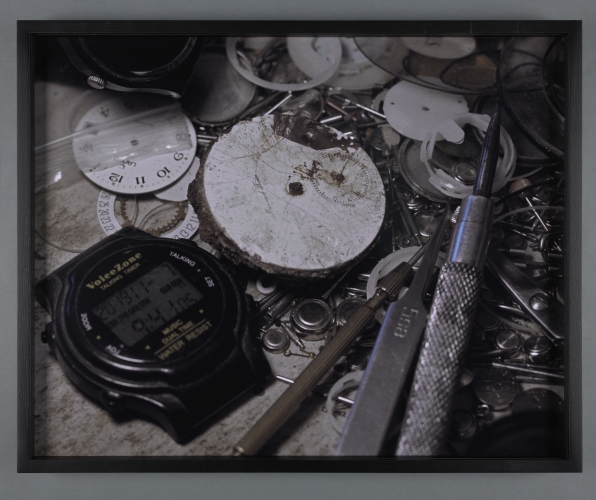
Extracted from the rubble of the ghetto, the watch, or rather the deformed dial without hands, lies next to other watches in the watchmaker's workshop. The watchmaker takes it carefully in his hand, examines it through a magnifying glass and raises it to his ear to hear the steady ticking of the second hand, which has stopped its course in the fires of the Holocaust.
All of these borrowed items are therefore finding their place. They are at home again. They are back among us.
Jacek Leociak
References (selected)
Joanna Borowska, Ryszard Cędrowski, 'Ślady nieobecnej obecności mieszkańców dawnej dzielnicy żydowskiej w Warszawie', in: Archeologia współczesności, vol. 1, ed. Anna I. Zalewska, Warsaw 2016.
Beata Chomątowska, 'Okruchy pamięci', Znak 2017, no. 745.
Jacek Leociak, 'Redefinicja kategorii świadka i świadectwa. Refleksje wokół rzeczy wykopanych na terenie miejsca po getcie', Teksty Drugie 2018, nr 3.
(mal), 'Muzeum Auschwitz: Odnalezione rzeczy ofiar będą pokazywane na wystawach', RMF 24, 8.06.2016, https://www.rmf24.pl/fakty/polska/news-muzeum-auschwitz-odnalezione-rzeczy-ofiar-beda-pokazywane-na,nId,2215216#crp_state=1 dostęp: 10.01.2018.
Nie-miejsca pamięci 1. Nekrotopografie, ed. R. Sendyka et al., Warsaw 2020.
Nie-miejsca pamięci 2. Nekrotopologie, ed. R. Sendyka et al., Warsaw 2020.
P.P. Reszka, Płuczki. Poszukiwacze żydowskiego złota, Warsaw 2019.
M. Rusiniak, Obóz zagłady Treblinka II w pamięci społecznej, Warsaw 2008, especially the chapter 'Długi cień Treblinki - Eldorado Podlasia?'.
R. Sendyka, Poza obozem. Nie-miejsca pamięci – próba rozpoznania, Warsaw 2021.