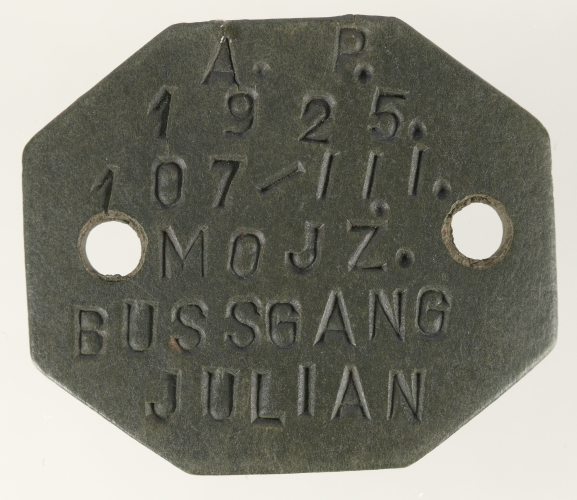
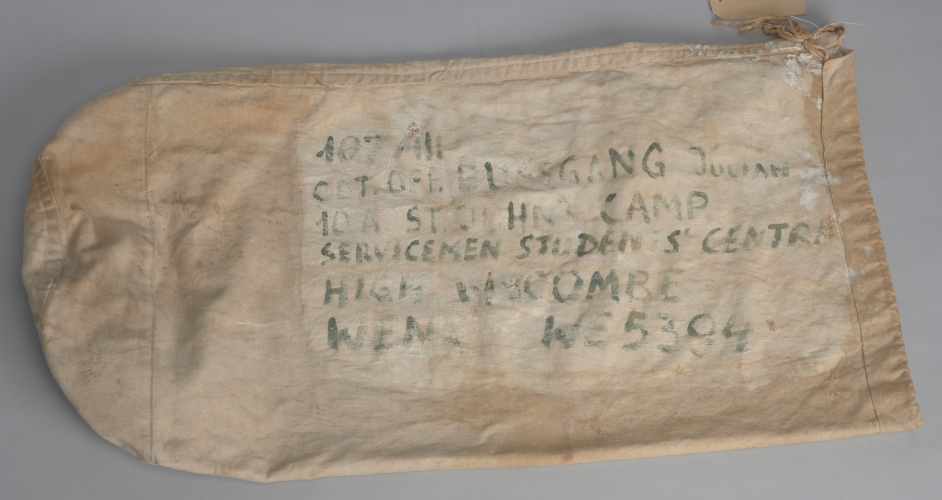
In an interview conducted for the United States Holocaust Memorial Museum in 2002, Julian Bussgang recalls his youth in pre-war Poland and the years of war and service in the Anders Army.
He was born on 26 March 1925 in Lviv to a Jewish family with roots in the Eastern Borderlands: his father came from Rohatyn (now Ukraine, Ivano-Frankivsk region) and his mother from Lviv. Julian's parents met in Lviv - his father had moved there for business purposes.
The Bussgang family was assimilated (to learn more on the assimilation process, see https://sztetl.org.pl/pl/slownik/asymilacja). They spoke Polish at home, but most of their friends were Jews very familiar with Polish culture just like the Bussgang family. Surrounding themselves with acquaintances from a similar cultural background was characteristic of this group of Jews. The family was well off - there were servants in the house. Julian, together with his older sister, studied French and German.
The Bussgangs attended the Tempel Synagogue in Lviv - the first reformed synagogue in Galicia. The designer of its building was Jan Lewicki, who drew inspiration from the Viennese city synagogue at 4 Seitenstattgasse Street (to learn more, see https://sztetl.org.pl/pl/miejscowosci/l/703-lwow/112-synagogi-domy-modlitwy-mykwy/86677-synagoga-tempel-we-lwowie-staryj-rynok-14 or A. Maślak-Maciejewska, "Modlili się w Templu. Krakowscy Żydzi postępowi w XIX wieku. Studium społeczno-religijne", Kraków 2019).
When Nazi Germany attacked Poland, Julian's father made the decision to evacuate from Lviv relatively quickly - on the first days of September 1939. The family owned a car, which was not common at the time, but which significantly sped up the escape. The Bussgangs reached Romania, where they met members of the Polish government and representatives of the Polish Bank (to learn more on the course of the first days of the war, see https://sztetl.org.pl/pl/slownik/wybuch-drugiej-wojny-swiatowej). While in Romania, Julian attended a French school.
The next stop on the Bussgangs' journey was Palestine, specifically Tel Aviv, where they settled on one of the main streets, Dizengoff. Julian and his sister studied at a Polish school, which was also attended by many children of Polish government representatives.
In 1943, Julian Bussgang joined the Anders Army. As he recounts in an interview in 2002, his main motivation was to fight against the Nazis. He took part in many battles, including the famous Battle of Monte Cassino. As he recalls: "The battle of Monte Cassino was a battle of Poland".
All Polish citizens could join the Polish Army in the USSR under the command of General Władysław Anders. However, on 1 December 1941, the Soviet authorities announced that they considered only people of Polish nationality to be Polish citizens, while Byelorussians, Ukrainians, Lithuanians and Jews would be treated as Soviet citizens and could not join the Polish army. The Polish ambassador protested. As a result of negotiations, the USSR authorities agreed to recognise as Polish citizens those Jews who came from central and western Poland. However, this order was applied inconsistently - the difficulties in restoring citizenship to Jews were increased not only by the delegates of the Soviet authorities, but also by the Polish military. The reason for this, in addition to nationalism and anti-Semitism, was the limited number of food rations granted to the Polish army under an agreement with the USSR government. Nevertheless, it is estimated that around 3,500 Jews served in the Anders Army. However, while stationed in Palestine, around 3,000 of them deserted and joined Jewish military organisations: Haganah and Irgun.
The experience of constant wandering left its mark on Julian, who confessed that he felt more like a refugee than a survivor. The family's attachment to Poland is evidenced by Julian's recollection of his father, who is said to have kept the keys to his home in Lviv for the rest of his life.
Natalia Różańska