
Dąbrowszczacy – Poles in Defence of the Spanish Republic (1936–1939)
Krzysztof Persak
On 7 July 1936, nationalist and monarchist groups led by General Francisco Franco launched an armed rebellion against the constitutional government of the Spanish Republic.
In a time when fascist and authoritarian regimes were taking sway in Germany, Italy, and other European countries, the Spanish Civil War came to be seen as a stand-off between the progressivism and democracy embodied by the Republic and the forces of reactionary and totalitarian movements. Following the outbreak of the conflict, leftist groups throughout Europe joined forces in an international alliance in support of the fighting Republic. Early on in the war, this movement enjoyed the support of the French government formed by the Popular Front.
In the summer of 1936, the People’s Olympiad was set to take place in Barcelona as a left-wing alternative to the 1936 Olympic Games organised in Berlin by Germany’s Nazi government. Many of the athletes who arrived in Spain, including around a dozen Polish émigrés from France, volunteered to pick up arms for the Republic. This was the inception of the International Brigades, formally established in October of the same year under the auspices of the Communist International.

The first Polish unit in the Brigades was formed on 8 September 1937, its patron being Jarosław Dąbrowski. A 36-person MMG (medium machine gun) battalion, it immediately engaged in combat, fighting in the area of Tavalera de la Reina. As more and more volunteers were flocking into Spain, the unit was expanded to form the 9th Dąbrowski International Brigade. In November 1936, it comprised three infantry companies and one MMG company, around 500 soldiers in total. The name traditionally referring to all Poles fighting on the side of the Spanish Republic – ‘Dąbrowszczacy’ – comes from the unit’s patron, a Polish emancipation activist and general of the 1870 Paris Commune.
Many Polish volunteers joined other units forming part of the International Brigades (e.g. Poles fighting in the German battalion under Ernst Thälmann or in the ranks of the). Apart from the Dąbrowski Battalion, the Polish units involved in the Civil War were the Mickiewicz Company (later Battalion) in the 13th International Brigade and the José Palafox Battalion formed in 1937 (the latter included the Jewish Naftali Botwin Company). Several dozen Polish physicians and nurses worked in the medical services of the International Brigades. One of the doctors was Leo Samet, whose personal items from the period of the Spanish Civil War now form part of the POLIN Museum collection.
In late 1936, a total of ca. 850 Poles fought in Spain in various international units. Most Polish volunteers were economic migrants to France and Belgium. They usually had ties to the left-wing trade unionist movement, some were communists. With time, volunteers coming directly from Poland started to arrive in Spain – a group estimated at several hundred people. According to detailed statistics from late December 1937, the Polish units of the International Brigades comprised 1,648 Poles, 521 Jews, 206 Ukrainians, 55 Belarusians, 26 representatives of other nations (216 soldiers did not disclose their ethnicity). Among these, 1,700 had arrived from France and Belgium and 380 from Poland. It is estimated at a total of ca. 5,000 Polish citizens passed through the ranks of the Republican forces, which constituted one sixth of all international volunteers. Some 3,000 Poles died in defence of the Spanish Republic.
The Dąbrowski Battalion had its first chance to prove itself in battle in November 1936, during the heavy defensive combat in Madrid taking place in the Casa del Campo park and the university campus. The battalion lost half of its manpower. After replenishment, it fought in the Battle of Jarama at the beginning of 1937. This was followed by the Battle of Guadalajara in March, in which the Poles fended off the attack of Italian troops. In the same period, the Mickiewicz Company fought on the frontline near Cordoba. The Dąbrowski Battalion once again suffered heavy losses in June 1937, in the Huesca Offensive on the Aragonese front.

The troops underwent reorganisation in August 1937, which resulted in the formation of the 13th Jarosław Dąbrowski International Brigade. It merged most of the Polish units active in Spain, including the Dąbrowski Battalion, the Mickiewicz Battalion, and the Palafox Battalion. However, Polish soldiers became a minority in the newly established 3,055-strong unit. Over the following months, the 13th Brigade fought in battles in the vicinity of Brunete west of Madrid, Fuentes del Ebro and Teruel in Aragon, and Extremadura, where the Botwin Company suffered defeat.
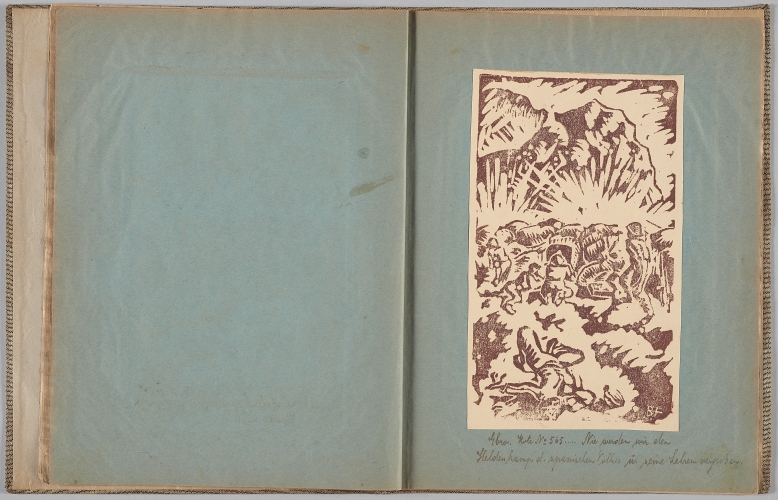
Throughout the war, the International Brigades were deployed to fight on the most challenging sections of the front. The largest – and last – operation in which they took part was the Battle of the Ebro in July 1938 (this is why it has been immortalised in a sketch made by a soldier, now in the POLIN Museum collection). The 13th Brigade engaged in combat for control over the strategic locality of Gandesa, but it did not manage to push away the enemy. Planned as a break-through, the Republican offensive failed, and the frontline returned to its initial position two months later.
In late September 1938, the government of the Spanish Republic, motivated by the international political situation, decided to disband the International Brigades and withdraw foreign volunteers from Spain (at the time, ca. 12,000 of them were fighting in the war). The last soldiers of the 13th Dąbrowski Brigade crossed the French border on 9 February 1939. A year earlier, the Poland’s government had stripped the people fighting in the ranks of the Republican forces of Polish citizenship, which is why most of the Dąbrowszczacy who arrived in France were detained in internment camps as stateless persons. Their later fortunes followed varied paths.
Some managed to join the Polish Army in France after the outbreak of World War II, others fought in the French Foreign Legions, and many became involved in the anti-Nazi resistance movement in France. The Vichy government moved a group of former Dąbrowski Brigade soldiers to an internment camp in Algeria. Having been freed by the Allies in 1942, they made their way to the USSR.

Others still, for example former 13th International Brigade commander Bolesław Mołojec, were transported to Poland during the German occupation and helped create the structures of the Polish Workers’ Party and the People’s Guard. Several dozen others were involved in the communist apparatus of repression (Henryk Toruńczyk was the first commander of the Internal Security Corps, and Wacław Komar became chief of military and civilian intelligence).
About a half of the 1,000 former Dąbrowski Battalion soldiers who survived World War II came to stay in the Polish People’s Republic (mainly migrating back from France). One of the most prominent representatives of these circles in the immediate postwar years was Gerszon Dua (Bogen), but he died in a traffic accident in 1948 (the POLIN Museum collection holds the lettering design for his tombstone).
As a group, Dąbrowszczacy did not play an important political role in People’s Poland. The Communist propaganda used them as an element of the mythos of the Polish nation’s progressive stance and struggle against fascism, although the figure most prominently promoted in this regard was Karol Świerczewski aka ‘Walter’, a Soviet general of Polish descent with no ties to the Dąbrowski Brigade. At the same time, however, the state authorities had a rather ambivalent attitude towards Dąbrowszczacy. Some of the veterans fell victim to the Stalinist repressions of the 1950s, considered suspect due to their international contacts. Among those who ended up in prison were Wacław Komar, Stanisław Flato, Michał Bron. Later, in March 1968, some Jewish former members of the Dąbrowski Brigade were targeted in the country-wide anti-Semitic smear campaign. One of them was Emanuel Mink, commander of the Botwin Company, who returned to Poland from France in 1950 but was forced to leave the country during the March ’68 purges. One of the last living Dąbrowski Brigade fighters, he died in Paris in 2008 aged 98.


After 1989, the state was not eager to commemorate Dąbrowszczacy in Poland; quite the opposite – in the efforts to ‘decommunise’ public space, the authorities pushed them into oblivion. In 1990, a plaque commemorating the activities of the International Brigades in Spain was removed from the Tomb of the Unknown Soldier in Warsaw. The former Dąbrowski Brigade soldiers were also at a risk of losing their veteran privileges. A fierce debate on the subject re-emerged in Poland in 2007, after the socialist Spanish government adopted a law rehabilitating Republican forces and condemning the Franco regime. At a time when Spain was granting citizenship to the veterans of the International Brigades and France was recognising them as equal to Résistance fighters, right-wing opinion writers in Poland were referring to Dąbrowszczacy as ‘Stalin’s soldiers’ and blaming them for the installation of Communist rule after the war.
The controversy saw its climax after the streets named after the Dąbrowski Brigade in Warsaw, Gdańsk, and Olsztyn were forcibly renamed under the 2016 law prohibiting the commemoration of ‘people, organisations, events, or dates symbolising communism’. Eventually, three years later, administrative courts repealed the ordinances of provincial governors and the original street names returned. The same period saw the formation of a social initiative called ‘Hands off Dąbrowski Brigade Street’ [Łapy precz od ul. Dąbrowszczaków], which then gave rise to the Volunteers of Freedom Association, restoring the memory of soldiers who fought in the International Brigades.
Krzysztof Persak