
Bio-Texture. Helena Berlewi
The vase seems to be growing out of the earth. If the little vase, in which a bouquet of small red flowers nestled in a sheath of leaves once stood, was made of glass, then it really did come from the earth, because the main ingredient of glass is quartz sand. Similarly, if it was made of porcelain. Keramos in Greek, meaning earth or clay. The vase grips and holds the bouquet as if it was a tense muscle, a powerful paw which has grasped it and will not let it go.
No one, like Helena Berlewi, could capture the materiality of flowers. About representations of still life, French psychoanalyst Gérard Wajcman writes:
"Ni nature, ni morte” (Neither nature nor death). Still life does not tell the story of nature, but the story of bodies. Although no bodies are visible, the body is the great absence of still life."
The scholar claims that this is because still life presents objects from a person's immediate surroundings - objects which are sources of pleasure and delight and, thus, sources of life. That is why, in Helena Berlewi’s compositions, the vase attracts as much attention as do the flowers. Like them, it is alive. Every element of the painting is alive, even the signature. For years, Helena Berlewi was defined as a painter of flowers. That is the title of Konstanty Gordon's 1967 film "Kwiaty Hel Enri" (The Flowers of Hel Enri). Nothing could be more mistaken.
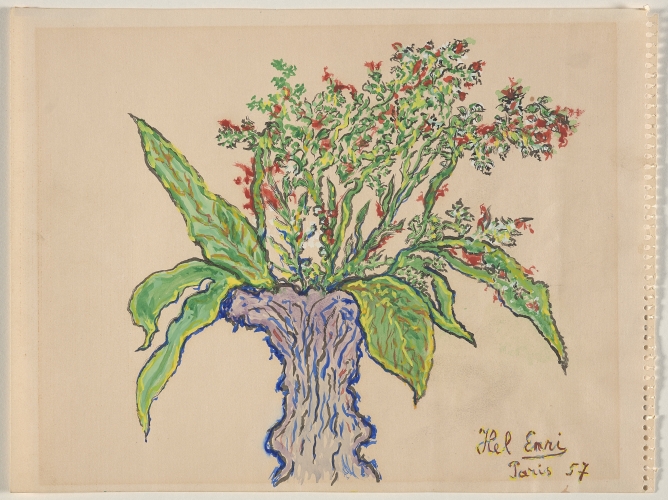
In her tempera and oil paintings, works on paper with watercolour, markers, or ink, we indeed see flowers - but they are merely a manifestation of the deeper issues which concerned her and which are more complex than merely the representation of a fragment of the surrounding world. These concerns are binding, connecting, and flowing - in other words, communication between the subject and the world. The fact that this is a female subject has its own significance.
Women’s art often arises, if not in opposition, then at least in dialogue, with a dominant narrative language. By choosing flowers, Helena Berlewi, whose artistic activity spanned from 1952 to 1973, positioned herself in relation to two currents of that narrative.
The first was the professional art scene, where flowers and still life belonged to a lower status genre, traditionally assigned to women and naive painters. The second - her son Henryk Berlewi’s artistic career and achievements, a major figure of the 1920s Polish and international avant-garde.

Hel Enri and the field of contemporary art
Helena Berlewi, known artistically as “Hel Enri”, made her debut in 1954 with a solo exhibition at the M. Bénézit Gallery in Paris. This venue, which drew upon the tradition of the École de Paris, showcased the art of émigrés such as Józef Czapski, Kim Whanki, Michel Adlen, Zawado, Boris Taslitzky, as well as works by non-professional artists. Berlewi belonged to both categories.
By taking up the still life genre, and particularly flowers, the artist - according to the sociology of art - acted in line with her disposition. Her class status, based upon her background, was high. Born in 1873 in Warsaw, she came from a wealthy family. In her youth, she received an artistic education focused on music, taking private singing lessons. Like many daughters from Jewish households in the late 19th century, she was raised in both Polish culture and language, as well as Yiddish culture. She married at the age of eighteen and lost her husband, Izaak Berlewi, early - around 1912. As far as we can reconstruct today, he was a deeply religious man. Helena had three children - two sons and a daughter. Her elder son, Henryk, received formal training in art, studying at art academies in Warsaw, Paris, and Antwerp.
After her son's emigration in 1928, she most probably lived in Nice, perhaps also dividing her time between Paris and Antwerp, the two cities where Henryk worked and created. She and her family survived World War II and the Holocaust in France. Following the war, Helena lived with Henryk in Paris, although their financial situation had worsened significantly. Following his death in 1967, she continued creating art and did not interrupt her artistic work.
The choice of the flower motif in 1952, from which her first known work dates, confirmed her social position - that of a person with a high level of literary and artistic culture, yet still seen primarily as a housewife. Flowers are a common subject in the work of non-professional women painters. In the history of French painting, the best example is Séraphine Louis, whose promoter and discoverer was Wilhelm Uhde.
Regarding women artists, especially to those labelled as "naïve", flowers respond to a certain social demand. A woman artist, who begins her creations by painting a bouquet of flowers, does not disrupt her worldview and ensures that the gender order remains undisturbed.
Norman Bryson identified the status of still life, among other painting genres, as a lower-ranking form, associated with the feminine element, and recognised its gendered inflection. This does not necessarily mean that “still life” was painted primarily or exclusively by women, but rather that it was associated with the domestic sphere and activities of care and maintenance and, therefore, was to be regarded as secondary or inferior.
According to Bryson, the opposition between high genres such as history painting and “still life” is ultimately a tension between the elevated and heroic and what is linked to intimacy and daily routine.
This polarisation is rooted in the social determinants of gender difference and in cultural narratives about women and femininity. As Elisabeth Grosz has observed, in Western culture, the female body is constructed as uncontrolled, fluid, lacking clear boundaries or contours - a formless overflow. It is therefore perceived as a threat to order, structure and to what is culturally read as “masculine”. This fluidity or formlessness corresponds to the historical association of femininity with nature, and often with residue, dirt, disease and that which is considered impure.
In Hel Enri’s early work, especially between 1952 and 1958, classically composed floral arrangements can be found - flowers in bouquets, sometimes placed in vases. An example of this is a 1957 watercolour on paper, held within the collection of POLIN Museum. However, this was not the rule.
Works from around 1952 also include compositions in which elements such as flowers, branches or leaves are scattered across the surface of the painting - without any clear indication as to whether the surface is vertical or horizontal. These works verge on the abstract/ornamental.
Over time, her art evolved - in that very direction. The flowers freed themselves from vases and bouquets, transforming into botanical or landscape-like motifs or metaphorical compositions. A growing sense of fluidity, fraying, ambiguity and a disruption of gravity began to emerge, as if Hel Enri was permitting the culturally-negative connotations of femininity to speak freely.
Some of her 1960s works significantly depart from the model of still life. Viewed through the lens of critical gender studies, one could argue that, in Hel Enri’s paintings, the cultural norm of femininity is exploded through a joyful, energetic and pleasure-filled affirmation of femininity - thereby
undermining the very foundations upon which that norm is constructed.
Helena and Henryk
In the text about her painting entitled “The Language of Flowers”, published in the 2019 catalogue for the artist’s monographic exhibition, organised by Galeria Wejman in Warsaw, I used the term “bio-facture.” I argued that the way, which Hel Enri constructs pictorial space, is analogous to the approach to painting formulated by her son, Henryk Berlewi, the originator of the concept of "mechano-facture".
I would now like to expand on this idea to avoid the impression that it is merely a rhetorical device, lacking any theoretical significance. On the contrary, the bio-factural quality of Berlewi’s work is central to its uniqueness, and to its clear divergence from what is commonly labelled as “naïve art” or the work of amateur painters.
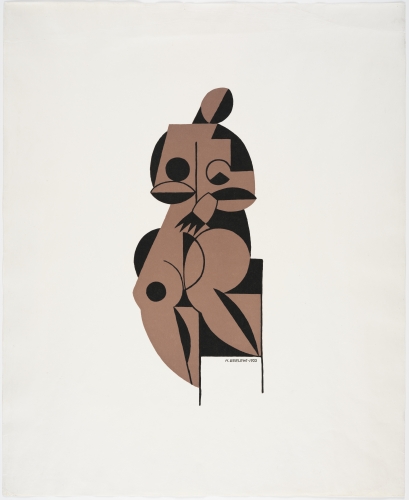
Mechano-facture, whose theoretical foundations were laid by Henryk Berlewi in 1923–1924, was based on a specific form of translation or transposition. Berlewi believed that what aligned with the spirit of modernity was a flat, two-dimensional treatment of a pictorial surface. He believed that a painting should use means appropriate to its nature - its material properties - and these properties are two-dimensional.
As such, all textural impressions should be rendered pictorially - within the painting's own language. Sculpture, hapticity, collage-like assemblage and, thus, any intrusion of a third dimension, should be eliminated. A painting must remain flat - otherwise, it ceases to be a painting.
What Clement Greenberg would later proclaim - the primacy of the famous concept of “flatness” as a rule of modern painting - had already been formulated earlier and more radically by Henryk Berlewi. In 1923 and 1924, during his period of programmatic collaboration with Constructivist and post-Dada avant-garde circles, the artist strictly adhered to this principle in his compositions. He introduced flat equivalents of materials and textures, only expressed through the arrangement of lines.
For him, by 1952, mechano-facture was already something from the past. In the late 1920s, Henryk Berlewi moved away from avant-garde forms and turned to portraiture and still life painting. Straight after the war, his art entered a period of "reintegration of the object". It was only at the end of the following decade that he returned to abstract art and, once again, he appeared in exhibitions as the creator of mechano-facture.
In 1957, there came a turning point, when he participated in the exhibition of Polish abstract pioneers at Galerie Denise René in Paris, as well as in “Fifty Years of Abstract Painting”, curated by Michel Seuphor at Galerie Creuse. One may speculate as to what extent this return, this renewed attention to the surface values of painting, was influenced by the artistic emergence of Hel Enri.
When Hel Enri first picked up a brush and paints in 1952, she stood closer to the avant-garde, with its radicalism and reductivism, than her son Henryk did at that time.
I theorise that, firstly, through her bio-facture, she recalled Henryk Berlewi’s mechano-facture. Secondly, she translated the idea of mechano-facture into a language and a voice of nature. Thirdly, she engaged in a particular polemic with it - from a feminine, anti-formalist perspective.
As her practice evolved towards a more abstract treatment of pictorial elements, Berlewi directed attention to the medium itself. She described and defined painting as the result of an interplay between two dimensions.
“Flatness” accompanied her every step. The artist remained committed to the principle that a painting is a flat work, but also - echoing the premises of the radical avant-garde - that a painting’s task is to describe the conditions of its own making. The sensation of a pulsating surface, of swirling motion, of biological, nerve-like facture that differentiates distinct forms - these are the distinctive features of Helena Berlewi’s painting.
While, during the mechano-facture period, Henryk sought to represent the distinct properties of materials using mechanical raster, Helena was drawn to various types of tissue. She created equivalents of entities with diverse cellular textures and differing DNA.
Painting and History/Experience
As we know, there is no such thing as viewing objectively. Everyone views in their own way - also because viewing is not a passive act. It is an activity rooted in the individual, in their body, preferences and experiences. It is also conditioned by the collective and the social contracts that govern it.
As John Berger wrote, viewing requires effort: “We only see what we look at. To look is an act of choice.”
For André Breton, the "eye in its wild state" is a synecdoche of the subject. It is a separate entity governed by its own impulses and desires, able to soar skyward or plunge sharply underground. It is a bodily probe linked to the brain - a kind of organic drone.
Following the discoveries is visual physiology and Surrealism, in his art theory, Władysław Strzemiński developed the concept of the after-image. After-images come in different forms. Some are short-lived, momentary, physiological memories - moving images that shift under the eyelid, formed on the retina after looking at a light source.
However, according to Strzemiński, there are also memory-based after-images, connected to long-term memory, deeply rooted in personal history and experience. These are images which we store in our inner visual archive, which return to us, sometimes vividly, with precise detail, as if appearing before our eyes.
We may ask, what were Hel Enri’s after-images and what story do her plant compositions narrate?
Helena Berlewi, born Helena Szrajber into a Jewish family, decided to leave Poland in 1928. Without doubt, this decision was influenced by her son’s earlier departure. It is possible that her other children also emigrated around the same time - Marian Berlewi, a book editor and religious history scholar, and Róża (later Stephanie), who was a trained musician.
After the war, they lived in Paris. However, there is no confirmation that they were there at the outbreak of the war. We ae able to reconstruct that, following the German invasion of France, Helena, her daughter Róża and Henryk found themselves in the Nice region. For a time, Nice had a special status. Until Italy’s surrender, it was under Italian administration. During that period, tens of thousands of Jews passed through Vichy territory to reach Nice, where many found temporary refuge.
In September 1943, when the Nazis entered, the first deportations from this region It is likely that, around this time, Helena and her daughter ended up in a transit camp, waiting to be deported to Drancy and, from there, to an extermination camp.
This was described in a testimony by Izabela Czajka, entitled “A Beautiful Evening”, published in the weekly Świat in 1957. They managed to escape. It remains unknown where they stayed afterwards, how they avoided other deportations or how and where Henryk survived.
In 1965, Helena gave an interview to the Jewish Press in New York, in which she said that fifty-six members of her family perished during the war (see reprint in: Hel Enri. Retrospective 1952–1970, Lyon 1970). This brief statement testifies to her close connection with family members who survived in Poland.
In one interview, the artist described painting as a means of remembering. Her works, especially those in which we see interwoven branches and broad forms that seem to support one another in a self-sustaining network stretched across the canvas, recall, in their structure, the way a story is told.
In storytelling, a story branches out and blossoms. As Roland Barthes writes, “Every point in a narrative radiates simultaneously in several directions.”
Hel Enri’s plants may serve as symbolic representations of the Kabbalistic Tree of Life, but they also resemble a living genealogical tree. They depict - in organic and biological terms - the story of life unfolding, the formation of pairs, splitting and branching out. At times, there is a sense that the number of buds, fruits, twigs and flowers is not accidental.
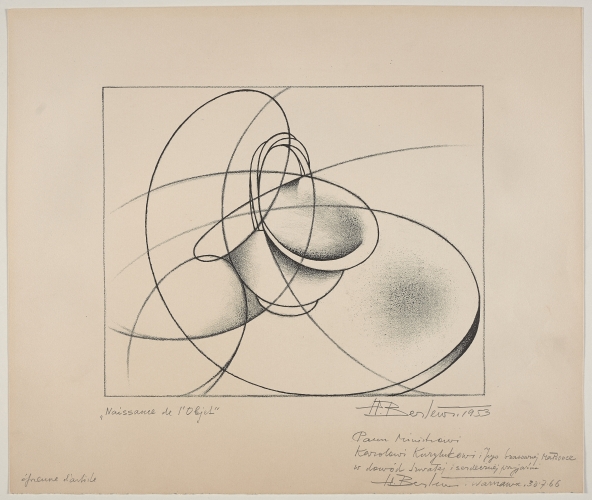
As well as a painting by Hel Enri, created in Paris in 1957, the POLIN Museum collection also received a work, on paper, by Henryk Berlewi, bearing a dedication, dated 30 July 1966, to Karol Kuryluk and his wife Maria: "To Minister Karol Kuryluk and his esteemed wife, as a token of enduring and heartfelt friendship." These objects were donated to the museum’s collection by their daughter, Ewa Kuryluk.
As Izabela Czajka, the initiator of Hel Enri’s first exhibition in Poland in 1958, recalled, the exhibition took place thanks to the involvement of Karol Kuryluk, then Minister of Culture. When Henryk and Helena were in Poland in 1966, they gifted their works to Karol and Maria.
Henryk Berlewi’s work Naissance de l’Objet (Birth of the Object) dates from 1953 and was created using a lithographic technique. It depicts a vase standing on a table, suspended in a network of several sweeping, circular lines. The print refers back to one of his 1950 paintings (accessed 23/09/2024), reworking its central motif and giving it a more modernised interpretation. It reveals the form creation mechanism, its placement within the composition and can be read as an interpretation of the architectural structure of the earlier canvas.
The two works - by Hel Enri and Henryk Berlewi - in the POLIN collection are at once closely related and distant. As his task, Henryk Berlewi takes the analysis and objectification of what is seen. His graphical language speaks of separation, the structure of vision and the translation of the visible into the language of painting. The table and the object upon it confirm the status quo, suggesting home and domestic living, the everyday and the order of the everyday.
Hel Enri, too, speaks of the everyday. What could be more ordinary, and more affirming of domestic order, than a bouquet of flowers in a vase? And yet, her art throws open a window to a vast current of air, in which object and subject, things and people, sight and touch, exchange places. Ongoing joy and the sensual delight of active viewing are revealed. At the same time, it is suffused with bodily memory and memory of the dead. Paraphrasing the title of Henryk’s work, one could say that her compositions form part of a story about the "birth of the subject”.
Dorota Jarecka
Bibliography
Roland Barthes, Introduction to the Structural Analysis of Narratives, trans. Wanda Błońska, Pamiętnik Literacki, 1968, no. 4.
John Berger, Ways of Seeing, Penguin Books, 1972.
Henryk Berlewi, Mechano-Facture, Jazz Publishing, Warsaw, 1924.
Norman Bryson, Looking at the Overlooked: Four Essays on Still Life Painting, Reaktion Books, London, 1990.
Izabela Czajka, “Hel Enri przyjeżdża” [Hel Enri Arrives], Świat, 1958, no. 36.
Izabela Czajka, “Piękny wieczór” [A Beautiful Evening], Świat, 1957, no. 18.
Konstanty Gordon, Kwiaty Hel Enri [The Flowers of Hel Enri], documentary film, Educational Film Studio in Łódź, 1967.
Elisabeth Grosz, Volatile Bodies: Toward a Corporeal Feminism, Indiana University Press, 1994.
L.W. Harris, “Grandma Moses of Paris Visits America,” in: Hel Enri. Retrospective 1952–1970, Galerie Verrière, Lyon, 1970.
Dorota Jarecka, “The Language of Flowers,” in: Hel Enri (1873–1976). The Power of Colour, Wejman Gallery, Warsaw, 2019.
Dorota Jarecka, “Słońce szyjo ścięta” [The Sun, O Severed Neck], in: Looking into the Sun. Hanna Orzechowska, eds. Dorota Jarecka, Luiza Nader, Warsaw, 2024.
Luiza Nader, The Effect of Strzemiński. Theory of Vision, War Drawings, In Memory of Friends – Jews, Museum of Art in Łódź; Academy of Fine Arts in Warsaw; Institute of Literary Research of the Polish Academy of Sciences, Warsaw–Łódź, 2018.
Gérard Wajcman, Ni nature, ni morte. Les vies de la nature morte [Neither Nature nor Dead: The Lives of Still Life], Editions Nous, 2022.
See also the biography of Helena Berlewi on the Virtual Shtetl portal.
Original quotations form English and French literature:
Gérard Wajcman, “Ni nature, ni morte. Les vies de la nature morte”:
„La nature morte ne raconte pas des histoires de nature, elle raconte l’histoire des corps. Pourtant le corps est absent, le grand absent de la nature morte. Pas de nature morte avec des corps, par définition. Alors ? La nature morte raconte le corps parce qu’elle raconte l’histoire des objets qui font jouir le corps, autant dire qui le font vivre. Parce que la vie, c’est le corps qui jouit. Un art de la vie matérielle. Ni nature ni mort, voilà la nature morte. La nature morte raconte la vie du corps vivant. En un mot, la nature morte, c’est la vie.”
“Still life does not tell stories of nature - it tells the story of bodies. And yet the body is absent - the great absence of still life. By definition, there are no bodies in still life. So? Still life tells the story of the body because it tells the story of the objects which give the body pleasure - in other words, that make it live. Because life is the body in joy. An art of material life. Neither nature nor death - that is still life. Still life tells the life of the living body. In a word, still life is life.”
Norman Bryson, Looking at the Overlooked: Four Essays on Still Life Painting:
“The opposition between megalography and still life, between the values of greatness, heroism, achievement, and the values which rhopography pits against them, certainly operates. Yet the opposition does not exist in a vaccum - it is overdetermined by the polarity, that of gender.”