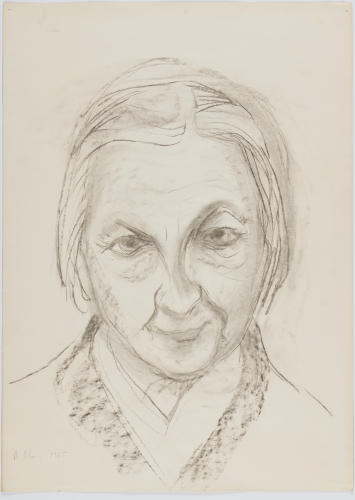
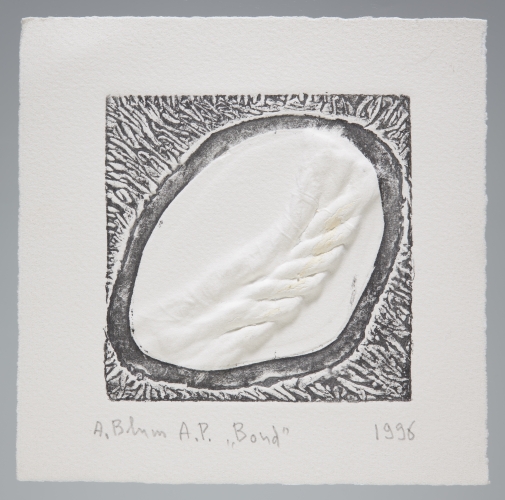
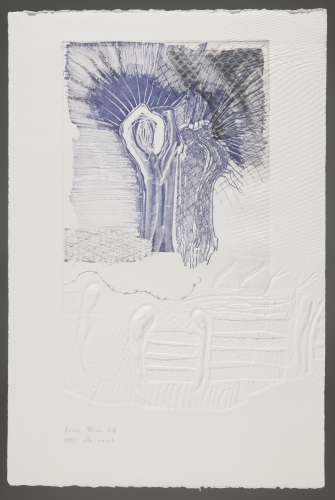
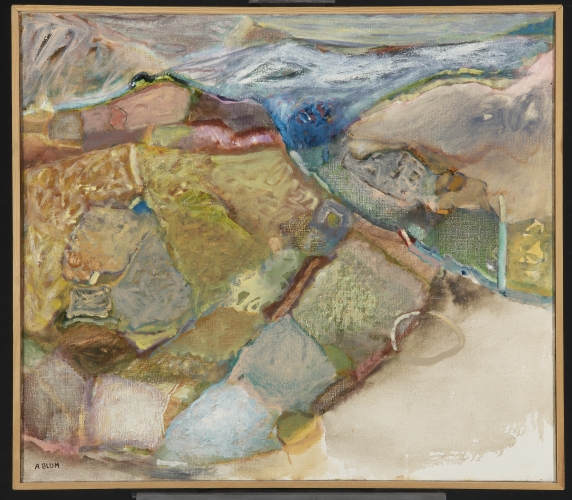
Aviva (Wiktoria, Wiesia) Blum-Wachs' artistic journey (b. 1932, Warsaw) is inseparably linked to her biography. The decision to become an artist and what she created were influenced by three key areas of her life:
• her experiences during the war and the Holocaust,
• the figure of her mother, Luba Blum-Bielicka, and
• the emotional connection the artist had with her, as well as her move to Israel.
Even though she managed to survive, the artist experienced the trauma of the war and the Holocaust. After her father's murder, Aviva, together with her brother, was forced to hide, first inside the Warsaw Ghetto and, later, after being smuggled out by her mother. After the war, she experienced antisemitism. For this reason, she developed a strong desire to leave Poland. Since most of her friends and acquaintances had emigrated to Israel, this became the obvious direction for her own emigration.
Despite her initial reluctance, her mother's eventual consent allowed seventeen-year-old Wiktoria to leave Poland. Arriving in Israel meant not only a completely new, independent life, but also a new identity. She changed her name to Aviva, as it was easier to pronounce for those who spoke Hebrew.
The artist's mother, a nurse and an outstanding figure, who was deeply involved in activities for the Jewish community, remained in Poland (see: Luba Blum-Bielicka). “We didn't have a mother in our childhood, she was always busy with other people, other children”, the artist said in an interview (“I paint to forget” an Interview with Aviva Blum-Wachs - Museum of the Warsaw Ghetto (1943.pl), accessed on 30/07/2024), later adding, emotionally, “I loved my mother very much.” She last saw her mother in 1973 – Luba Blum-Bielicka enabled an exhibition of her daughter's works at the Bund building in New York. That same year, she passed away from cancer.
Aviva wanted to create. The opportunity for develop in this direction only came when she moved to a kibbutz in Israel. With this support, in 1957, she was able to begin studying drawing followed by painting in Tel Aviv and then, in the mid-1960s, graphic design at the famous Bezalel Academy in Jerusalem.
The artist worked through her own experiences in her artwork. Her experiences and longings are most visible in her graphics. In them, she returned to the Polish landscape and symbolic elements connected with her childhood and the time spent in hiding (such as the motif of a cord, which she used to weave baskets at the time). In her drawings and paintings, she most often reflected on nature and the landscapes of Jerusalem.
Initially, she painted exclusively in watercolours on paper. After leaving the kibbutz in 1972 and marrying her second husband in 1980, financial stability and the possibility of having a studio allowed her to paint larger works.
Małgorzata Bogdańska-Krzyżanek