
A New Life - Jews in Poland 1944/45-1950
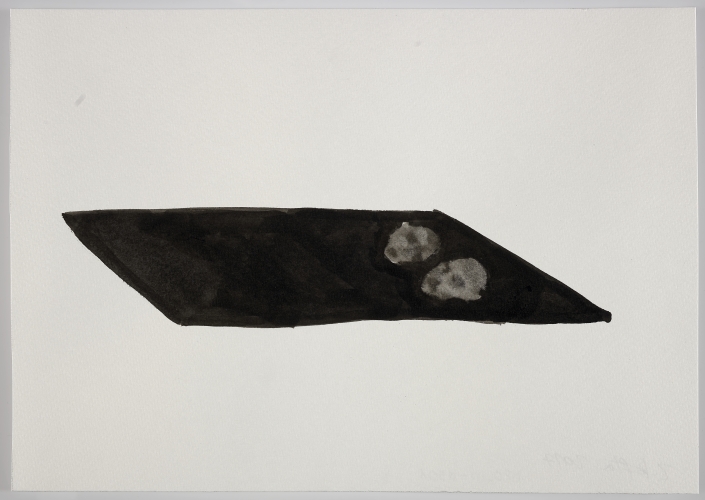
Life after the Holocaust began for survivors by being confronted with the scale of loss. The Germans and their collaborators murdered millions of Jews, almost completely annihilating hundreds of thousands of Jewish families, and destroying thousands of communities along with the social institutions that functioned within them.
Of the more than 3.3 million Jewish men and women living in Poland in 1939 (then part of the Second Polsh Republic), no fewer than 80% perished during the war. In total, no more than 425,000 individuals survived (see: A. Stankowski, P. Weiser, Demographic Consequences of the Holocaust, pp. 15 and 38). It is estimated that the largest number of Jews in postwar Poland - approximately 210,000 - were within the country’s current borders just prior to the Kielce pogrom in July 1946. Reacting to that violence, over 100,000 people left the country.
Around 50,000 Polish Jews survived until the liberation from German occupation with the territory of Poland - just over 10% of all survivors. These individuals survived in various ways - in camps, with the partisans or by hiding on the "Aryan side" in forests, hideouts or out in the open. Among them, the largest group consisted of prisoners from concentration camps and labour camps. A smaller portion survived in hiding within Poland. However, the majority of survivors - estimated at about two-thirds - survived the war deep within the Soviet Union. They began returning to Poland as part of a series of repatriation agreements between Poland and the USSR. Between 1944 and 1946, individuals of Polish and Jewish nationality were eligible to return to their country of birth, provided they had held Polish citizenship prior to 17 September 1939, the date when the Soviet Union occupied the eastern territories of the Second Polish Republic. (This theme of repatriation appears in the POLIN Museum collection, for example in the Włodawer family’s certificates or Emilia Ratz’s letter to Halina Altman dated 22 November 1945.) From September 1944, over the course of the next twenty-four months, at least 158,000 Polish Jews crossed the Polish-Soviet border in organised transports. (Some of them continued onward immediately. See: L. Dobroszycki, Survivors of the Holocaust in Poland, pp. 19-22.)
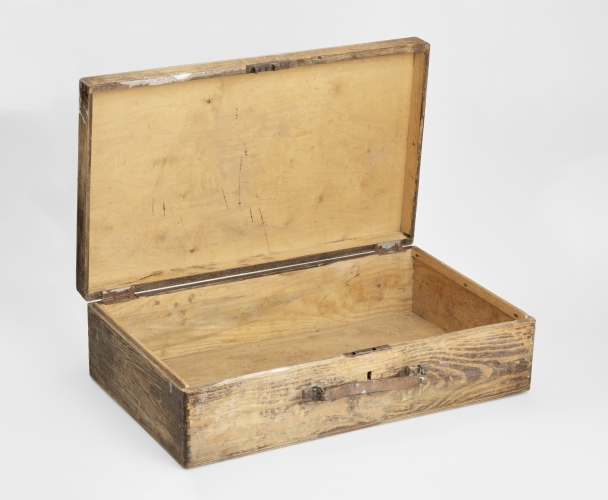
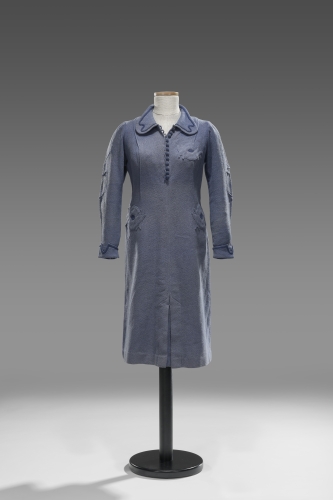
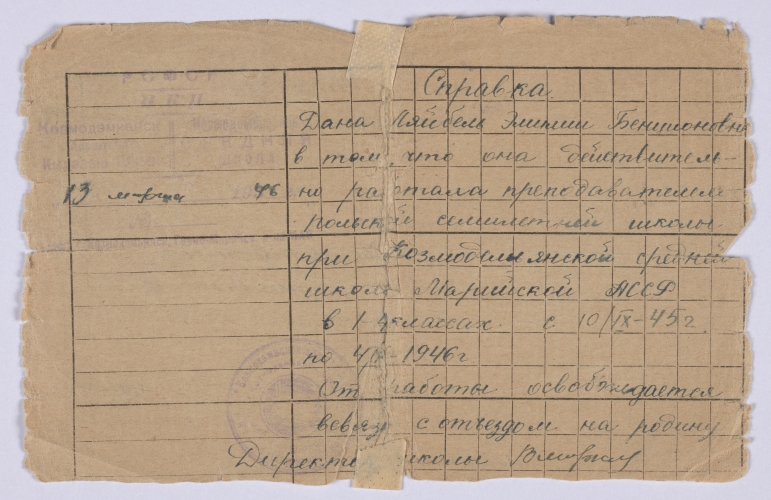
Those, who had managed to survive until the collapse of Hitler’s regime, were, in most cases, in catastrophic physical and psychological condition. After years of struggling to survive, they were also, generally, in a dire material situation. Only a few survivors possessed more than what they had on them and, more rarely, with them. Everything was invaluable. Belongings were usually limited to a few items (the size of Marek Oberländer’s wooden suitcase is indicative), the most essential clothing (like the warm dress worn by Grunia Klitenik, sewn from scraps of military fabric during her time beyond the Volga), photographs, and finally, all kinds of documents - both private, such as correspondence (e.g., letters from a sister to the Märc brothers), and official, including identification papers, civil status documents, education certificates, proof of professional qualifications and employment records (such as those of Emilia Leibel).
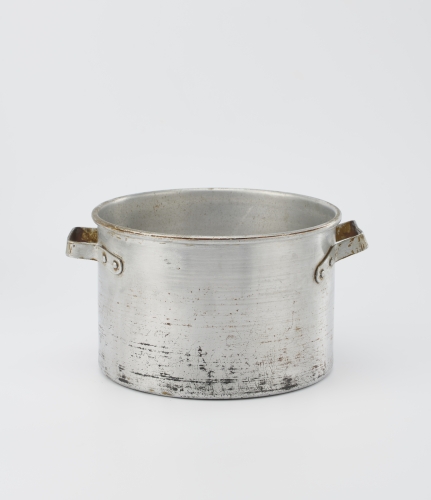
These items served as a link to the world which was buried during the Holocaust, or as mementos from places of survival, but they were also tools for building a new life. The pot, brought from Kuybyshev by the Kacman family, illustrates this in perhaps the most powerful and evocative way.

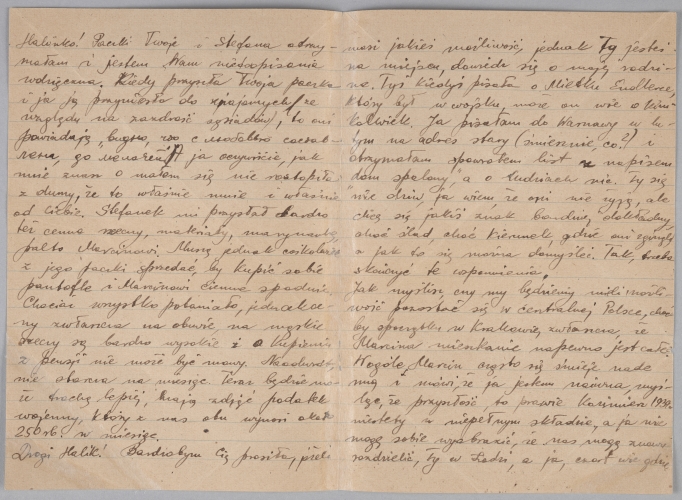
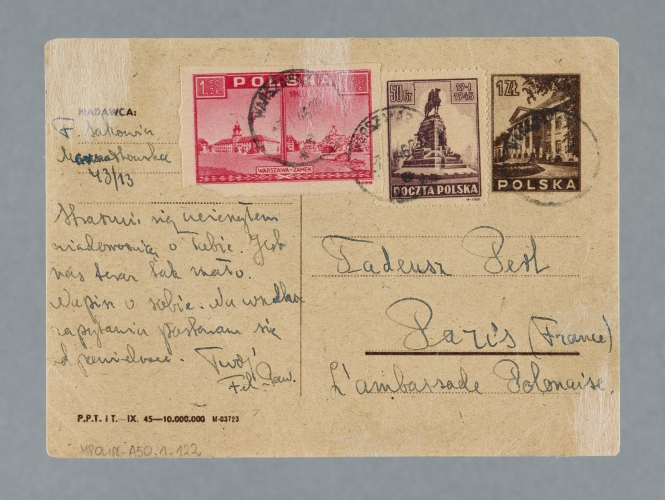
The Central Committee of Jews in Poland*, in a memorandum addressed to the commission investigating the situation of Jews in Europe and Palestine, raised the alarm: “[The survivors] are generally people who are alone, without a roof over their heads, without families and friends, without any moral or material support” (“Memorandum to the Anglo-American Committee of Inquiry on Palestine”, Przełom, 1946, no. 1, p. 11). Survivors began their re-engagement with the post-catastrophe world by trying to find out what had happened to their loved ones. Jews exchanged information amongst themselves (see, for example, a letter from Feliks/Paweł Perl in Warsaw to Tadeusz Perl or a letter from Emilia Ratz in Świerłowsk to Halina Altman, dated 18 August 1945). They reached out to Jewish organizations - especially branches of the CKŻP (Central Committee of Jews in Poland). Its Department of Registration and Statistics included a search section. They also published announcements in the Jewish press. Almost every newspaper ran dedicated columns to help reunite relatives and acquaintances.
Many Jews, as soon as it was possible following the German occupation, set out for their hometowns. In most cases, no one was waiting for them there. Their homes and workshops had new residents and workers, and their non-Jewish neighbours - afraid that the returning Jews would seek to reclaim lost property - often greeted them with hostility or enmity.
____________________________
The sense of threat, the fear for their physical safety and the daily confrontation with displays of antisemitism from the majority of the society - at work, in various state institutions such as schools, hospitals, during interactions with representatives of the state administration or local authorities, and with officers of the Citizens' Militia - significantly shaped the post-war attitudes of Polish Jews. According to various estimates, between 1944 and 1947, between 500 and 2,000 survivors and their descendants lost their lives at the hands of their non-Jewish fellow citizens in Poland.
Discussions amongst researchers of this period focus on the question of the motives behind these crimes - how far or to what extent were they driven by racist ideology, and to what degree can they be explained by other factors (political sympathies, ideological and organisational affiliations of the perpetrators, their wartime demoralisation, banditry, etc.). However, historian David Engel emphasised that a high proportion of the victims of post-war murders of Jews were women and children, a significantly higher percentage than among the non-Jewish Polish men and women killed during the wave of post-war banditry (D. Engel, “Patterns of Anti-Jewish Violence in Poland, 1944–1946”, pp. 94-95). In a report from the Central Special Commission, established by the CKŻP (Central Committee of Jews in Poland) after the Kielce pogrom in July 1946 for the protection and defence of Jewish institutions, it states that more than 2,000 interventions carried out over the course of one year.

Most of the survivors, who remained in Poland after the war, at least for a period of time, did not choose to settle in the place where they had lived prior to September 1939. Some were motivated by concerns about safety, others could not bear to live in the place where their closest family members (usually the entire community) had perished. Still others could not reconcile themselves with the hostility of the surrounding environment. The displacement of large populations, including the Jewish population, was also due to the shifting borders of Poland. More than 80,000 survivors of the Holocaust, who had registered with Jewish committees in the first half of 1945, initially settled in 235 towns. Over time, the number of Jewish communities decreased - survivors moved toward larger centres, choosing those that were not only more densely populated by Polish Jews (including Łódź, Warsaw, Kraków, Szczecin, Katowice, Wrocław), but also guaranteed employment and greater safety. By early January 1946, Jews in Poland were settled in only 169 towns (A. Rykała, “Przemiany sytuacji społeczno-politycznej mniejszości żydowskiej w Polsce po drugiej wojnie światowej”, p. 24). According to data from the end of 1946, the largest number of survivors (and their descendants) lived in Dolny Śląsk, particularly in Wrocław, Bielawa, Świdnica and Dzierżoniów.
It was in Dolny Śląsk - at the initiative of Jews liberated from concentration camps in the area - that a special Jewish settlement was created, where Jews, repatriated from the Soviet Union, were to be sent (see Emilia Ratz's letter to Helena Altman from 31st July 1945). This region was practically untouched during the war and the German inhabitants, fleeing before the victorious forces, left behind their homes and apartments (or it was known that they would have to do so soon). They also abandoned farms, factories, mines and production plants, which created opportunities for employment for the newly arriving populations, in accordance with the programmatic idea of "productivisation" promoted by most of the Jewish parties of the time. It was postulated that the goal of this "restructuring" was to align the socio-professional structure of the Jewish population with that of other societies, particularly by increasing the number of physical and manual workers, as well as those employed in industry, crafts, and agriculture. Various courses were organised to prepare individuals for professional work, with the main organiser being the Society for the Promotion of Vocational and Agricultural Work Amongst Jews (ORT), which had been founded in the late 19th century and resumed its activities in 1946 after the war.

In 1947, Dr. Joseph Szwartz, the General Director of the American Jewish Joint Distribution Committee**, spoke at a meeting of the Presidium of the Central Committee of Jews in Poland (CKŻP). He shared his impressions from his fourth visit to Poland since the end of the war. He said: “In no European country have I seen as much progress in work after two post-war years as in Poland - economic work, social welfare, child care, cultural work. Nowhere have I seen the pace of work that is present in Poland. The Jewish population is small, and yet there has been such progress and development - all thanks to the energy, courage and imagination of Polish Jewry. The only country that resembles Palestine in this regard is Poland.” In response, the then-chairman of the CKŻP, Adolf Berman, among other things said: “Polish Jewry, and all its political groupings, despite the terrible defeat and destruction, is determined to continue to build a life. Polish Jewry wants to live and will live. We are a small community, but blessed with the dynamism and vitality that remain within us.” (Minutes of the plenary meeting of the CKŻP with the participation of the Joint on June 1, 1947, Jewish Historical Institute Archives 303/I/21, k. 67.). In the second half of the 1940s, many survivors shared Berman's view.
Ewa Koźmińska-Frejlak
* The Central Committee of Jews in Poland (CKŻP) operated from 1944 to 1950, was the largest Jewish institution in the country after the war, brought together representatives of most legalized Jewish political parties and social organizations, which represented Polish Jews before the state authorities and various Jewish structures abroad.
** American Jewish Joint Distribution Committee (Joint) - an American philanthropic organization established during World War I in the United States to provide aid to Jews in Europe, after the war it played a key role in rebuilding Jewish life in Poland by allocating funds to all Jewish institutions in proportion to their size.
Literature (selection)
Józef Adelson, „W Polsce zwanej Ludową”, w: „Najnowsze dzieje Żydów w Polsce w zarysie (do 1950)”, red. Jerzy Tomaszewski, Wydawnictwo Naukowe PWN, Warszawa 1993.
Natalia Aleksiun, „Dokąd dalej? Ruch syjonistyczny w Polsce (1944–1950)”, Trio, Warszawa 2002.
Halina Birenbaum, „Powrót do ziemi praojców”, Czytelnik, Warszawa 1991.
Mordechaj Canin, „Przez ruiny i zgliszcza. Podróż po stu zgładzonych gminach żydowskich w Polsce”, przeł. i oprac. Monika Adamczyk-Garbowska, Nisza, Warszawa 2018
Lucjan Dobroszycki, „Survivors of the Holocaust in Poland: A Portrait Based on Jewish Community Records, 1944–1947”, M.E. Sharpe, Armonk–New York–London 1994.
David Engel, „ Patterns of Anti Jewish Violence in Poland, 1944–1946”, „Yad Vashem Studies” 1998, t. 26, s. 43–85.
Jan Tomasz Gross, „Strach. Antysemityzm w Polsce tuż po wojnie. Historia moralnej zapaści”, Znak, Kraków 2008.
Henryk Grynberg, „Zwycięstwo”, W Drodze, Poznań 1990.
Irena Hurwic-Nowakowska, „Żydzi Polscy (1947–1950). Analiza więzi społecznej ludności żydowskiej”, Wydawnictwo IFiS PAN, Warszawa 1996.
Ewa Koźmińska-Frejlak, „Po Zagładzie. Praktyki asymilacyjne ocalałych jako strategie zadomowiania się w Polsce (1944/45-1950)”, Żydowski Instytut Historyczny, Warszawa 2022.
Noach Lasman, „Wspomnienia z Polski”, Żydowski Instytut Historyczny, Warszawa 1997.
Jacob Pat, „Ashes and Fire”, przeł. Leo Steinberg, International Universities Press, New Jork 1947.
Andrzej Rykała, „Przemiany sytuacji społeczno-politycznej mniejszości żydowskiej w Polsce po drugiej wojnie światowej”, Łódź 2007.
Shmuel Leib Shneiderman, „Between Fear and Hope”, Arco Publishing Company, New York 1947.
Albert Stankowski, Piotr Weiser, „Demograficzne skutki Holokaustu”, w: „Następstwa zagłady Żydów. Polska 1944–2010”, red. Feliks Tych, Monika Adamczyk-Garbowska, Wydawnictwo UMCS i ŻIH, Lublin 2011.
Bożena Szaynok, „Ludność żydowska na Dolnym Śląsku 1945–1950”, Wydawnictwo Uniwersytetu Wrocławskiego, Wrocław 2000.
Joanna Tokarska-Bakir, „Pod klątwą. Społeczny portret pogromu kieleckiego”, t. 1–2, Czarna Owca, Warszawa 2018.
Marcin Zaremba, „Wielka trwoga. Polska 1944–1947. Ludowa reakcja na kryzys”, Znak i Wydawnictwo ISP PAN, Kraków 2012.