Jewish Children Just After the War
Helena Datner

There are many things we cannot imagine, this one included: that one can want to exterminate all the members of a nation, proceed to do it in a systematic way, and achieve great success. The weakest, most vulnerable - the youngest and oldest - were the least likely to survive.
In the Warsaw Ghetto in October 1942, after a large-scale transportation of Jews to Treblinka, the "resettlement rate" (as the nomenclature used to retreat from the word "death") for children under the age of nine was 99%. Shortly after the war, among all Polish citizens, children under the age of 18 accounted for 37%, among Jews repatriated from the Soviet Union - 25%, and those rescued in Poland - 14% (data after: "Zarys Działalności Centralnego Komitetu Żydów w Polsce. Za okres od 1 stycznia do 30 czerwca 1946 r.", Warsaw 1947, p. 8). The Jewish community lacked children.
At the time of the end of the war, between 4,000 and 5,000 children (persons under 14 years of age) were registered within the new borders of Poland. This number does not include those who have not yet come out of hiding or who, while remaining in Polish families, never found out about their origins or only found out when they were adults. Later statistics showed that among those rescued in Poland, a small group (around 5%) had both parents, most were orphans, some had one parent.
Small groups of older children - actually already adolescents - have returned from camps in Germany. Most Polish Jews survived in the USSR. Thanks to repatriation agreements among other citizens, approximately 20,000 Jewish children returned to Poland. In this group, more had both parents and fewer were full orphans. Some of the children attended Polish schools in the USSR (for example, a school certificate from Samarkand can be found in POLIN's collection), some found themselves in orphanages that were repatriated to Poland. Their life in the USSR was difficult, but fortunately for them, this childhood cannot be compared to what the children experienced under the German occupation.

The suffering of the Jews was so horrifying that to those who were able to view it from some distance, yet with complete empathy, it was clear that those who managed to survive, children in particular, would be tenderly cared for and given the utmost attention by the post-war world. One of those helping those in hiding, Maria Hochberg-Mariańska (a member of the Council for Aid to Jews, Żegota), wrote: "During the Nazi occupation I met with children and mothers living in hiding. Listening to the accounts and those of the mothers and looking at the children's lives, I thought, with an uplift in my heart, of the moment when the rescued and liberated will go out into the free, bright, good world" - and that world will do everything to help them. This was not the case, the world was rather indifferent, often hostile, but the Jewish community did much to ensure that these children were helped.
The size of this assistance can be illustrated by the budget of the main Jewish organisation of the time, the Central Committee of Jews, in which the largest percentage of expenditure (40) was spent on childcare: both the material assistance to children who lived with their parents (parent, guardian) and the financing of orphanages; a large item in this part of the budget was also the financing of half-terns - a day-care centre which, in towns where there was no Jewish school, was supposed to provide, in addition to care, elements of Jewish education (this was the budget of the Education Department of the Central Committee of Jews, which took care of the care and educational institutions). The money came mainly from a donation from the JOINT American aid organisation which resumed its activities in Poland in the spring of 1945 (more on this in the text from the collection's ecatalogue: "New Life. Jews in Poland 1944/45-1950").
In the programmes of all political groupings that existed within the territory of Poland at that time, concern for children occupied a central position. For Zionist groups, a part of this concern was to deport the children to Palestine, and for religious organisations, where traditional education could be provided for the children. The Holocaust broke traditional bonds between people that were a condition for the transmission of an unchanged tradition; the rapid reduction in the size of the Jewish community itself encouraged assimilation - a departure from Yiddish tradition and language.

The most important task for everyone was to meet the children's living needs: food, health, and physical safety. Health care was taken over by the experienced and reactivated Healthcare Society (Towarzystwo Opieki Zdrowotnej - TOZ), which carried it out through a network of outpatient clinics, sanatoriums (in Szczyrk, Otwock) and organizing health camps. The TOZ also had an Abandoned Child section, which, thanks to its international contacts, dealt with finding people willing to help specific children and also to adopt them. Orphans were taken care of by orphanages that were quickly established in the liberated areas: in Lublin already in the summer of 1944, in the following year in Otwock, Zatrzeb (near Falenica), Helenówek near Łódź, Chorzów, Bielsko, and Kraków. In 1946, after the repatriation from the USSR had ended, there were 13 orphanages run by the Central Committee of Jews, with more than 700 wards, and a network of institutions - kibbutzim - run by various Zionist groups; there were also orphanages, in Zabrze and Łódź, run by religious organisations. Children with parents were also admitted to the Jewish Committee houses if they were in a difficult health or living situation. Kibbutzim - run by organisations representing various branches of Zionism and aimed at preparing people through education and apprenticeships, mainly in agriculture, to go to Palestine and build a Jewish state there - generally existed for a short time, but in the first period had the largest number of children; by the end of 1946 there were to be 27 such institutions with more than a thousand children.
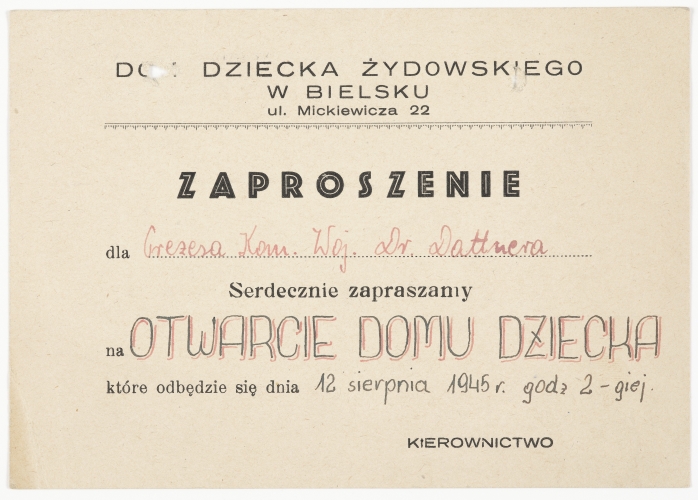
The physical safety of children was a major concern until 1947 (reflecting the situation of the entire Jewish community). The therapeutic and educational homes in Rabka and Zakopane were quickly liquidated: the Rabka facility was the target of a regular attack by the underground and ceased to exist as early as August 1945, the Zakopane facility in the spring of the following year. POLIN's collection contains an invitation to the "President of the Jewish Committee in Bialystok" for the opening of an orphanage in Bielsk on 12 August 1945. Its first occupants were a group of older boys from the Bialystok region, evacuated due to lack of security. The orphanage from Lublin was moved to Lower Silesia, to Piotrolesie (Pieszyce). It was believed that the social aura towards Jews would be more favourable in the Recovered Territories. Which turned out to be only partially true.
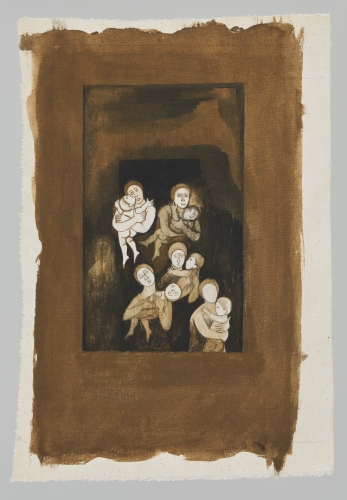
In addition to the health consequences, the Holocaust had psychological effects on children. Mental trauma, traumas manifested in some children with anxiety, night screaming, neurosis reported by the caretakers of educational institutions; the TOZ diagnosed problems of this kind in a quarter of the repatriated children (Archive of the Jewish Historical Institute, TOZ team, sign. 9). And even more so, when it came to the children who survived in Poland. The diagnosis of the condition of children, primarily from orphanages, was handled by the Treatment and Vocational Clinic. Career guidance was an important part of the institution's work - the aim was to ensure that young people chose their career paths as appropriately as possible, in accordance with their aspirations but also their psychological and intellectual capacities. The aim was to embed them as best as possible in the surrounding world. The Holocaust, which constituted a traumatic situation to a degree scarcely comparable, left lasting traces in many, diagnosed decades later as Post Traumatic Stress Disorder (PTSD), often with wide-ranging consequences in the lives of those who experienced it. The assumptions of the Counselling Centre's work were broad and referred to the pre-war tradition of psychological and educational care: "We are concerned not only with the treatment of cases of a pathological nature, but above all with implementing the principles of mental hygiene with regard to every Jewish child" (Report on the Activities of the Neuro-Psychological and Educational Counselling Centre for September 1945, Archive of the Jewish Historical Institute, Department of Education, sign. 133, k. 23).
Some children, especially those who survived the war in Poland, experienced a condition that could be called an identity crisis. Being Jewish was a threatening stigma that could only be dealt with, as perceived by them, by running away from it. All Jewish organisations were interested in ensuring that children who found themselves with Polish guardians were returned either to their parents or next of kin, or into the care of these institutions. Such "Returns" were often dramatic: not only because of the child's bond with the guardian (sometimes strong, authentic, but sometimes weak or even negative), but the fear "of the Jews". The children did not want to return to a Jewish environment, they ran away.
Jewish welfare institutions faced the task of not only providing for the children's livelihood and safety, but of psychological rehabilitation and trying to convince the pupils that life had meaning, a kind of philosophical rehabilitation. The Zionists saw their "rehabilitation" in leaving a country in which the Jews had suffered endless humiliations and ultimately the Holocaust, and building their own state in which their human dignity would never again be destroyed. The institutions subordinate to the Jewish Committees were focused on rebuilding life in Poland, their left-wing (not only communist) ideology had great potential for psychological help. Point one of the children's welfare institutions of the Jewish Committees, enacted in July 1945, spoke about instilling a sense of human dignity in children, point three about instilling a sense of Jewish national dignity. These points were developed as follows: "children should be instilled at every opportunity with the thought: the victory of democracy has given you back your humanity, your thing now, being aware of your rights, is to make full use of them and not to fawn yourself before anyone in a sense of your equality" (Guidelines for educators implementing ideological and educational guidelines in children's homes, Archive of the Jewish Historical institute, Department of Education, sign. 133).
After the war, the environment surrounding institutions such as children's homes also changed. These were no longer the pre-war "orphanages", but institutions where children experienced by their fate are supposed to have the same rights as other children, are supposed to grow up with a sense of respect for themselves and others, and where work and the ability to cooperate constitute the central educational values. It is a wide range of "Korczakian" assumptions. Korczak is referred to explicitly, some children's homes are named after him.

One more element for the psychological and spiritual reconstruction of the orphaned Jewish children was of great importance: the relationship with the educator/caregiver, meaning an important adult. These relationships should not be idealised, but in children's and young people's memories it is not uncommon for home staff to have an important caring and socialising function. They share a common destiny with the children; moreover, many of them - surprisingly, given the war and the post-war situation (the departure of large groups of people) - have a pedagogical background. POLIN's collection includes letters from a pupil of the Otwock home written in 1947 from France, then Palestine, to its principal, Luba Blum-Bielicka. These letters testify to Blum-Bielicka's extraordinary bond and role in the girl's life. At the same time, the correspondence constitutes a record of the history of youth emigration from Poland. Some of them left legally, thanks to the efforts of the Jewish Agency, mainly to France, where they waited in good conditions for an equally legal departure to Palestine (by 1948, about 1,500 children, mainly from Poland, were to have left in this way, see "L’aliah des jeunes", Paris 1948, p. 7). Others were leaving illegally, such trips being organised by the Bricha organisation. In such a case, the route usually led through the Alps to Italy, where groups waited for a ship to Palestine. Such a journey often ended with an internment of illegal, from the British point of view, immigrants and incarceration in camps in Cyprus (Irit Amiel, for example, writes about this in the autobiographical book "Life - A Temporary Title").
The story told here ends in 1950, when the nationalisation of Jewish institutions, including children's institutions, and the dismantling of cultural and political pluralism - changes the course of Jewish history in Poland.
Helena Datner