
Jews in the Polish Armed Forces (Anders’ Army) during World War II

In September 1939, and in the months that followed, many Jews - mainly from central Poland - fled from the advancing Germans to the eastern borderlands (Kresy) of the Second Polish Republic, which, after 17 September 1939, came under Soviet occupation. In the summer of 1940, during the “third deportation”, most of these Jewish refugees were deported deep into the Soviet Union (USSR).
The Soviet occupation, including the deportations and the fate of Jews within the USSR, is described in greater detail elsewhere in POLIN Collections Portal portal by Anna Zapalec—see the chapters The Holocaust and Survival and Journeys Eastward (to be published soon). According to NKVD sources, Jews made up more than 84% of those deported in this operation -categorised as special settlers-refugees (spetspereselentsy-bezhentsy). They were placed in 251 special settlements (spetsposyolki), under the oversight of 158 NKVD command posts across the USSR, including in various parts of Siberia.
The outbreak of the German-Soviet war in June 1941 marked a new chapter for the deportees, including Jews. At that time, diplomatic relations between the Polish Government-in-Exile and the USSR were reestablished, on 30 July 1941, the Sikorski-Mayski Agreement was signed. This agreement included a provision for an “amnesty” for Polish citizens located within the Soviet Union. A subsequent step in the re-establishment of relations was the 12 August 1941 decree on the “amnesty”, which authorised the release of all Polish prisoners-of-war, detainees and internees from prisons, jails, and labour camps (gulags). A military agreement was also signed, outlining the formation of a Polish Army on Soviet soil. General Władysław Anders, appointed by the Commander-in-Chief General Sikorski, was to lead this army.
The army’s headquarters was established in Buzuluk (near Kuybyshev), with training and mobilisation camps set up in Totskoye (near Buzuluk), Kołtubanka, and Tatishevo (near Saratov), i.e., localities in the European, Volga region of Russia. On 22 August 1941, General Anders issued an order calling for enlistment into the army. This resulted in the formation of recruitment commissions in the gulags. Under the Polish-Soviet agreements of March 1942, the size of the Polish Army in the USSR was set at 44,000 soldiers. In the meantime, however, the Soviet authorities issued a ban on admitting Jews who, as of November 1939, had been residing in the territories of the former Second Polish Republic which had come under Soviet control.
Admission and Exclusion from Anders’ Army
Information about the "amnesty" began to reach places of exile and internment in the autumn of 1941 and, in some cases, only by the spring of 1942. Many deportees, along with their families, began trying to leave for the emerging Polish army. To do so, they were willing to travel hundreds of kilometres from the northern regions of the USSR to the south, to the Central Asian republics. Among them were also people of Jewish origin, including the heroes and heroines of the POLIN Museum collection.
Not all Jews managed to reach the military recruitment commissions. Among those who did, not all passed the verification process. There were two reasons for this - firstly due to the already mentioned ban imposed by the USSR. The recruitment commissions were Polish-Soviet, with NKVD officials and Soviet doctors sitting alongside Polish representatives. These Soviet officials were tasked with obstructing or even preventing the admission of individuals into the Polish Army if their Soviet passports listed their nationality as Jewish, Ukrainian, or Belarusian - on the grounds that their Polish citizenship was being questioned.
The Polish government-in-exile, of course, held a different view. For them, all inhabitants of the territories occupied by the USSR after 17 September 1939, regardless of nationality, were Polish citizens and all should be covered by the amnesty and have the same right to join the newly-forming Polish Army. Moreover, under international law, anyone who held Polish citizenship before 1st September 1939, was legally considered a Polish citizen.
However, due to the high level of interest in enlisting in the emerging army, among Jews in the USSR, the Polish authorities also began efforts (already initiated in the autumn of 1941) to limit the number of Jews being accepted. This became the second reason why Jews were often disqualified by the recruitment commissions. Many Jews were denied entry into the Army under the pretext of poor health. Their acceptance into technical units, including into the air force, was restricted.
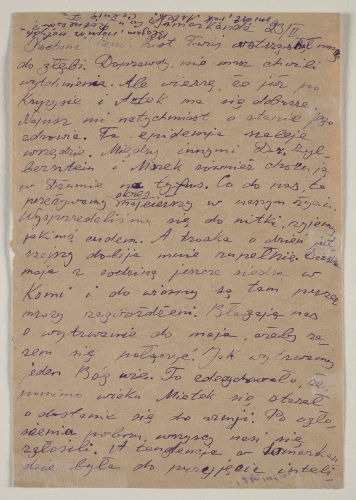
In various memoirs and letters from that time, the topic of Jews being turned away recurs as a deeply painful experience. In February 1942, with sorrow, Fania Landau, in a letter to Paulina Włodawer wrote: "[The men] were given category E, like most of ours. What will come of it, and whose decision this is, the future will reveal. In any case, once again, we are being beaten, this chosen people”.
From the very beginning, there were instances of discrimination and mistreatment of Jews recorded - treated as second-class soldiers - both by commanding officers and fellow soldiers. Many Jewish servicemen complained about antisemitic incidents, including insulting displays of mistrust towards them and the use of offensive remarks about Jews. As a result, in the autumn of 1941, a group of Jewish soldiers proposed the creation of a Jewish Legion. However, this initiative was never implemented.

The Evacuation of Anders’ Army
At the beginning of 1942, the soldiers were relocated to the territory of the Uzbek and Kyrgyz Soviet Republics, as well as to the southern area of the Kazakh Republic. It was there, beginning on 6 February 1942, that recruitment into the Polish Army resumed (although Jewish enlistment continued to be hindered).
The next step was the evacuation of the army to Persia (today, Iran), a move strongly advocated by General Anders, who recognised that the amnesty agreement was not being fully honoured by the Soviet side. The evacuation took place in two phases - the first phase occurred between 25 March and 5 April 1942, and the second between 5-26 August of the same year.
Civilians were evacuated along with the army, but, like the recruitment process, the Soviet authorities opposed the departure of Jews together with the Polish Armed Forces. Only military family members, namely wives, minor children and soldiers’ parents - as well as Jews who had entered Soviet-occupied territory after 1 November 1939 - were permitted to leave. As a result, Jews comprised a very small percentage of the total number of evacuated civilians.
According to Ignacy Schwarzbart, approximately 2,500 Jewish civilians were evacuated. Israel Gutman estimated that a total of 6,000 Jews were among those evacuated, including 3,500 soldiers. Szymon Redlich assessed the number at between 5,000 and 7,000 Jews, including 4,000 soldiers. By contrast, Klemens Nussbaum reported that, at the beginning of 1942, there were just over 2,000 Jews in the Anders Army, making up only 3.73% of the total number of soldiers.
This very small proportion of Jews in the ranks of the Polish Army sparked criticism and concern amongst Jewish communities and institutions, including the Representation of Polish Jewry and the Jewish Agency in Palestine.
In September 1942, part of the Anders Army was transported to Iraq, specifically to the Kirkuk-Mosul region. Later, between August and September 1943, some units were transferred to Palestine. During this period, in the territory of Palestine, the army was subordinated to the British 9th Army under General William Holmes and was divided into two groups - northern and southern.
The remaining units and services remained in Iran and Iraq, while others, such as the field hospital, the railway engineer battalion and the engineer staging company, were moved to Egypt, to El Qantara on the Suez Canal. (A regional command headquarters was established in Cairo). Matters concerning the Jewish faith and other non-Catholic denominations were overseen by the Personnel Division of the Command of the Polish Army in the East.

Desertions
The number of Jewish soldiers declined. A significant increase in desertions occurred during the stay of the Polish 2nd Corps in Palestine. Many factors influenced their decision to leave the Polish army - in addition to antisemitism, a major reason was the lack of any realistic possibility of returning to post-war Poland.
General Władysław Anders wrote: “Over 3,000 Jews left the ranks of the Corps. About 1,000 remained and took part in later battles. The desertion of so many Jews, some of them well-trained, caused significant gaps in the units. I did not authorise a search for deserters and we did not arrest a single deserter. I decided to not strictly apply, to national minorities, the law on the universal obligation of military service for all Polish citizens outside the country. I did not want to have, under my command, soldiers who did not want to fight.” (W. Anders, Without the Final Chapter, London 1949, p. 176).
Another wave of desertions by Jewish soldiers occurred in January 1944 in the United Kingdom, when sixty-eight Jewish soldiers, who were on leave in London, refused to return to their units stationed in Scotland. However, they expressed a willingness to continue serving in the ranks of the British Army. As the reason, they cited the widespread antisemitism in the military. After many weeks of discussions, they were incorporated into the British Royal Engineers. In February 1944, another group of 136 Jewish soldiers expressed a desire to join British units.
Between January 1943 and April 1944, 2,972 Jewish soldiers deserted from the Polish Army in the East, while 1,328 remained - including 851 in the 2nd Polish Corps of the Polish Armed Forces.
The story of the Jewish soldiers in Anders' Army does not end with the desertions. At least 838 Jewish soldiers participated during the battles, in 1944, fought by the 2nd Polish Corps at Monte Cassino, Loreto and Bologna. Despite the seriousness of the situation and the difficult conditions on the Italian front, they continued to experience antisemitism within the army. In these battles, twenty-seven Jewish soldiers were killed (a total of around seventy-seven likely died throughout the entire combat route of Anders' Army), among them Eljahu Shapira, Mordechai Haskalowicz and Artur Weinreb. Of the Jewish soldiers who fought at Monte Cassino, six were awarded the Silver Cross of the Virtuti Militari War Order, sixty-eight received the Cross of Valour, and fifty-two were awarded the Cross of Merit.
Artifacts in Various Collections
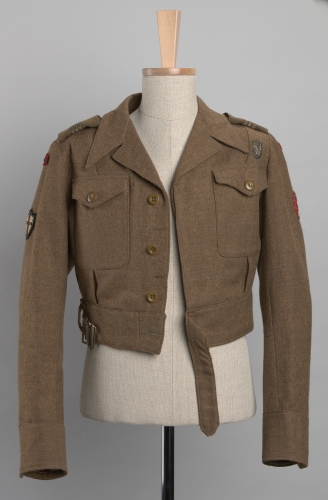
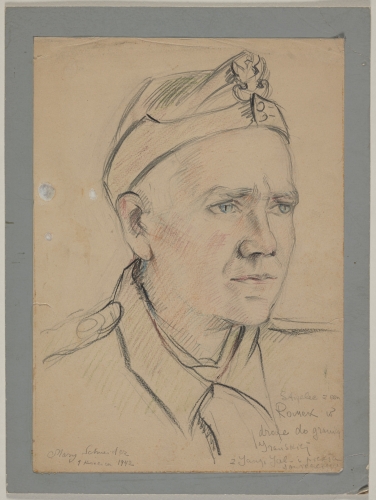
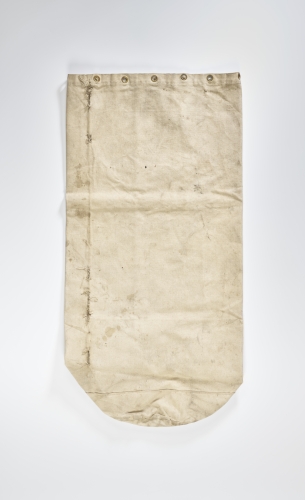
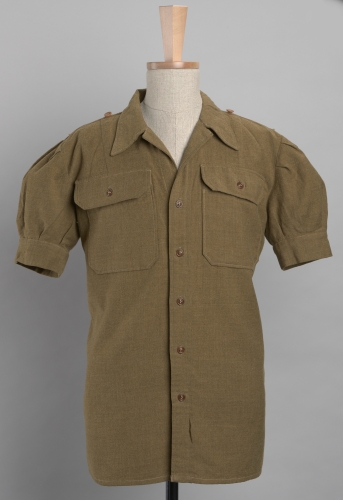
The fate of the Jewish soldiers in Anders’ Army can be reconstructed thanks to archival documents (including personal accounts, such as wartime diaries and memoirs) and museum artifacts - objects which once belonged to the soldiers themselves. These items tell the story of the extraordinary and difficult path which they travelled, as well as of their great bravery.
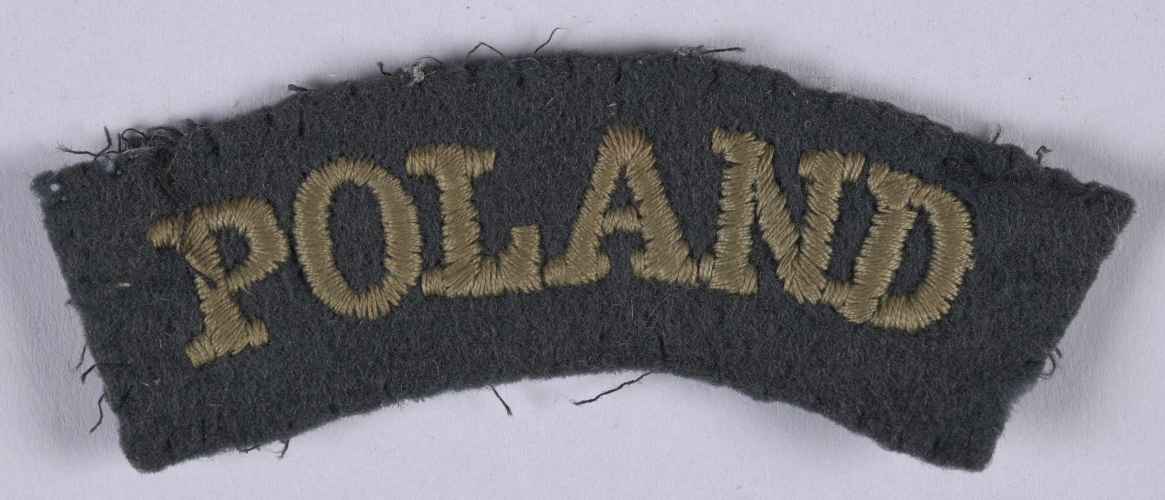
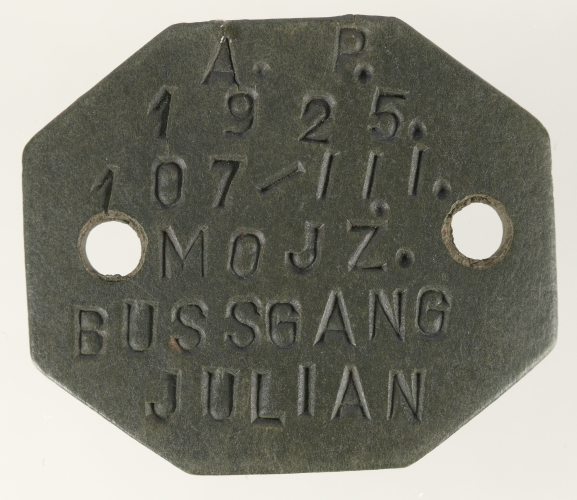
Among the museum artifacts are identification tags, which symbolised a soldier’s identity - they included the surname, first name, year of birth and religious affiliation. When broken in half, they became a symbol of heroic death. When left whole, a keepsake of a life that was saved. There are also other markers of identity - engraved metal tags containing the surname, initial of the first name, year of birth and religion. Sometimes, they were part of a bracelet. There are also commemorative and special insignia for uniform tabs. Through them, we know to which division a soldier belonged. (See, for example, the collections of the Museum of the Second World War in Gdańsk).
Some collections include maps that show the combat route of the 2nd Polish Corps, with locations marked of battles and engagements, in which the soldiers participated. Others, for example in the Józef Piłsudski Institute in New York and the Polish Social and Cultural Centre (POSK) in London, contain wartime periodicals covering the activities of the 2nd Corps, including a publication entitled Żyd Polski - Żołnierz Polski (Polish Jew – Polish Soldier). Another type of artifact consists of military booklets (or military certificates), which document the course of a soldier’s service, including their time in the 2nd Polish Corps.
A large group of documents, found in both archival (including personal legacies) and museum collections (often as part of a broader collection left by a former Anders Army soldier) consists, of correspondence sent by 2nd Corps soldiers whish were addressed to fellow soldiers at the front, as well as to friends and family members scattered around the world (for instance, the YIVO Archives in New York hold the personal papers of Emanuel Scherer).
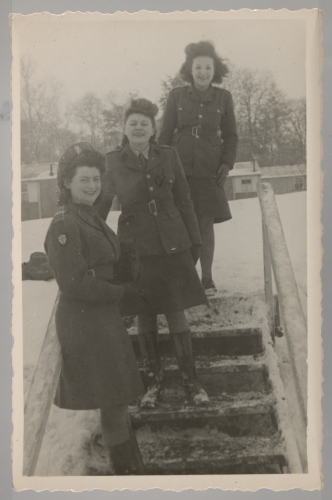
Another important group includes photographs taken along the combat route, as well as soldiers’ calendars, in which some men recorded major events of their service under the appropriate the dates.
After the war, former soldiers received an identification card for the 2nd Polish Corps commemorative badge, authorising them to wear the badge, which was issued in 1949. Some collections also include the Monte Cassino Commemorative Cross.
Martyna Rusiniak-Karwat

Bibliography
In the West, many studies have been written about the Polish Armed Forces, commonly known as Anders’ Army. Numerous memoirs, by former soldiers of the Anders’ Army, have been published, along with photo albums documenting their experiences. In most of these works, the participation of Jewish soldiers is presented primarily through the lens of their desertion in the territory of the Land of Israel (Palestine), as well as during the Army’s stationing in the United Kingdom in early 1944. Only a few publications highlight their involvement in the subsequent stages of the combat route. Below is my subjective selection of works on Anders’ Army which provide core information about it, as well as memoirs, published in Polish, of Jewish soldiers who remained in the Army until its demobilisation.
Sources – Memoirs of Jewish Anders’ Army Soldiers:
Zygmunt Blumenfeld, Diaries of an Exile and a Soldier, ed. Henryk Markiewicz, afterword by Andrzej Romanowski, Kraków 2013.
Edward Herzbaum, Between Worlds - a Diary of an Anders’ Army Soldier 1939-1945, afterword by Norman Davies, Warsaw 2016.
Julius Margolin, Journey to the Land of the Zeks, trans. Jerzy Czech, Wołowiec 2013.
Pinkas Rosengarten, Notes of a Rabbi in the Polish Army, trans. Jarosław Kociszewski, foreword by Feliks Tych, Warsaw 2001.
Sources – Other Memoirs and Documents:
Władysław Anders, Without the Final Chapter - Memoirs from the Years 1939–1946, London 1949 (first edition).
From Soviet Archives, Vol. II: The Polish Army in the USSR 1941–1942, translated, edited, annotated and introduced by Wojciech Materski, Warsaw 1992.
Studies:
Norman Davies, Trail of Hope: The Anders Army - An Odyssey Across Three Continents, trans. Iwona and Aleksandra Zych, Warsaw 2020.
Krystyna Dąbrowska, Monika Sołoduszkiewicz, 2nd Polish Corps 1943-1947, Gdańsk 2023.
Marek Gałęzowski, Jews Fighting for Poland. Forgotten Defenders of the Republic, Kraków 2021 (Chapter XIV: Matzevot at Monte Cassino, pp. 321-329).
Tomasz Gąsowski, Under the Banner of the White Eagle. The Jewish Question in the Polish Armed Forces During World War II, Kraków 2002.
Yisrael Gutman, “Jews in General Anders’ Army in the Soviet Union”, Yad Vashem Studies, 1977, Vol. XII, pp. 231–296.
Krystyna Kersten, Poles - Jews - Communism: Anatomy of Half-Truths 1939–1968, Warsaw 1992 (chapter: The Jewish Question in the Polish Armed Forces in the USSR and in the East in the Context of Polish-Jewish Relations During World War II, pp. 15–75).
Zbigniew Moszumański, Zbigniew Palski, The Polish Army in Iraq: History and Present, Warsaw 2003.
Klemens Nussbaum, A History of Illusions: Jews in the Polish Army in the USSR, 1943-1945, Warsaw 2016, pp. 45–67.
Jacek Pietrzak, On the Desertion of Jews from the Polish Army in the East and the Conflict in Palestine: The Case of the Incidents in Kibbutzim Chuldai and Ramat Ha-Kovesh in 1943, Dzieje Najnowsze 2022, no. 3, pp. 69–84.
Dariusz Stola, Hope and Destruction: Ignacy Schwarzbart - the Jewish Representative in the Polish National Council (1940–1945), Warsaw 1995.
Piotr Szubarczyk, The Life Story of Michał Zammel, IPN Bulletin 2005, no. 11, pp. 76–85.
Józef Smoliński, The Issue of Jewish Desertions from the Polish Army in the East, 1942–1944, in: Jews and the Polish Army in the 19th and 20th Centuries, eds. Tomasz Domański, Edyta Majcher-Ociesa, Warsaw-Kielce 2020, pp. 265-278.
Sylwester Strzyżewski, Jewish Desertions from Anders' Army in the Light of Documents from the Polish Institute and General Sikorski Museum in London, Scientific Papers of the Land Forces Military Academy 2012, no. 3, pp. 220-238.
Kazimierz Zamorski, Jewish Desertions from the Polish Army, Zeszyty Historyczne (Paris) 1993, no. 104, pp. 5-22.