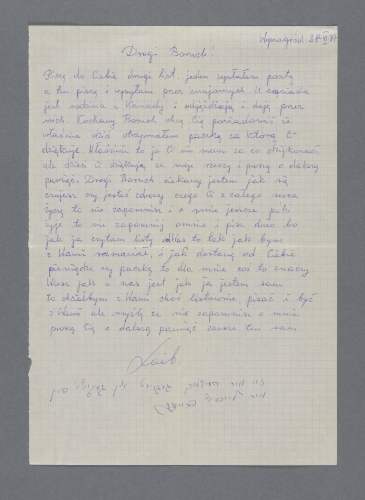
Souvenirs of Chaja (née Bełchatowska) and Boruch Spiegel (Szpigl), related to their combat history during the Warsaw Ghetto Uprising, as well as the 1944 Warsaw Uprising and their post-war life – leaving Poland after the war and going to Canada via Sweden.
Chaja (also using Polish variant of this name, Halina) Bełchatowska was born in Warsaw in 1919. (her post-war ID card, which is in the museum's archival collection, features her date of birth: 11 November 1919). Her mother worked as a bookbinder and was active in the Jewish Women's Organisation (JAF) associated with the socialist Bund (see https://sztetl.org.pl/pl/slownik/bund). They lived with their grandmother at 14 Smocza Street; she did not know her father, who had left Poland (she did not make contact with him until after the war, later moving to Montreal, where he lived). She was a member of the Bund-related Cukunft Youth Union. She and her colleagues in the organisation travelled to the Włodzimierz Medem's sanatorium to repair underwear and clothes. During the occupation, in the ghetto, she worked in the Bund's kitchen at Nowolipie as a cook and dishwasher, and also distributed underground press. In the autumn of 1942, during the great liquidation action in the Warsaw ghetto, she was taken to the Umschlagplatz. The train to Treblinka stood for a long time and then shunted slowly. Just outside Umschlagplatz, still within Warsaw, Chaja and the other seven ghetto activists sawed through the bars on the train window with a saw smuggled in their shoes, and then jumped out one by one. Before that, they still shared Lola Wiernik's dollars and the bread that Chaja always carried in her bag, just in case. When they jumped out, they were exposed to gunfire from the Ukrainians sitting on the roof of the train; fortunately, in the case of this group, the Ukrainians fired inaccurately. However, the fugitives were spotted by the Poles, who saw a profit to be made. The group paid them off, and in return were also escorted to the ghetto gates. She waited for the return of the so-called outpost workers, i.e. Jews working outside the ghetto, on outposts, and returned to the ghetto with them. At the time, Chaja was living at Nowolipie Street together with Spiegel.
Boruch (Baruch) Spiegel, or in the Polish version of the name Bronek Szpigiel (Szpigel), was born in 4th November 1919 (sharing the month of birth with his wife) in Wyszogród. His father's name was Chile (as recorded in Bronek's provisional ID in the collection, althought it should probably be 'Hilel') and his mother's name was Ruchla, née Skrobek. When Boruch was a few months old, his parents returned to Warsaw (they had lived there before the First World War, during which they moved to Wyszogród, surrounded by villages, for victualling reasons). They settled at 30 Pawia Street (here they lived until the last period of the ghetto's existence). His father became involved in political activities and made a living sewing felt gaiters. Boruch Szpigiel also acquired the profession of tailor, but with a higher specialisation – cutter (he dealt with the cutting of clothes parts). Following the example of many of his colleagues in the Jewish quarter, he joined the Bund's Cukunft Youth Union, like his wife, Chajka. In the autumn of 1939, he escaped to Białystok, but decided to return to Warsaw (he lived for some time first in Wyszogród, the situation of his family in Warsaw was very bad); in October 1942, he became a member of the Jewish Combat Organisation (Polish: Żydowska Organizacja Bojowa, ŻOB). During the January 1943 deportation action, he hid in the attic and avoided capture. He later worked in Roerich's store at 8/10 Smocza Street and learned the use of weapons. He was a member of the group led by Wewło Rozowski. Szpigl's first armed action, together with Mordechaj Anielewicz and Gabryś Fryszdorf, was to break into Hallman's store and rescue ŻOB activist Aron Zandaman, who was imprisoned there. When the uprising broke out, he fought in the vicinity of Smocza, Nowolipki and Leszno Streets (among other things, he detonated a mine, which, unfortunately, was laid incorrectly and exploded ineffectively). He escaped from the burning ghetto through the sewers: a group that included both Boruch Szpigiel and, among others, Chaja Belchatowska, was led out from the premises of the Toebbens Schulz's store by Symcha Rotem (Kazik Ratajzer), they got out on Prosta Street. They were transported by lorry to Łomianki and were then shipped out to the partisans. From 15 May 1943, Boruch and Chaja became members of the Jewish Partisan Group fighting in the forests near Wyszków. However, they decided to cross back to Warsaw (being completely unfamiliar with the forest, they did not know how to move safely in such terrain). Chaja Belchatowska left the partisans on 22 August 1943, Boruch on 18 October. During the Warsaw Uprising, they lived with Jakub Putermilch and Masza Glajtman at 64 Żelazna Street at the home of a Pole, the ŻOB liaison officer Władek Świętochowski. The men decided to join the fighters. From Zvi Florman's account: “On the seventh day of the uprising, they brought three Jews to our group, they were Jews from the ŻOB who had been sent to us to participate in the uprising. Of course we welcomed them, I cannot say we welcomed them well, one might even say it was a cold reception. I remember the name of one of them – Szpigel. He was a member of the Bund, today he is in Sweden or Canada. This man had never served in the army, he could not even stand at attention. We accepted these people into the military organisation, he participated without even knowing the drill. These three Jews were in my group by chance, because Jews were sent to different units. Apart from Kledzik [an acquaintance who introduced Zvi Florman to the Home Army], nobody in the Home Army knew that I was Jewish. Even the Jews themselves did not know” (in the book “Żydzi w Powstańczej Warszawie”, ed. B. Engelking, D. Libionka, Association of the Centre for Holocaust Research, 2010).
After the fall of the uprising, fearing denunciation, they decided not to leave Warsaw with the civilian population. They holed up in the ruins, joined by Pnina Grynszpan and other people, unknown by name - these nine people hid in a bunker on Sienna Street with no food or drink. After several days of digging with a tin plate, they managed to dig into the water at a depth of one meter.
The Russians entered Warsaw on 17 January 1945, but Bronek and the others did not leave the bunker until six or seven days later, unaware that the Germans were no longer in Warsaw. A temporary ID issued on 15 March 1945 listed Boruch's residential address as: 38 Sienna Street.
After the war, Chajka and Boruch got married. Earlier, Chajka, as Halina Bełchatowska, had taken a job as a clerk at the Jewish Provincial Committee on Targowa Street and in June 1945 received a card in the name of “Bałucka Helena”. The Szpigels did not find themselves in Poland; they emigrated as early as 1946. Eventually, in 1948, they settled in Montreal, Canada, where they had come from Sweden. Bronek Spiegel (Szpigiel) used his skills as a cutter - he made bags for a living. Halina Spiegel died after a long illness in 2002, her husband died in 2013. Their memorabilia related to Poland was donated to the POLIN Museum by their daughter, Mindy Spiegel.
Ewa Małkowska-Bieniek
Based on:
Anka Grupińska, Ciągle po kole. Rozmowy z żydowskimi żołnierzami, Warsaw, 2000.
Anka Grupińska, Odczytanie listy. Opowieści o powstańcach żydowskich, Kraków 2003.
Barbara Engelking, Dariusz Libionka, Żydzi w powstańczej Warszawie, Warsaw 2010.