Mary Litauer-Schneider was a painter, member of “Kolor,” the only female artistic group in the interwar period; after World War II, she was a co-creator of the artistic community in Toronto.
Litauer (Mary – this is the name the artist used after she left for Canada) was born to a wealthy family in Vilnius in 1900. After graduating from a seven-grade lower secondary school, she was one of the youngest students to begin studying at the School of Fine Arts in Warsaw. During the following five years, she studied under Prof. Stanisław Lentz in Warsaw, Prof. Wojciech Weiss in Krakow, and spent two years in Berlin, where she became familiar with the works of Aleksander Archipenko, Wassily Kandinsky and Paul Klee; after her return to Warsaw, she attended the class taught by Prof. Tadeusz Pruszkowski. Although she considered Wojciech Weiss as her master until her death, her work was influenced the most by the studies under Pruszkowski. In 1929 in Warsaw, she founded the “Kolor” art group together with two fellow students, Elżbieta Hirszberżanka (1899–196?) and Gizela Hufnagel (1903–1997) – both also had Jewish roots.
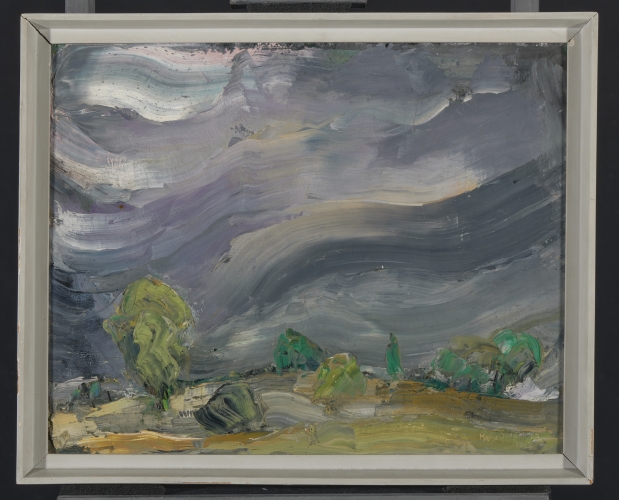
The group was active for several years, during which the painters jointly exhibited their works at the premises of the Polish Artists’ Union (1929), at Czesław Garliński’s Art Salon (1930) and at the Institute of Art Propaganda (1931). Their works were warmly received by critics. What met with special appreciation was the painters’ freedom of creative expression, as well as their special interest in form and colour, building the composition and atmosphere of the paintings. Unfortunately, few of Litauer’s pre-war works have survived; they suggest a predominance of a broad palette of strong colours. Over time, the palette become more limited and cool, but it was still the colour – not the content – that remained the dominant feature of her paintings.
Soon after the painters’ artistic paths parted (although Gizela Hufnagel [Klimaszewska-Arctowa] and Mary kept in constant and close contact until the end of their lives, despite the distance separating them), Mary Litauer married Roman Schneider, a fellow Academy student (1889–1969; this was his second marriage, he became involved with Litauer after the death of his first wife Helena; he had a daughter Anna with her, who was raised by the family). Despite the disintegration of “Kolor”, the artist continued to create and present her works at collective exhibitions at the Institute of Art Propaganda.
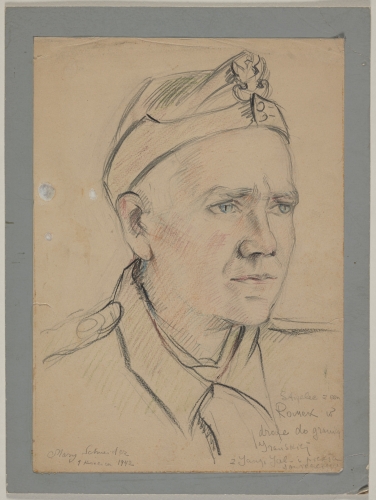
It was only the outbreak of World War II that brought an end to the heyday of the painter’s talent and work. Shortly after the beginning of the war, Mary Litauer-Schneider and Roman Schneider found themselves in the Soviet-occupied Lwów (today Lviv, Ukraine). There, they were arrested and imprisoned in the former buildings of the Order of the Most Holy Saviour, known as the Bridgettine order. Schneider was taken to a camp by the White Sea, and Mary was sent to a labour camp in Mariinsko near Novosibirsk, where she worked in a wicker basket factory. Even in the camp, she secretly made charcoal sketches on fragments of newsprint; the thought of returning to painting kept her alive. In 1941, after the signing of the Sikorski-Mayski pact between the Polish government and the USSR, Mary Litauer was granted amnesty and released from the camp. She made her way to Buzuluk, where the Polish armed forces were being formed under the command of Gen. Władysław Anders, and started working at the Organisational Centre of the Army. Aware of the important historical events taking place around her, she began to document them in the form of drawings that were to make up the “Buzuluk portfolio”. She did not reunite with her husband Mary Litauer-Schneider until 1942 in the Uzbek city of Yangiyul, where the Polish Armed Forces in the USSR (Anders’ Army) were being formed. Shortly after, Roman Schneider was discharged from the army. His and his wife, together with General Anders’ troops, were evacuated to Tehran, where they resumed their former careers. Schneider returned to working as an architect, and Mary Litauer-Schneider to painting. Together, they also founded the Polish Art Studios, which became the focal point of the artistic community for several dozen artists.
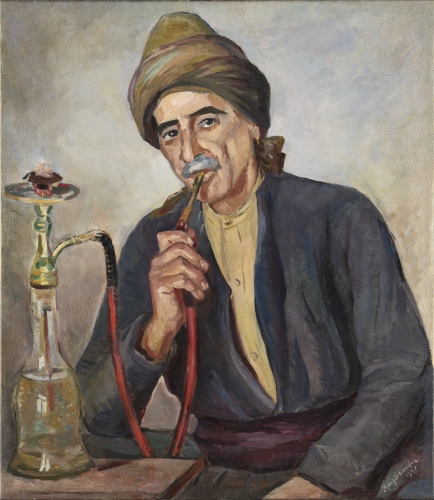
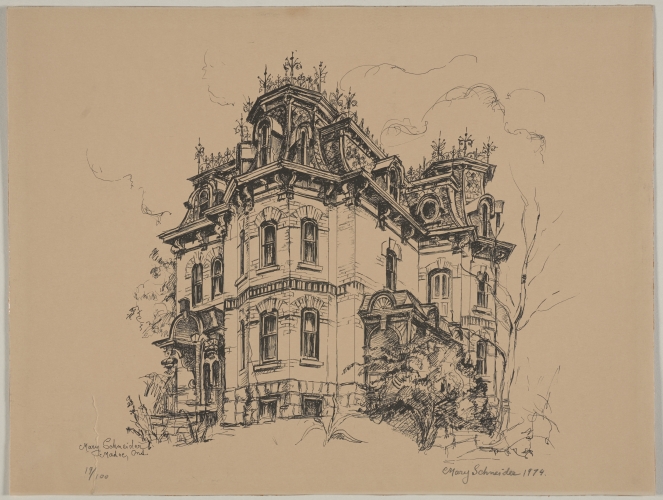
After the war, she and her husband moved to Lebanon, where she lived for four years, painting mountain landscapes. When she was denied permission to enter Great Britain in 1950, the couple left for Canada, where, after a short stay in Nova Scotia, they settled permanently in Toronto. Shortly thereafter, Mary Litauer-Schneider took over as director of the Madoc Art Centre, where she lectured in painting from 1952 to 1962. A year later, in 1963, she and her husband founded the Mary and Roman Schneider School of Fine Arts in Actinolite, Ontario (today the Bridgewater Retreat and Art School), which operated uninterrupted until the artist’s death in 1992. During the Canadian period, besides her activity as a teacher, Mary Litauer continued to paint, successfully exhibiting her works at venues such as the Museum of Art-Fort Lauderdale in Florida, as well as the Pollock Gallery and Cobourg Art Gallery in Toronto. At that time, she painted not only in Canada, but also during numerous trips (Israel, Italy, Mexico). The artist’s favourite technique was watercolour, and the theme was landscape: natural and urban alike. The paintings, donated to the museum by Teresa Gierzyńska, Wanda Gierzyńska and Dorota Wnuk, tree granddaughters of the Schneiders (Anna's daughters), come precisely from that creative period and from her stay in the Middle East. The compositions exhibit excellent painting skills and a unique charm.
Jan Orliński